

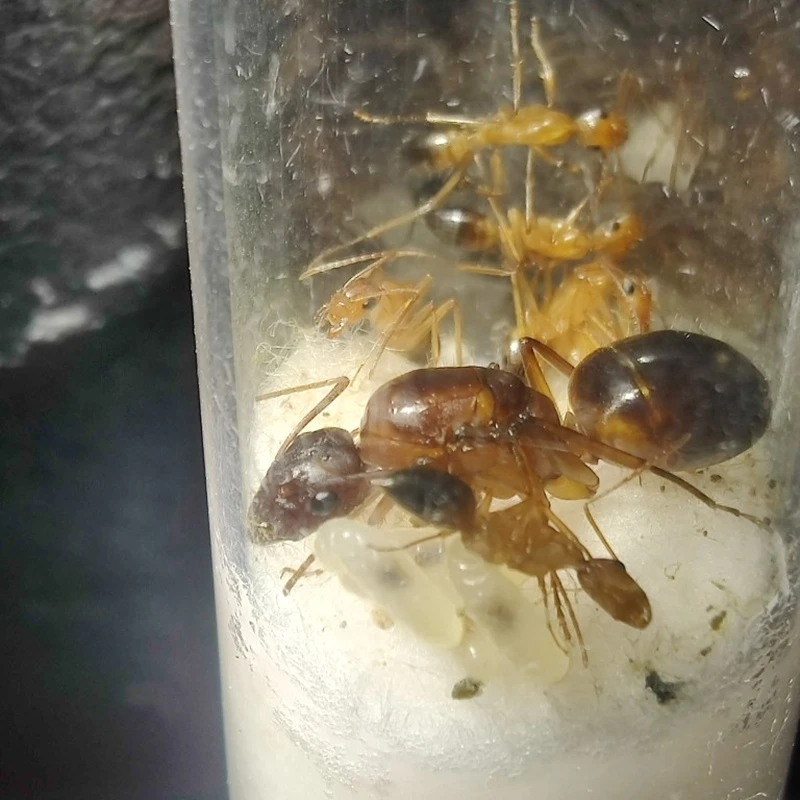


Camponotus pilicornis
Leave feedback on the product

Select product variant:
Individual variants may differ in price
Ask about the product

Administratorem danych osobowych jest PHU Krystian Solga. Przetwarzamy je w celu przesłania odpowiedzi na zapytanie. Więcej informacji dotyczących przetwarzania danych osobowych znajduje się w polityce prywatności.
Share the product card



Shipping cost for the selected product
The shipping cost applies to this product (in the selected variant - if applicable). It may change after adding other products to the cart.
Description
Camponotus pilicornis - Golden Amber Mediterranean Carpenter Ant with a Powerful Soldier Caste
Camponotus pilicornis is one of the most sought-after and elusive European carpenter ants, admired for its warm golden-amber coloration. This species stands out with spectacular allometric polymorphism, producing massive major workers with broad heads and powerful mandibles. Unlike invasive tropical species, a mature colony maintains a stable and manageable population of 3,000 - 5,000 workers, making it an ideal choice for rewarding, long-term home keeping.
- Rare honey-amber coloration: The striking contrast of a darker head against a golden thorax and gleaming gaster gives the colony an exotic appearance rarely seen among European ant fauna.
- Massive major workers: An impressive caste of giant workers (up to 14 mm) featuring powerful heads serves as living nutrient reservoirs and nest defenders.
- Mild winter diapause: Requires only 2.5-3 months of rest at 10-15°C (50-59°F), allowing hassle-free hibernation in a pantry or cooler room without specialized wine coolers or fridges.
- Calm, majestic behavior: Crepuscular and nocturnal activity paired with deliberate exploration eliminates chaotic nest panic and ensures stress-free outworld maintenance.
| Scientific name | Camponotus pilicornis |
| Origin | Iberian Peninsula (Spain, Portugal), southern France, North Africa |
| Queen size | 14-16.5 mm |
| Worker size | 5-14 mm (minor, media, and massive major workers) |
| Nest temperature | 22-26°C (72-79°F) (thermal gradient recommended) |
| Outworld temperature | 20-28°C (68-82°F) |
| Nest humidity | 50-65% (drier gradient zone for pupae) |
| Outworld humidity | 30-50% (xerothermic environment) |
| Diapause (hibernation) | 2.5-3 months at 10-15°C (50-59°F) |
| Recommended nest | 3D printed, acrylic, or gypsum nest (chambers min. 10 mm) |
| Diet | Carbohydrates (honey, sugar water, nectar syrups) and protein (fresh feeder insects) |
| Difficulty level | Intermediate |
Choosing a Variant and First Steps with Your Colony
Selecting your colony option from the dropdown menu allows you to tailor your ant-keeping journey to your experience and preferences. A solitary queen offers an extraordinary opportunity to witness fully claustral colony founding from the very first egg batch, requiring patience and quiet conditions. In contrast, a colony with her first workers provides an established biological buffer, immediate outworld exploration, and greater colony resilience.
Step 1: Calm transit acclimation - Upon delivery, place the test tube in a dark, quiet spot at room temperature of 20-22°C (68-72°F) for 24 hours without heat mats. Physical vibrations and sudden heating escalate post-shipping stress.
Step 2: First energy meal - After 24 hours, offer a micro-drop of honey or specialized ant nectar on a small piece of aluminum foil. Keep the droplet tiny to ensure delicate nanitic workers do not become stuck.
Step 3: Connecting to the outworld and secure housing - Open the test tube inside an outworld secured with an escape barrier. The colony should remain in their water-buffered test tube setup until reaching at least 20-30 workers. Moving into a spacious formicarium too early leads to waste accumulation inside empty chambers and mold outbreaks.
Recommended Formicarium and Starter Conditions for Camponotus pilicornis
The ideal starter habitat is a 3D printed nest or a gypsum nest featuring chamber heights of at least 10 mm. The key to success is establishing an asymmetric thermal gradient of 22-26°C (72-79°F) inside the nest, paired with moderate humidity of 50-65% and a dedicated drier section for pupae.
In nature, these ants nest beneath sun-warmed rocks in sandy-clay soils. For optimal brood development, place a heat mat beneath only one third of the nest surface. This thermal setup allows workers to regulate brood position, moving larvae and pupae into the warmth while resting in the cooler chamber sector. Coat the outworld floor with dry sand and gravel, and protect the upper perimeter with talcum powder or PTFE barrier fluid, as large majors climb glass surfaces with ease. Unlike darker Mediterranean relatives such as Camponotus barbaricus or Camponotus sylvaticus, this species favors noticeably drier nest sections.
Dietary Requirements and Feeding Balance for Camponotus pilicornis
The core diet consists of liquid carbohydrates provided continuously in ant feeders and fresh feeder insects offered regularly as protein for developing brood. Feed founding colonies 2-3 times per week with sliced feeder insect nymphs or flightless fruit flies. Seeds are completely ignored by this species.
Adult workers draw energy from simple sugars - pure natural honey, sugar water, agave nectar solution, and specialized ant nectars work exceptionally well. Animal protein is essential for larval growth and the formation of massive major workers. Offer freshly pre-killed or frozen feeder insects like red runner roaches, cricket pinheads, or fruit flies. For small colonies, always slice feeders open to provide effortless access to nutrient-dense hemolymph. Remove insect remains from the outworld within 24 hours to prevent mite proliferation.
Common Husbandry Mistakes and How to Avoid Them
- Evenly heating the entire nest: Lack of a cooler zone prevents thermal brood regulation and risks overheating the colony. Always heat no more than one third of the nest surface.
- Excess moisture and waterlogging: This xerothermic species requires drier conditions for spun pupal cocoons. Excessive nest humidity triggers brood mold and invites harmful mites.
- Mechanical stress and vibrations with nanitics: Solitary queens and first-generation nanitics are extremely sensitive to disturbances. Tapping the test tube can prompt the queen to cannibalize her brood.
- Freezing temperatures during diapause: Hibernating below 5°C (41°F) is lethal for Mediterranean ants. Maintain a safe range of 10-15°C (50-59°F) and verify test tube hydration.
Taxonomic Framework and Diagnostic Features
The species was formally described in 1859 by Julius Roger as Formica marginata var. pilicornis and later placed into the genus Camponotus by Gustav Mayr. The specific epithet derives from the Latin words pilus (hair) and cornu (horn or antenna), referencing the dense standing setae covering the antennal scapes and legs. A defining trait distinguishing this taxon from the sympatric Camponotus barbaricus is the rounded hind tibiae lacking a longitudinal furrow, accompanied by noticeably brighter amber-orange mesosomal coloration.
Obligate Endosymbiosis with Blochmannia Bacteria
Like other specialized carpenter ants, Camponotus pilicornis relies on a mutualistic relationship with intracellular Blochmannia bacteria residing within specialized midgut cells known as bacteriocytes. These endosymbionts act as microscopic biochemical synthesis plants, recycling nitrogenous waste into essential amino acids. This adaptation empowers the colony to synthesize biomass efficiently even when foraging primarily on nitrogen-poor honeydew.
Rare Social Inquilinism with Camponotus universitatis
Wild nests of Camponotus pilicornis occasionally host one of the rarest parasitic ant species on Earth - Camponotus universitatis, an IUCN Red List species. The parasitic queen infiltrates the host nest through cuticular hydrocarbon mimicry, peacefully coexisting with the resident queen while utilizing host major workers to nourish and rear exclusively her own reproductive alates.
Frequently Asked Questions (FAQ)
Does Camponotus pilicornis sting or pose any danger to humans?
No, ants in the genus Camponotus do not possess a sting. When threatened, they rely on rapid retreat or mechanical defense using their mandibles. A bite from the largest major workers may give a slight pinch on sensitive fingertips, but it cannot break skin harmfully and poses zero risk to children or household pets.
Why are the workers most active after dark?
In arid Mediterranean habitats, nocturnal foraging is a critical evolutionary adaptation guarding workers against lethal midday heat and dehydration. Darkness also provides a competitive edge over aggressive diurnal ant species. In captivity, this remains their natural rhythm - primary outworld foraging takes place during twilight and evening hours.
How do I prepare the colony for safe home hibernation?
Hibernating this species is straightforward and gentle. In late autumn (October - November), gradually lower the ambient temperature to 10-15°C (50-59°F) for 2.5-3 months. An unheated room, cool pantry, or basement is ideal. Stop feeding protein insects during this rest phase, but ensure uninterrupted access to water in the test tube reservoir to avoid dehydration.
When should I safely move the colony into a formicarium?
Wait with moving the colony until you count at least 20-30 active workers inside the test tube. Placing a tiny founding group into a large nest prematurely leads to stress and disorientation, causing empty chambers to be used as garbage dumps. Patient development in a test tube setup guarantees queen vitality and vigorous brood development.
Looking for a spectacular golden carpenter ant that commands attention with giant soldiers? Select your preferred colony option, add it to your cart, and enjoy observing one of the Mediterranean region's most captivating superorganisms in your own home.
Shipping and Live Arrival Guarantee
During cold weather, we include a professional HeatPack warming pad to maintain the proper transit temperature.
Live animals are shipped exclusively Monday through Thursday to prevent parcels from being held over the weekend.
We take full responsibility for safe transit, guaranteeing that your animal arrives healthy and in top condition.
Reviews
If you've added a review and it doesn't appear on the list, it may be pending moderation.
Leave feedback on the product
