

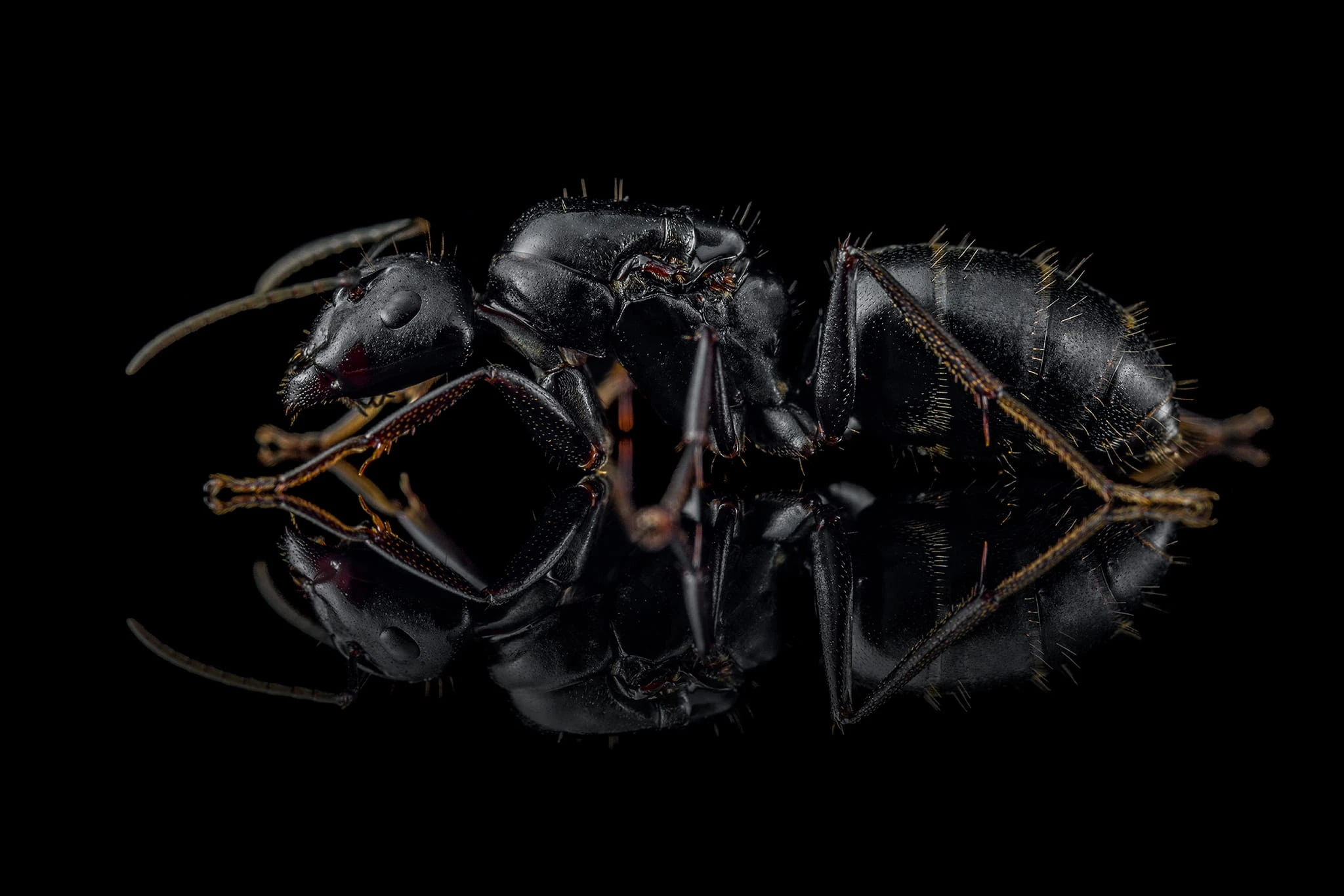


Camponotus japonicus
Leave feedback on the product

Wybierz wariant produktu:
Individual variants may differ in price
Ask about the product

Administratorem danych osobowych jest PHU Krystian Solga. Przetwarzamy je w celu przesłania odpowiedzi na zapytanie. Więcej informacji dotyczących przetwarzania danych osobowych znajduje się w polityce prywatności.
Share the product card



Shipping cost for the selected product
The shipping cost applies to this product (in the selected variant - if applicable). It may change after adding other products to the cart.
Description
Camponotus japonicus
Camponotus japonicus is one of the most recognizable and valued species in Asian myrmecofauna. It belongs to the group of the largest ant species available in the ant keeping hobby, offering spectacular observations thanks to its impressive size, deep glossy black coloration, and fascinating social structure.
These are ideal ants for beginners who are ready to show patience. In return, they offer an extraordinary glimpse into ant colony development — from a few small workers to massive, large-headed major castes (soldiers). The key to success lies in understanding their two fundamental requirements: higher temperatures (a distinctly thermophilic species) and specific nesting preferences. As insects inhabiting diverse Asian environments, the ants offered in our ant keeping shop are populations that do not require cold hibernation in a refrigerator, needing only a lighter diapause at room temperature.
| Feature | Description |
|---|---|
| Common name | Japanese Carpenter Ant |
| Origin | East and Central Asia (Japan, China, Korea, Mongolia, Russia) |
| Difficulty level | Easy / Low (requires patience for slow development in the first year) |
| Size | Queen: 14-18 mm, Workers: 6-15 mm |
| Polymorphism | Yes, strong and distinct (minor, media, major castes) |
| Nest temperature | 24°C - 28°C (75°F - 82°F) (Heating is strongly recommended) |
| Nest humidity | 50% - 70% |
| Outworld humidity | 30% - 50% (Outworld should be dry) |
| Diet | Sugars (e.g. sugar water or honey water) and protein (feeder insects) |
| Hibernation / Diapause | Does not require cold hibernation. Recommended room temperature diapause (15°C - 20°C / 59°F - 68°F) for 2-3 months, e.g. by turning off heating. |
| Recommended nest | Wood, Cork, Ytong (Acrylic is not recommended due to slippery surfaces and humidity fluctuations) |
Morphology and Fascinating Polymorphism
This species is easily recognized by its uniform, deep, glossy black coloration. From a keeper's perspective, one of the most desirable features is strong polymorphism. This means workers occur in various sizes — from small "minor" workers (6-8 mm), which perform internal nest tasks and care for brood, through "media", to massive "major" workers (soldiers measuring up to 15 mm in length). Majors are characterized by a large, wide head and powerful mandibles, performing logistical and defensive roles. Keepers should manage their expectations, as the colony begins producing larger castes only once mature (usually in the second year of keeping).
Environment and Care Requirements
Because this is a distinctly thermophilic species, standard room temperature (20-22°C / 68-72°F) slows down development. They require supplemental heating at 24-28°C (75-82°F) to grow dynamically (although at 20°C / 68°F they can also develop reasonably well).
When choosing a professional formicarium, entirely acrylic setups should definitely be avoided. Camponotus japonicus, like other ants in the subfamily Formicinae, have difficulty moving on perfectly smooth plastic or glass, and the larvae need anchor points to spin cocoons. The safest and best choices are porous nests: cork, hard wood, or aerated concrete (Ytong). A humidity gradient is essential — a gently moistened nest and a dry outworld to prevent mite outbreaks. In nests with solid substrates, the ants can also successfully perform their remarkable vibrational alarm communication ("drumming" with their head and gaster against nest tunnels).
Diet for Ant Colonies
Camponotus japonicus is an omnivorous species. An optimal diet for ant colonies must combine requirements for carbohydrates (energy) and protein (brood development). The primary carbohydrate source should be sugars (e.g. sugar water or honey water) available at all times. In addition, the colony requires protein. Live food for ants works wonderfully — for large colonies, live fruit flies, cockroach nymphs, or small crickets can be offered, whereas for small colonies, insects are best served pre-killed (e.g. cut open or crushed). Insect juices nourish the larvae and queen. Small, founding colonies may not consume large amounts of protein, which is completely natural.
Diapause and Colony Development
Development dynamics in the early years require patience. In the first year, one can expect a colony of 10-50 small workers, reaching around 100 to several hundred individuals in ideal conditions during the second year, while a fully developed colony can grow to thousands of members and become very bold, eagerly foraging in the outworld.
This species does not enter full winter hibernation. Never put them in the refrigerator! For health and to "reset" the queen's egg-laying cycle, ants require a cold diapause after a year of active life. Provide them with a 2-3 month rest period by turning off heating and keeping them at 15-20°C (59-68°F) (ideally during the natural winter months from November to February).
Interesting Facts and Parasites
It is worth mentioning that in its natural habitat, this species is particularly prone to parasitism. It falls victim to the ant species Polyrhachis lamellidens and butterflies of the genera Nyphanda and Lycaeides. The caterpillars of these butterflies are fed by the ants, and in the case of L. argyrognomon, they even pupate inside the ant nest. An interesting hobby fact is that their pupae can be successfully used as a boost for Camponotus ligniperda and C. herculeanus, and vice versa. Two-species mixed colonies look truly impressive in this setup.
Reviews
If you've added a review and it doesn't appear on the list, it may be pending moderation.
Leave feedback on the product
 Log in with Google
