

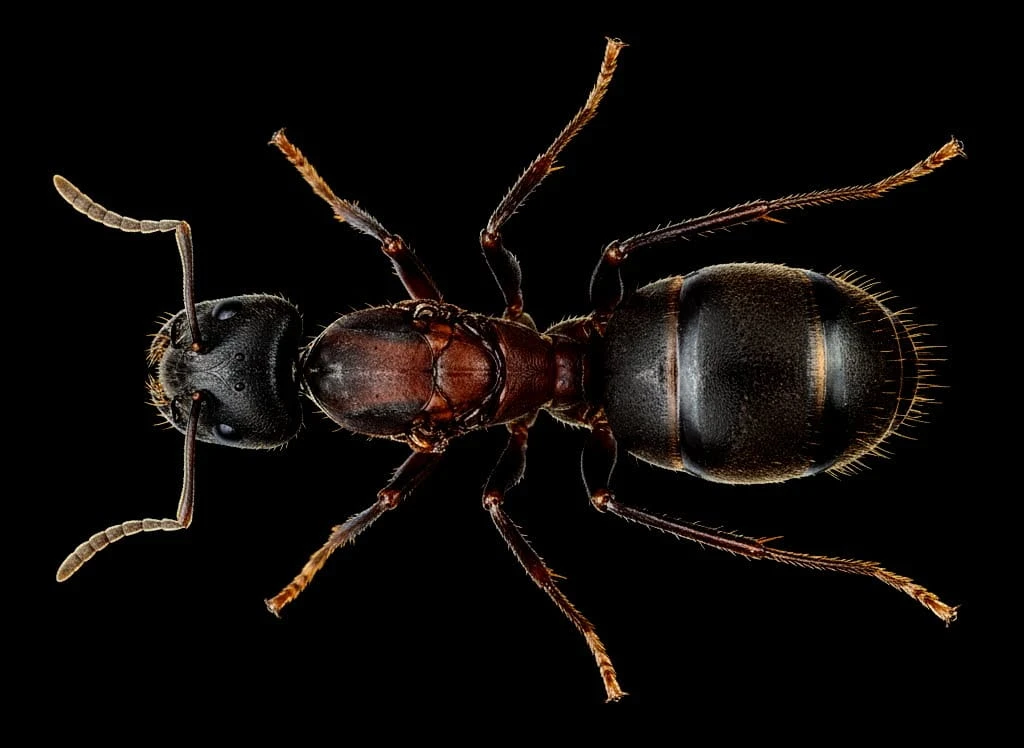


Camponotus angusticollis
Leave feedback on the product

Wybierz wariant produktu:
Individual variants may differ in price
Ask about the product

Administratorem danych osobowych jest PHU Krystian Solga. Przetwarzamy je w celu przesłania odpowiedzi na zapytanie. Więcej informacji dotyczących przetwarzania danych osobowych znajduje się w polityce prywatności.
Share the product card



Shipping cost for the selected product
The shipping cost applies to this product (in the selected variant - if applicable). It may change after adding other products to the cart.
Description
Camponotus angusticollis (Giant Long-Legged Carpenter Ant)
Imagine a night walk through a dense Asian forest. In the dark, you spot powerful, slender silhouettes scurrying across tree trunks. These are Camponotus angusticollis, the giants of the insect world. Keeping these remarkable creatures is an invitation to bring true exotica into your home. When dusk falls, majestic major workers of impressive size emerge from the nest, slowly patrolling their territory. If you are interested in exotic ants for keeping, this species will make a huge impression on anyone who has the opportunity to observe it.
Observing their slender bodies, resembling a silhouette with a long "giraffe neck", is an experience that fascinates every day. They beat even the famous Camponotus singularis in size. Every movement of these insects is full of grace, and their nocturnal activity makes evening sessions in front of the terrarium an addictive ritual. As a professional ant shop, we are truly proud to offer you such a phenomenal species in our permanent assortment.
Origin and natural habitat
This extraordinary species inhabits the humid and subtropical forests of the Indomalayan realm - from India through Nepal, Sri Lanka, up to China and Indonesia. In nature, they most often establish their nests in dead wood and a thick layer of forest litter. Despite their tropical origin and the requirement to heat the nest, these are ants not requiring hibernation in the classic sense of the word (in the fridge), which makes managing the colony easier.
Appearance
They belong to the group comprising the largest ant species available in the ant keeping hobby. The queen reaches an impressive 24-28 mm in length. Minor workers measure from 12 to 18 mm, while powerful major workers grow up to 20-25 mm. A characteristic feature is an exceptionally elongated pronotum, giving them a unique look. The abdomen and head have a deep, black-brown color, which beautifully contrasts with the reddish or orange thorax, a trait strongly pronounced in major workers.
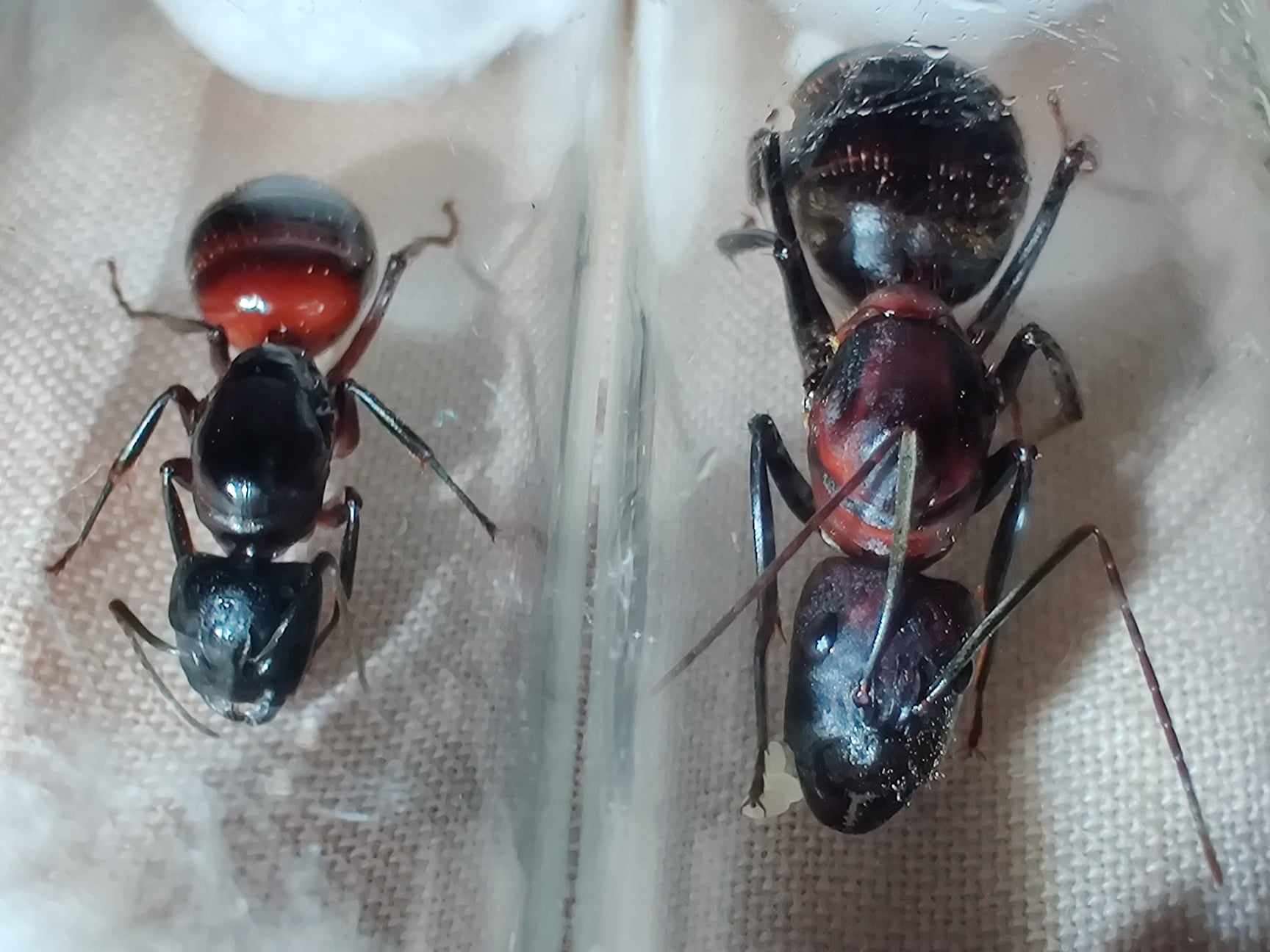
Comparison with Europe's largest ant Camponotus ligniperda
Colony life
This species is monogynous - with one queen in the colony, which can live up to 20-25 years. A mature nest usually counts several hundred, and up to a maximum of about 1000 workers. Ant colony development proceeds at a moderate pace, from an egg to an adult insect takes about 45 days (depending on the temperature). The queen founds the nest fully claustrally. They have a gentle disposition outside the nest, however, in its defense they can bite fiercely (they do not have a stinger). They are fast and agile insects, active mainly at night.
Diet
A proper diet for an ant colony is based on two pillars. Carbohydrates are the basis of nutrition, so we provide Sugars (e.g., sugar water or honey). The protein building block for the larvae is equally important. Remember the key rule: to small colonies we only serve feeder insects killed by cutting or crushing. However, in the case of large and developed groups, live food for ants such as roaches, crickets, or locusts will work perfectly. Meals should be served in the evening, according to their natural cycle. Initially, young colonies can be quite picky.
Keeping conditions
For a mature colony, a professional formicarium with a large space will be absolutely essential - we recommend a natural terrarium with soil substrate (so-called "Natural Terra"). Proper maintaining humidity in the formicarium is the key to success: it should be 60-70% in the nest and 50-70% in the outworld, while maintaining excellent ventilation to avoid mold.
The optimal nest temperature is 24-28°C (75-82°F), and 24-32°C (75-90°F) in the outworld.
This species requires a 4-month winter break at room temperature (around 20-22°C (68-72°F)).
VERY IMPORTANT: a lone queen founding a colony (before the emergence of workers) MUST NOT be heated. She should be kept in a quiet place at a temperature of 20-22°C (68-72°F). Due to the fact that ants in nature choose very tight shelters, the queen - contrary to popular belief - will feel great in a test tube with a diameter of 16-20 mm, until the emergence of the second generation of workers. We always use talc as a barrier against escapes.
Reviews
If you've added a review and it doesn't appear on the list, it may be pending moderation.
Leave feedback on the product
 Log in with Google
