

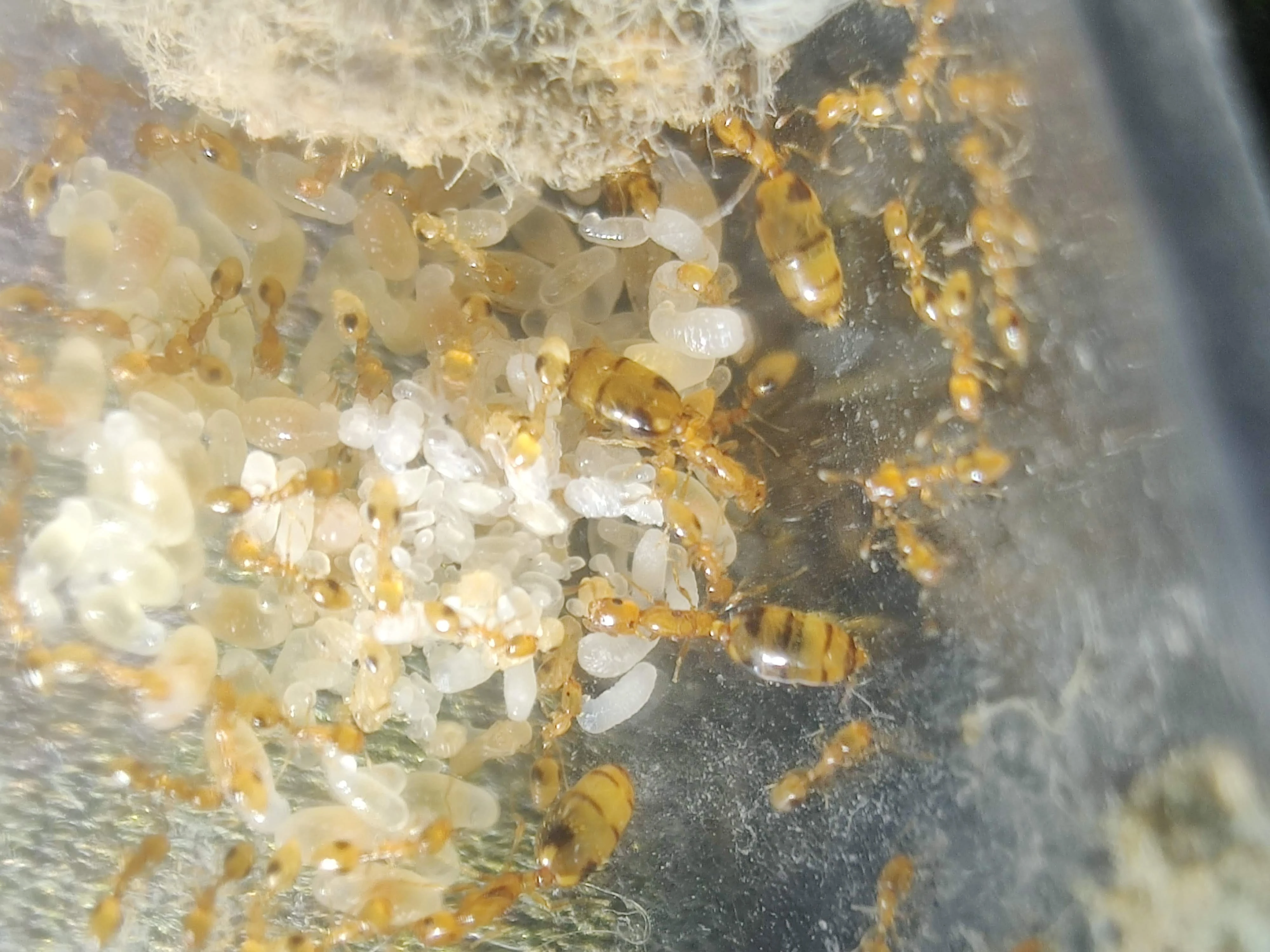


Monomorium hiten
Leave feedback on the product

Select product variant:
Individual variants may differ in price
Ask about the product

The controller of your personal data is PHU Krystian Solga. We process them to respond to your inquiry. More information regarding personal data processing can be found in our privacy policy.
Share the product card


Shipping cost for the selected product
The shipping cost applies to this product (in the selected variant - if applicable). It may change after adding other products to the cart.
Description
Monomorium hiten - a true Clone Army
Monomorium hiten is an absolute evolutionary phenomenon and a true diamond in modern terrarium keeping. This miniature, subtropical species originating from the dense forests of Japan and Taiwan completely redefines the concept of home ant keeping. These insects combine tiny sizes with an almost unimaginable swarm dynamic and an ability for biological immortality that is extremely rare in the natural world. This is an ideal choice for advanced and ambitious enthusiasts looking for a bustling ecosystem.
This species is famous for its incredible appetite and brutal, highly organized hunting strategies. Although the workers measure only one and a half millimeters, they can rapidly recruit thousands of sisters in huge, perfectly coordinated groups to attack feeder insects. Observing their scent trails and the rapid dismemberment of food is a fascinating spectacle. At the same time, these ants are completely safe for humans. Their tiny mandibles are unable to breach the human epidermis in any way, which makes them harmless even to the youngest household members.
By choosing to keep Monomorium hiten, you invite an organism with an unprecedented survival strategy into your home. Due to the specific and rigorous requirements regarding the tightness of the formicarium, this species teaches humility and attention to technical details. In return, it rewards you with spectacular and endless colony growth.
| Feature | Description |
|---|---|
| Latin name | Monomorium hiten |
| Worker size | From 1.4 to 1.5 mm (outstanding monomorphism) |
| Queen size | About 3.1 mm (up to 5 mm when filled with eggs) |
| Nesting type | Extreme polygyny (many cooperating queens) |
| Optimal temperature | From 24°C to 30°C (75-86°F) (will cope from 18°C (64°F) with slower growth) |
| Required humidity | Higher environmental humidity preferred |
| Wintering (hibernation) | None (species active all year round) |
The evolutionary miracle of parthenogenesis and appearance
The key to the extraordinary success of this species is its reproductive biology. Monomorium hiten reproduces through obligate thelytokous parthenogenesis. This means that queens are able to independently clone themselves and produce new workers without any involvement of males. In a mature colony, hundreds of queens live in complete harmony, constantly increasing the population. Such a mechanism guarantees the colony biological immortality. The keeper does not have to worry about the nest collapsing from old age, because the ants constantly renew their reproductive potential inside the formicarium.
Visually, the workers present a very slender silhouette. Their shiny, completely smooth bodies take on colors from light yellow to yellowish-brown, giving the impression of being almost translucent in strong light. A reliable distinguishing feature of this species is the presence of two distinct, contrasting brown spots on the dorsal part of the abdomen. The queens, on the other hand, have additional brown stripes and look incredibly majestic surrounded by a cloud of tiny workers.
Breeding conditions and nest engineering
This thermophilic Asian species develops perfectly and extremely dynamically in temperatures from 24°C to 30°C (75-86°F). It will also cope in room conditions above 18°C (64°F), it will simply develop a bit slower then. It is worth noting that colony growth is amazing already in the early stages, even with several dozen workers. You will get the best results by using a spot heating mat, which will create an appropriate thermal gradient in the nest, allowing the ants to move their offspring independently. This species prefers higher environmental humidity in the outworld. These insects cope great with drinking liquids, they eat normally from any feeder and absolutely do not drown.
The biggest challenge in keeping Monomorium hiten is choosing the right formicarium. Due to their size hovering around one and a half millimeters, these insects are excellent escape artists. They can squeeze through inaccurate silicone joints or loose seals. They require professional nests with extreme tightness. Our perfectly fitted modules created using 3D printing technology work perfectly here, holding them without any problems and being completely devoid of gaps on the doors.
Feeding the miniature marauders
The massive egg production by cloning mothers generates a gigantic demand for energy. The basis of the carbohydrate diet, driving workers to continuous activity in the outworld, are high-quality natural honeys, organic agave syrups, date syrups mixed with water, as well as plain sugar water. Sweet liquids are best served regularly, but the absolute minimum is feeding once a week.
Building thousands of new larvae, in turn, depends on a constant supply of protein. Soft protein food is preferred especially for a small colony, but an overgrown swarm will not despise any protein. The integrated ants can reduce the thrown-in insects to just their chitin shells with shocking speed. These remains should be regularly removed from the outworld to maintain a sterile and clean environment.
Important warnings and most common mistakes
The most common mistake made by beginners is moving the colony to a large formicarium too quickly. Forcing a small group of ants to go out into a huge outworld immediately stresses the insects, destroys their nest scent and completely inhibits development. The colony should be kept in a closed test tube until a huge cloud of workers begins to aggressively force the cotton wool barriers.
The issue of escapes is another key element of breeding. It is absolutely required to apply climbing prevention barriers on the edges of open outworlds. These barriers must be precisely applied without any gaps. It is worth noting, however, that possible escapees do not constitute a home plague. Unlike the well-known pharaoh ant, this species is extremely sensitive to the dry air of our apartments and usually dies within just a dozen or so days outside the formicarium. However, an escape means a painful loss of valuable capital for the breeder, which is why perfect security is the absolute foundation of success.
Reviews
If you've added a review and it doesn't appear on the list, it may be pending moderation.
Leave feedback on the product
