

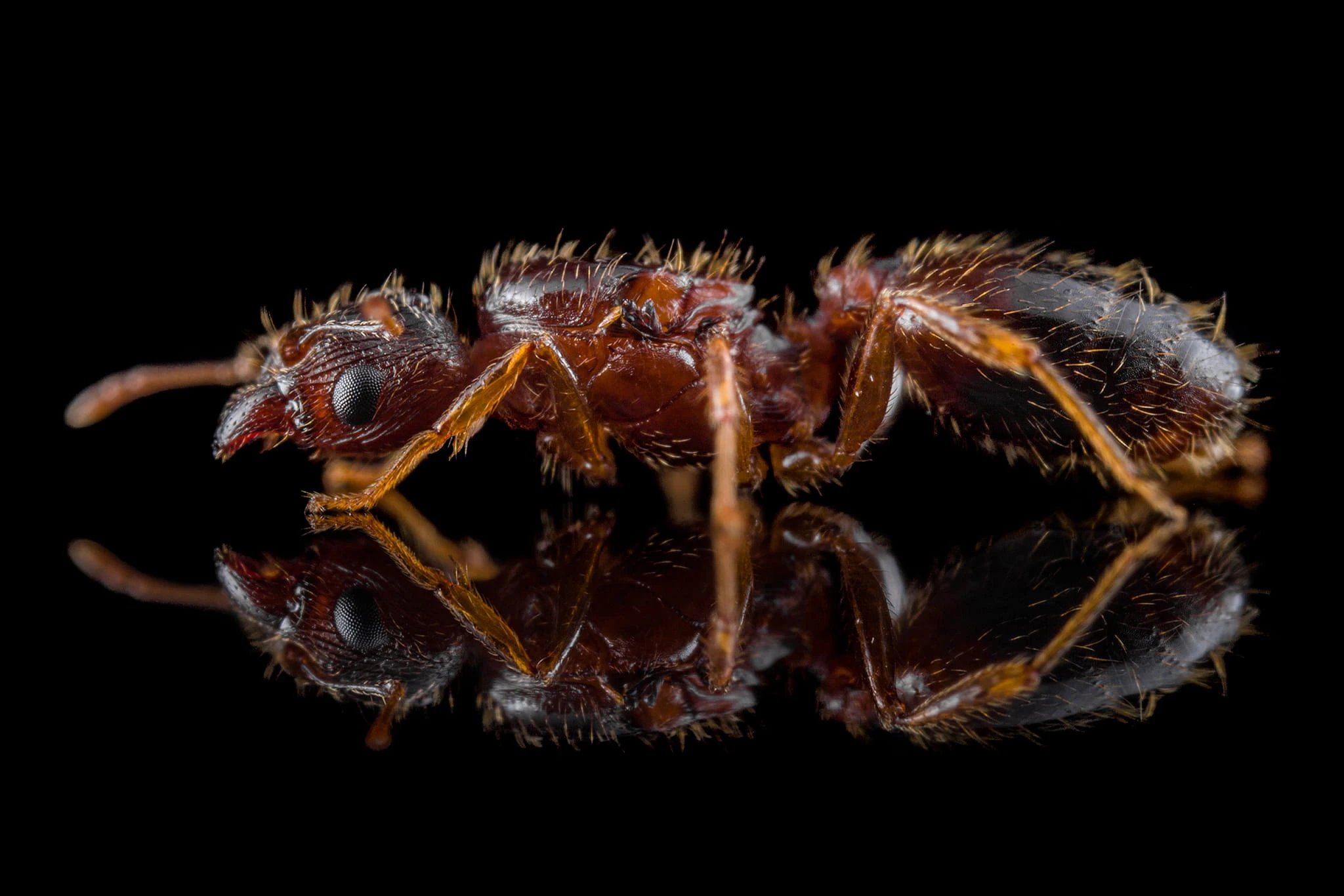


Pheidole megacephala
Leave feedback on the product

Select product variant:
Individual variants may differ in price
Ask about the product

Administratorem danych osobowych jest PHU Krystian Solga. Przetwarzamy je w celu przesłania odpowiedzi na zapytanie. Więcej informacji dotyczących przetwarzania danych osobowych znajduje się w polityce prywatności.
Share the product card



Shipping cost for the selected product
The shipping cost applies to this product (in the selected variant - if applicable). It may change after adding other products to the cart.
Description
Pheidole megacephala
Buying from us, you have 100% certainty that this is Pheidole megacephala. Every batch has been examined under a microscope by a professional myrmecologist. Beware of sellers offering other black Pheidole species as megacephala (such as the common Pheidole indica) – in their case, not only are you buying an inferior counterfeit of these aggressive and dominant ants, but you risk your colony splitting in two at around 1,000 workers and starting a bloody civil war against itself. True Pheidole megacephala form a massive, united supercolony.
Pheidole megacephala
We present one of the most aggressive, invasive, and dominant ants available for home antkeeping. Pheidole megacephala has redefined the very concept of dominance.
An Empire That Devours the World
Originating likely from Africa, these ants have conquered almost the entire globe, expanding across tropical and subtropical regions – from South America through Australia to Asia, North America, and Europe. They belong to the elite, dark circle of the "top 100 worst invasive species in the world", as one of only five ant species on this list!
Their power is rooted in strategy and ruthless cooperation. They are strongly polygynous and polydomous. Thanks to the phenomenon known as unicoloniality and the presence of the endosymbiotic bacterium Wolbachia, they bypass the inbreeding barrier (no inbreeding depression due to the bottleneck effect). This allows them to form gigantic supercolonies spanning over 3,000 kilometers – a colossal distance uniting millions of nests!
Wherever they appear, they become the absolute rulers of the ecosystem, reducing local biodiversity by up to 85%. They eradicate all other ants and insects, and even small vertebrates – they are known to devour nestlings alive in their nests. Some insectivorous bird species literally face starvation as they lose the competition for food. In occupied territories, this empire accounts for 20 times more biomass than all other native ants combined! The invasion advances by several hundred meters each year. A single nest develops into a network of cooperating outposts connected by permanent trails, much like carton-nesting ants. Underground, they tend aphids and scale insects, causing substantial agricultural disruption and displacing beneficial insects that previously protected crops.
They know no mercy. When they encounter live prey, they recruit their forces with blistering speed and efficiency. Programmed purely for survival, they consume virtually anything: feeder insects, oil seeds, and in urban environments, they will invade homes for meat in refrigerators, pet food, sweet spreads, and liquids – a large colony will devour almost anything in its path. When coming across a massive food source (such as dropped ice cream), they lay down powerful, short-lived trail pheromones to establish heavy-traffic supply highways that vanish as soon as the resource is exhausted.
They also have a darker side when living in close proximity to humans: they can enter houses, damage irrigation systems, chew through building walls, and their voracious appetite has even caused traffic incidents (such as by chewing through traffic light wiring). They nest anywhere as long as they avoid waterlogged areas: in soil, under rocks, in debris, inside and beneath rotting wood, in flower pots, and even within sidewalk crevices. They favor shade, vegetation, and high humidity, and in the event of heavy flooding, they will readily move into nearby residences seeking shelter.
Brilliant Strategy, Not Just Brute Force
The success of Pheidole megacephala is not merely a matter of numbers – it is calculated tactical intelligence and advanced strategy.
In a scientific experiment, Pheidole megacephala and 4 other highly invasive ant species were connected to a single outworld. Statistically, each colony should have secured roughly 20% of the available food. Instead, Pheidole megacephala completely dominated their rivals by securing 80% of the resources, leaving a meager 20% to be split among the remaining 4 species. This meant the average competing species received 16 TIMES less food than Pheidole megacephala!
Instead of immediately engaging in open warfare around a feeder on neutral ground, they rapidly deploy large numbers of soldiers (majors). These soldiers fill their crops and can carry an enormous droplet of liquid beneath their heads, draining the neutral feeder in no time and retreating underground before rival species can organize an army, effectively winning without a fight. Conversely, when they detect a persistent, dominant competitor nearby, the colony can trigger an emergency response: rearing super-sized majors "several times larger than normal", while significantly increasing their overall soldier ratio in the nest.
The Formicarium: Stage for a Dark Legion
These ants exhibit extreme polymorphism. Within their relentless ranks, you will find tiny minor workers (2-5 mm) and powerful major soldiers (up to 6 mm). The soldiers act as biological milling machines designed primarily for crushing hard seeds, with their differentiation triggered by elevated juvenile hormone (JH) levels. For defense and massive offensive assaults, they utilize potent pyrazine alarm pheromones (produced in symbiosis with endosymbiotic Serratia bacteria). They are predominantly black ants, though approximately 15% of the population produces queens with a striking red-and-black coloration.
In our ant shop, we only sell colonies budded from our own maternal stock. This means that every queen ant with workers offered comes directly from the budding of our captive mother colony. These are hardy ants not requiring hibernation (no diapause, constant temperature of 27-30°C (81-86°F)).
CRITICAL HEATING ADVICE: While large colonies thrive in tropical heat, we strongly advise against heating small founder colonies. Smaller colonies should be kept comfortably at 20-23°C (68-73°F) until they grow sufficiently. Only after moving them into a 10x10 cm or larger formicarium should you apply strong localized heating to one corner (creating a warm basking gradient). Applying excessive heat too early to a small budding colony creates excessive metabolic stress.
Because they thrive in shade, greenery, and high humidity, large bioactive terrariums built with a clay, sand, and perlite base are ideal for their setup (they can also be kept successfully in standard 3D printed formicaria). They avoid intense direct lighting, so in bright outworlds they will construct protective covered runways from sand or soil for safety, naturally shifting to nocturnal foraging on warmer days. In planted bioactive enclosures, ideal flora includes vines and epiphytes (such as Peperomia) mounted with roots wrapped in moss logs higher up, "above the substrate" – well away from powerful mandibles constantly tunneling through soil in search of root aphids.
For exotic ants in captivity, 3D printed formicaria perform exceptionally well (offering dependable escape-proof tightness against tiny minor workers), as do natural soil and acrylic setups. They also adapt readily to cork nests. The formicarium can easily be maintained open-topped, provided that an effective anti-escape barrier is properly applied and regularly maintained on the walls of the outworld.
Care and Common Mistakes
Keeping Pheidole megacephala requires great diligence. Here are the most common beginner pitfalls:
- Purchasing counterfeits from unverified sources: As mentioned above, cutting corners on cheap specimens often results in acquiring Pheidole indica, leading to colony fragmentation and lethal internal conflict later on.
- Heating small colonies: Forcing accelerated growth rates on a small budding colony before moving into an established nest almost always backfires.
- Placing small colonies in oversized nests: Causes stress and impairs their ability to manage food stores cleanly.
- Inadequately secured outworld: Relying on imperfect barriers is a major risk. In our experience, PTFE/fluon barriers alone are not always reliable for this species. We recommend dry talcum powder or thick mineral oils.
- Waterlogging the substrate (overwatering): Flooding planted enclosures from above causes rapid brood loss and triggers a frantic mass evacuation of the colony onto the glass walls and lid! Always water planted ant enclosures sparingly and strictly at the bottom or target points.
Feed the colony simple sugars (e.g., sugar water or honey) along with substantial amounts of protein. We do not recommend freezing or scalding feeder insects with boiling water as a preventive measure against harmless mites. Offer live, vigorous feeder invertebrates to established colonies, while small starter colonies are best fed pre-killed prey (such as a cut mealworm).
When a colony in a bioactive tank is abundantly and regularly fed with insects, their predatory hunting drive decreases noticeably. This allows keepers to safely combine the mighty supercolony with a peaceful "cleanup crew" (such as springtails and isopods) that maintains substrate hygiene without isopod casualties. Do you have the courage to welcome this invasive empire into your home?
| Feature | Description |
|---|---|
| Species | Pheidole megacephala |
| Care difficulty | Low |
| Soldiers (major caste) | Yes |
| Queen size | 6-8 mm |
| Worker size | 2-5 mm |
| Coloration | Workers black. Queens predominantly black, with roughly 15% displaying red-and-black coloration. |
| Origin / Distribution | Tropical and subtropical zones worldwide (likely originating from Africa) |
| Diet | Omnivorous. Sugars (e.g., sugar water or honey), feeder insects, oil seeds. |
| Hibernation | None |
| Temperature | 27-30°C (81-86°F). Exception: small founder colonies should not be heated (20-23°C (68-73°F)). |
| Recommended formicarium | Ideal for bioactive terrariums, as well as standard 3D printed, soil, acrylic, or cork nests. |
Reviews
If you've added a review and it doesn't appear on the list, it may be pending moderation.
Leave feedback on the product
 Log in with Google
