

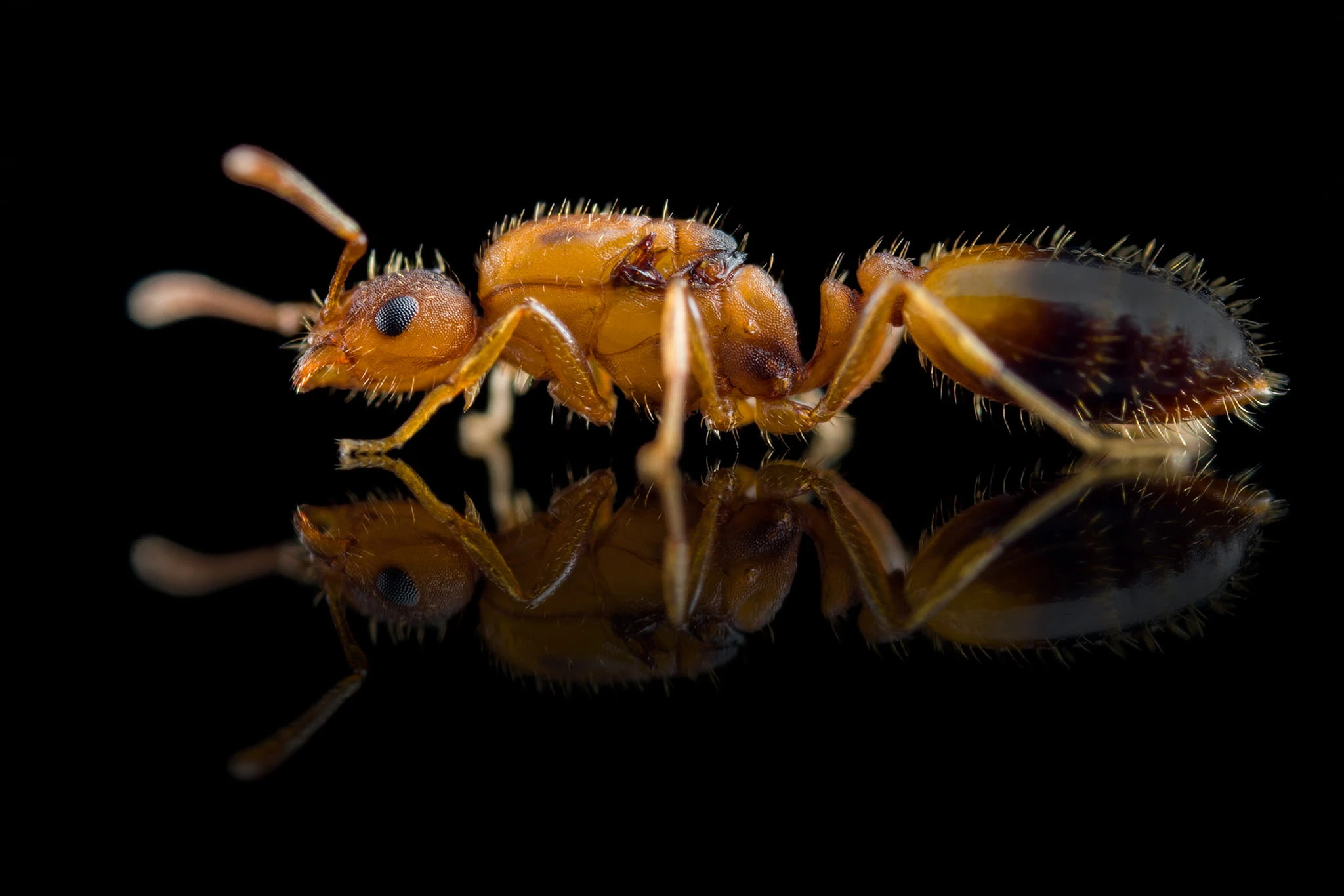


Absolut Perfekt. Bis auf eine Arbeiterin sind die Tiere sehr fit angekommen. Die Königinnen konnte ich nicht zählen und es waren definitiv mehr Arbeiterinnen als im Angebot angegeben. Dazu reichlich Eier und Larven. Ich werde hier wieder kaufen
Monomorium pharaonis
Leave feedback on the product

Monomorium pharaonis
€15.98
Price
€15.98
Regular price:
€15.98
0%
The lowest price during 30 days prior to the reduction:
€10.26
+56%
The promotion runs until %s
€15.98
Price
€15.98
Regular price:
€15.98
0%
The lowest price during 30 days prior to the reduction:
€10.26
+56%
The promotion runs until %s
Select product variant:
Individual variants may differ in price
in stock
Ask about the product

Monomorium pharaonis
Administratorem danych osobowych jest PHU Krystian Solga. Przetwarzamy je w celu przesłania odpowiedzi na zapytanie. Więcej informacji dotyczących przetwarzania danych osobowych znajduje się w polityce prywatności.
Share the product card



Shipping
from
€2.26
-
InPost Courier
(Poland)
from
€2.26
-
InPost Courier
(Poland)
Shipping cost for the selected product
The shipping cost applies to this product (in the selected variant - if applicable). It may change after adding other products to the cart.
Description
Description
Description:
Important information upfront: the queens I am selling here come from my own breeding, from a colony that has been with me for years. Periodically, I introduce males or queens from other colonies in several countries to diversify the gene pool. Larvae of various sizes are added to the colonies, which is often necessary to stabilize the breeding process. You can find more details about this in the description below.
In the internet, you can find a lot of information about pharaoh ants, but it's hard to find a single comprehensive description, so I tried to create one.
Monomorium pharaonis is already a legendary species. They are invasive, synanthropic ants that form massive supercolonies capable of taking over entire neighborhoods and creating a network of cooperating nests connected by communication trails, not only within walls or ventilation systems but also through underground channels between buildings. Once they discover a large food source, these ants can summon workers from flats located several meters away within a matter of hours. They can even summon hungry queens on occasion. Pharaoh ants are omnivorous and active around the clock.. Their vision is so weak that they can only differentiate between levels of illumination (dark, light, bright, etc.), relying solely on pheromone trails, which they can create in several types: long-lasting trails, typically between colonies or between a colony and a water source; medium-lasting trails, usually between the nest and a large food source; and short-lasting trails (even less than 15 minutes), often between the main trail and a small food source.
In the area they have invaded, pharaoh ants love to establish tiny satellite nests wherever they can, housing several hundred to several thousand workers. They can be found in tea boxes, cardboard walls, under shoeboxes, beneath flower pots, in flower pots, inside electronic devices, between book pages, on hot water pipes, in toys—anywhere that offers a relatively confined space. Workers are capable of initiating new nests without the involvement of queens; they only need a few eggs to start.
sposób, aby wyrosły z nich nowe królowe. ??? o co chodzi?
Unmated queens lay eggs of males, and these males fertilize the queens immediately after pupation. Pharaoh ants exhibit many interesting behaviors, for example, workers consume hemolymph from large larvae and later feed it to queens and smaller larvae, which is essential for colony development. Colonies grow extremely rapidly, eliminate all ants in their path, and exert absolute dominance over their territory, while individual nests cooperate with each other, exchanging workers and resources, allowing for the equalization of hormone levels between colonies and creating one large superorganism. Under favorable conditions, only 5-10% of workers are involved in foraging for food.
About 5% of the colony deviates from the trails and wanders in completely random directions. If they come across something noteworthy, such as a potential site for a new nest, a water or food source, or a foreign ant, they immediately lay down a pheromone trail and summon workers from the main trail. In the case of a large food source, queens are sometimes even called upon. Another few or several percent of the colony constantly shuttles between the nest and the water source. These workers have highly distended abdomens, and sometimes the mass of water they carry exceeds their own body weight. There is also a caste of storers within the colony. These workers store the food gathered by foragers, as well as water and hemolymph lapped up by other workers from large larvae. Additionally, Pharaoh ants have specially designated dry areas within the nest. In these locations, they accumulate large reserves of protein in the form of white or yellowish pellets stacked in piles. Many species of the Monomorium genus exhibit such behavior. At first glance, these piles resemble a heap of brood. If the humidity around the pile increases, fungus immediately appears. Therefore, the ants keep the protein in the driest part of the nest. Pharaoh ants are particularly concerned about cleanliness, as dead workers and food debris are swiftly transported away from the nest.
The number of queens in a large colony increases every day, and each queen can lay up to 350 eggs per month. Due to genetic defects, queens live only 6-24 months, but it's not a problem for a supercolony that can produce hundreds or even thousands of new queens daily. Workers live for 2-3 months, and their development from egg to adult takes about 32 days, while for the queen it takes around 42 days under optimal conditions. Pharaoh ants are highly aggressive, swarming and blindly stinging their prey. They rarely attack humans, only when defending their nest.
These ants are the first species that comes to mind when we hear "inbreeding," "swarming in the nest," or "queen multiplication." Their swarming occurs entirely within the nest or right at its entrance, without a nuptial flight. Observing dozens or even hundreds of new queens is an incredible experience for any breeder.
In breeding, pharaoh ants are highly resistant to errors and nearly impossible to kill. Moisture from food and the air can be enough for them to survive for several days, sometimes even weeks. Some even claim that they require no watering at all, but I always leave them with a test tube of water. They are omnivorous, undemanding, and develop rapidly. They can thrive in temperatures ranging from approximately 18°C to over 30°C (64°F to 86°F), although they prefer the range of 26-31°C (79-88°F).
They have no specific nesting requirements, they can manage in a test tube, any nest, or even underneath a loosely placed piece of plastic or cardboard on the arena – in fact, they often prefer such unconventional setups. The main challenges in breeding these ants are their ability to escape and their potential to establish themselves in a home. Contrary to popular belief, a small colony of up to a thousand workers has little chance of colonizing a relatively clean house unless it escapes in the kitchen itself. However, colonies with several thousand workers can confidently explore an area of several square meters, allowing them to find sources of water and food and stabilize themselves long enough to initiate expansion soon.
To tackle the issue of escapes, one can effectively use dry talcum powder applied to the walls of the arena with a makeup brush. There is no ant that can pass through this type of barrier overnight, and the trampled walls noticeably differ in color from the untouched ones, giving us plenty of time to react. It is important to note that an extremely starved colony exhibits an astonishing pace of trampling the barrier, regardless of whether it is talcum powder, fluon, or any other substance. Hungry ants are light enough to walk on the surface of water. Well-fed colonies pose no problem and retreat upon encountering talcum powder on the walls. In cases where a colony lacks large larvae for some reason, the rest enters a state of stagnation and perishes. Therefore, it is crucial to acquire a colony from breeders who know what they are doing and will send not only queens and workers but also the appropriate proportions of offspring to maintain colony continuity.
Here are a few interesting facts to add:
These ants are believed to originate from Egypt, and the name "pharaoh ant" was given to them by Linnaeus, who thought they were undoubtedly responsible for one of the Egyptian plagues.
Pharaoh ants have been spread worldwide through human transportation, including ships, trucks, and airplanes. They likely reached Europe with the French in 1978, specifically with the troops returning from Al-Lahun.
Adopting eggs laid by a queen from outside the colony inhibits the production of new queens for a period of time. In my opinion, this suggests that if there are enough eggs, queens and workers do not strive to produce new queens, which would only be unnecessary baggage.
In nature, there are typically fewer than 13 workers per queen, although this ratio sometimes increases in larger colonies.
Naturally formed colonies resulting from the division of the main colony range from 441 to 497 workers, although there is usually a free flow of workers and resources between the colonies even after division.
A diet low in sugars and high in protein accelerates colony growth, but shortens the lifespan of workers. And vice versa. Workers cannot separate the food they have consumed, so it is a good idea to feed them sugars and protein separately, not at the same time.
Queens mainly feed on hemolymph from larvae. If they do not have enough of it, they lay fewer eggs, resulting in fewer larvae, and the cycle continues. In a small colony, this loop often leads to complete extinction, and the only way to prevent it is by introducing larvae of different sizes from another colony.
There is a theory that pharaoh ants may originally come from tropical regions of Asia rather than Africa.
- Species: Monomorium pharaonis
- Difficulty: very easy (excluding escape abilities)
- Soldiers: none
- Size: queen 5-6mm, worker 2-3.5mm
- Coloration: black with translucent red
- Distribution: North Africa, South Europe and the Arabian Peninsula (native range), introduced in: other parts of Asia, both Americas
- Nutrition: honey water and feeder insects
- Hibernation: none
- Temperature: 26-31°C (79-88°F)
- Recommended formicarium: any, preferably dry
Reviews
Reviews
Number of ratings: 39
If you've added a review and it doesn't appear on the list, it may be pending moderation.
Leave feedback on the product
 Log in with Google

Torsten Futterer