

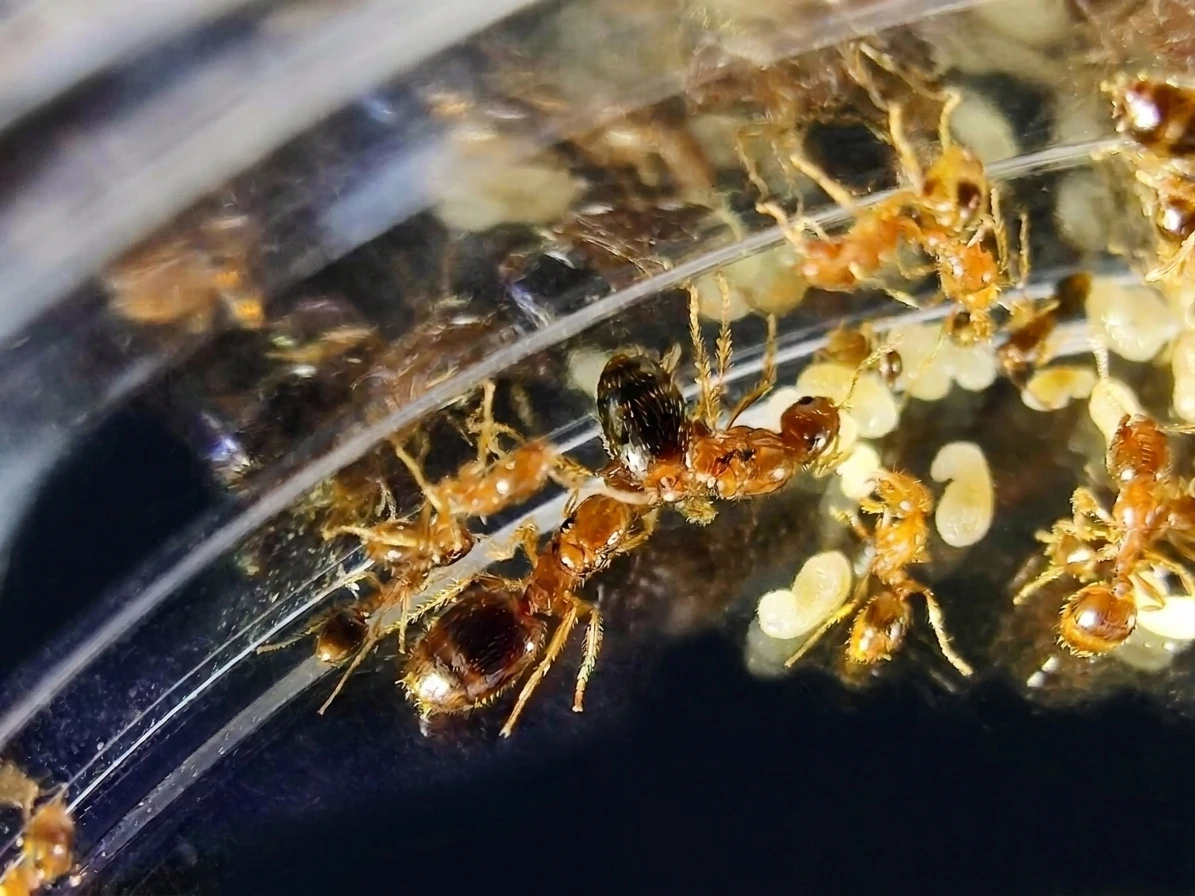


Erromyrma (ex. Monomorium) latinodis
Leave feedback on the product

Wybierz wariant produktu:
Individual variants may differ in price
Ask about the product

Administratorem danych osobowych jest PHU Krystian Solga. Przetwarzamy je w celu przesłania odpowiedzi na zapytanie. Więcej informacji dotyczących przetwarzania danych osobowych znajduje się w polityce prywatności.
Share the product card



Shipping cost for the selected product
The shipping cost applies to this product (in the selected variant - if applicable). It may change after adding other products to the cart.
Description
Erromyrma latinodis (formerly Monomorium latinode)
Erromyrma latinodis is a fascinating species, perfectly fitting the highly desired exotic ants for breeding, representing one of the most sought-after subjects in modern myrmecology. Among the species available on the market, it is absolutely the best substitute for the legendary Monomorium latastei. They are equally beautiful and possess almost identical morphology, being barely noticeably smaller, but they develop tens of times faster and show much higher activity in the outworld.
Their uniqueness lies in the extraordinary phenomenon of inbreeding – these ants mate inside the nest, creating massive supercolonies based on the coexistence of multiple cooperating queens (polygyny). Thanks to the continuous recruitment of queens, the entire colony gains the status of biological immortality. Observing their enormous appetite, organized feeding trails, and combative defensive behaviors guarantees amazing spectacles for every enthusiast.
| Feature | Description |
|---|---|
| Latin name | Erromyrma latinodis (formerly Monomorium latinode) |
| Worker size | From 3.0 to 4.2 mm |
| Queen size | From 7.0 to 9.0 mm |
| Nesting type | Extreme polygyny (a very large number of queens in the nest) |
| Optimal temperature | From 28°C to 30°C in the nest area |
| Hibernation | None (species active all year round) |
| Diet | Carbohydrate syrups, feeder insects, and even dairy (e.g., ripened cheese) |
Appearance and combat behavior
The workers attract attention with an unusual, two-colored body coloration. They have a bright, rusty-red head and thorax, which contrast beautifully with a pitch-black gaster. Unlike most ants, their surface shines beautifully in the light, resembling polished glass. They have relatively large and convex eyes, which translates into an excellent sense of sight actively used during mass hunts.
As successful synanthropic ants and opportunists, they can defend their nests extremely aggressively. In the event of any threat, thousands of workers spring into sudden action, tuck their legs, and raise their dark gasters maximally upwards, aiming their sting straight at the attacker. This combat pose strongly resembles the reactions of the most dangerous American fire ants (Solenopsis invicta), making Erromyrma latinodis a legal and incredibly spectacular alternative in home breeding.
Incredible development dynamics and inbreeding
The key to the gigantic success of this species is abandoning risky nuptial flights. Reproduction (inbreeding) has moved entirely to the safe, underground zones of the nest. Young queens, right after pupating, mate with males without leaving the formicarium. Since they are ants not requiring hibernation, the development of the ant colony progresses continuously throughout the year. This mechanism completely protects the colony from dying of old age – the superorganism systematically multiplies successive mothers inbredly and rapidly increases its numbers, expanding through budding. Under home conditions, development is very fast; while maintaining optimal parameters, you can count on seeing huge piles of white egg batches numbering thousands of pieces.
Breeding conditions and environment
These ants are characterized by excellent resistance and will forgive many mistakes. They develop well even in temperatures from 18°C upwards, however, to reach their full reproductive potential, they need higher values. The golden standard is spot heating the nest with a heating mat to an optimal temperature of around 28°C - 30°C, leaving the cooler outworld at room temperature. This provides the ants with an excellent thermal gradient, allowing the workers to independently control the development of the pupae.
The plasticity of the ants allows for the use of a wide range of nests, but you must avoid extreme drying at all costs. Outstanding ovulatory results are achieved by placing fragments of clean, very wet forest moss in the incubation zone, which simulates their natural breeding grounds in tropical trees. Because of their size, they climb great, which is why a precise anti-escape barrier on the upper edges of the outworld is crucial (dry-applied talc or specialized oils).
Feeding and the deadly risk of drowning
An exotic metabolism and a bustling colony require a large food supply. A proper diet for an ant colony consists largely of carbohydrates – workers eagerly devour all sweet syrups (e.g., sugar water or honey). For the larvae, in turn, live food for ants provided in the form of freshly killed feeder insects, such as crickets and roaches, is essential. These ants also have an interesting attraction to fats and animal protein – it has been documented that they eagerly eat pieces of ripened cheese or the flesh of sweet canned corn served on saucers.
CRITICAL WARNING: Due to their enormous, almost furious appetite, these ants are extremely susceptible to mass drownings. Dropping a large drop of sweet liquid onto the outworld guarantees a tragedy – in the frenzy of fighting for food, they break the surface tension, get covered in syrup, drown, and drag subsequent sisters called by pheromones to their deaths. To avoid tragedy, all liquids should be administered exclusively in the form of single drops or on a 3D-printed feeder. A large colony can be given larger amounts of sugar water at once, but it must be done with a feel for it – the portion should be such that they eat it all within 20 minutes. Then, even if they fall into the liquid, they won't have time to drown.
Reviews
If you've added a review and it doesn't appear on the list, it may be pending moderation.
Leave feedback on the product
 Log in with Google
