

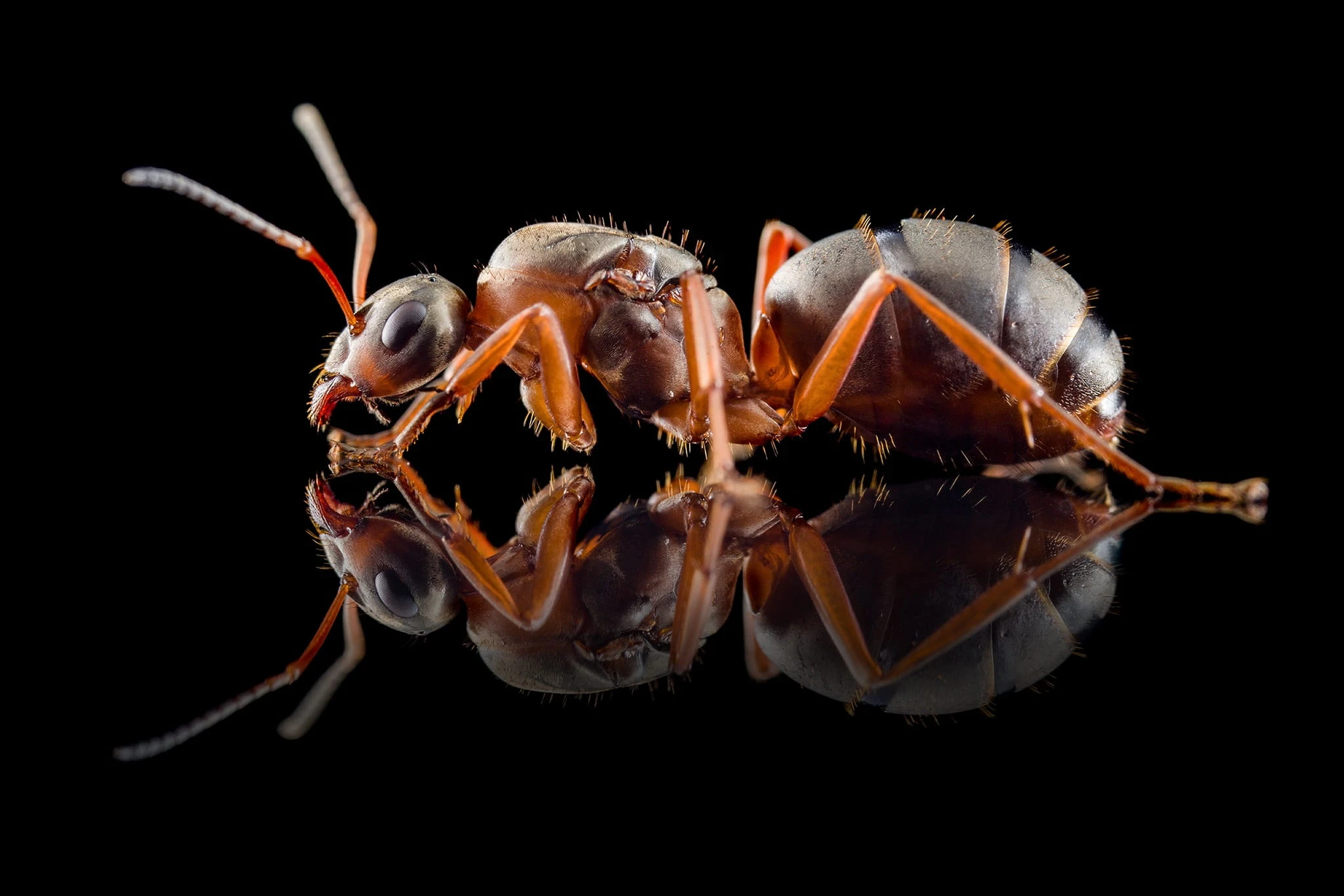


Formica cunicularia
Leave feedback on the product

Select product variant:
Individual variants may differ in price
Ask about the product

The controller of your personal data is PHU Krystian Solga. We process them to respond to your inquiry. More information regarding personal data processing can be found in our privacy policy.
Share the product card



Shipping cost for the selected product
The shipping cost applies to this product (in the selected variant - if applicable). It may change after adding other products to the cart.
Description
Formica cunicularia - Bicolored diurnal ant with exceptional eyesight
Discover Formica cunicularia - a bicolored diurnal ant equipped with high-resolution compound eyes that uses its sharp eyesight while hunting in broad daylight and stands out with a striking contrast between its rusty-brown thorax and dark gaster. Unlike many cryptic nocturnal species, these ants lead a strictly diurnal lifestyle, guaranteeing fascinating observations of dynamic hunts right when you are watching the outworld. If you are looking for reliable beginner ants, this species is an excellent starting choice and the perfect next step after Lasius niger or Messor barbarus.
- Sharp eyesight and daytime hunting: Well-developed, high-resolution compound eyes allow workers to instantly spot movement in the outworld and actively hunt during the day using their keen vision.
- Striking color contrast: A rusty-brown thorax paired with a dark, matte head and gaster creates a spectacular appearance that sets the colony apart from common, uniformly black ants.
- Rapid claustral founding: The queen establishes her nest independently without requiring feeding, raising the first generation of workers in just about 40 days.
- High resilience and easy care: A forgiving nature, a simple honey-and-protein diet, and excellent adaptability make this species a safe choice for every beginner ant keeper.
| Scientific name | Formica cunicularia (Latreille, 1798) |
| Difficulty level | Very easy (beginner-friendly) |
| Queen size | 8-12 mm |
| Worker size | 4-7 mm (polymorphic species) |
| Colony type | Facultative polygyny (pleometrosis in nature) |
| Mature colony size | Up to 5,000 - 10,000 workers in captivity |
| Outworld temperature | 22-28°C (72-82°F) |
| Nest temperature | 21-25°C (70-77°F) |
| Outworld humidity | 30-50% (dry, sunlit foraging area) |
| Nest humidity | 50-60% (moderate moisture) |
| Hibernation | Required (October - March at 5-10°C (41-50°F)) |
| Primary diet | Carbohydrates (honey water) and protein (feeder insects) |
| Recommended nests | 3D printed nests, aerated concrete (Ytong), gypsum, acrylic |
Choosing your variant and first steps with your colony
When you choose the queen-only variant, you receive an inseminated queen in a test tube with a water chamber. The queen founds her colony claustrally, relying exclusively on her own metabolic reserves, so she requires no feeding before the first workers emerge. By opting for a colony with workers, you gain a higher biological buffer and the immediate opportunity to observe exploration and foraging in the outworld.
Step 1: Peace and acclimation - After unpacking your parcel, wait 24 hours at room temperature of 20-22°C (68-72°F) in a darkened spot so the ants can calm down after transit. Strictly avoid heating a test tube containing a solitary queen with a heating mat, as it rapidly accelerates metabolism and causes severe stress.
Step 2: First meal - For a colony with workers, place a micro-drop of liquid carbohydrate, such as natural honey, on a tiny piece of foil alongside a small, pre-killed and halved feeder insect (e.g. a cockroach nymph or a piece of mealworm). Always offer pre-killed insects to a small colony, giving timid young workers immediate access to hemolymph without stress or risk of injury.
Step 3: Safe nesting in the test tube - Keep the colony in its test tube connected to a small outworld for as long as possible. A safe move into a dedicated formicarium should only take place once the colony reaches at least 30-50 workers and the space inside the test tube becomes too tight. First and foremost, we recommend modern 3D printed ant nests, aerated concrete, or gypsum nests connected to a spacious outworld.
What formicarium and setup does Formica cunicularia need to start?
Formica cunicularia thrives best in a 3D printed formicarium, aerated concrete, or gypsum nest connected to a spacious outworld. During feeding and maintenance, it is best to keep the outworld open and secured with a talcum powder barrier, which prevents the buildup of formic acid fumes. Nest temperature should be kept at 21-25°C (70-77°F), and the outworld at 22-28°C (72-82°F) with low humidity of 30-50%, mirroring their natural, dry meadow habitat.
In the wild, this species nests in the soil and beneath stones, building noticeable sand mounds across dry, sun-drenched grasslands. In captivity, provide them with a spacious outworld lined with dry sand and constant access to fresh water in an ant drinker. To prevent these agile insects from escaping an open foraging area, coat the upper inner rims of the walls with a thin layer of dry talcum powder.
What to feed Formica cunicularia and how to balance their diet?
The diet of Formica cunicularia is based on regularly offering liquid carbohydrates in the form of honey water alongside high-protein feeder insects. These ants have a high demand for protein during larval development, meaning protein food disappears quickly and stimulates the queen to lay eggs intensively.
In nature, workers actively hunt small arthropods using their sharp eyesight, collect nectar, and tend aphids to harvest sweet honeydew. In captivity, offer carbohydrates 2-3 times a week in micro-drops. Feed small colonies pre-killed and halved insects (flightless fruit flies, cockroach nymphs, mealworms, banana crickets), while a large, mature colony can be given live feeder insects so you can watch spectacular, coordinated hunts in the outworld.
Most common ant keeping mistakes and how to avoid them
- Risk of formic acid self-poisoning in enclosed spaces: Under severe stress (vibrations, aggressive tapping on the test tube, sudden handling), alarmed workers defensively spray formic acid. In tightly sealed containers, the accumulation of acid fumes leads to fatal poisoning of the entire colony. Give your ants peace after transport, and keep the outworld open and protected with talcum powder during feeding.
- Moving into a formicarium too early: Releasing a small colony into a large nest causes the ants to store food scraps inside unused chambers, which triggers mold growth. Plan the move only once the colony reaches at least 30-50 workers, and keep a solitary queen strictly inside her test tube.
- Heating a solitary queen with a heating mat: Heating a test tube containing a lone queen rapidly accelerates water evaporation, risks flooding the cotton plug, and depletes the insect's fat reserves. A solitary queen develops most safely at a stable room temperature of 20-22°C (68-72°F).
- Wearing down the talcum barrier during escape attempts: These agile ants constantly explore vertical outworld walls. With frequent climbing attempts, the powder gradually crumbles under the weight of the workers, eventually creating gaps in the protective band. Regularly inspect the barrier and replenish any missing dry talcum powder along the outworld rims.
Pronunciation, taxonomy, and fascinating biology of Formica cunicularia
In myrmecological nomenclature, the specific epithet of Formica cunicularia derives from the Latin word for a burrower or miner, and is pronounced phonetically as "koo-nee-koo-LAH-ree-ah" in Classical Latin (with a hard "k" sound for the letter "c"). The species was described in 1798 by the renowned French entomologist Pierre-Andre Latreille and belongs to the Formica rufibarbis species group within the subgenus Serviformica.
Although it is sometimes confused with the uniformly black Formica fusca, it differs by having distinct rusty-red coloration on the thorax and legs as well as a matte body lacking a strong metallic sheen. It is distinguished from the closely related Formica rufibarbis by having fewer erect hairs on the pronotum (up to 2 bristles or none at all).
In forest-edge and meadow ecosystems, Formica cunicularia plays an extraordinary ecological role: it contributes to the passive dispersal of lichens by transporting microscopic soredia on its body. In the wild, it is also a primary host for socially parasitic slave-making ants, such as the blood-red ant (Formica sanguinea) and the Amazon ant (Polyergus rufescens), which organize raids on its nests to capture cocoons.
Frequently Asked Questions (FAQ)
Can a Formica cunicularia colony have multiple queens?
This species exhibits facultative polygyny. In nature, young queens may found a nest together (a phenomenon known as pleometrosis), which speeds up raising the first generation of workers. However, once mature, the colony most often transitions into functional monogyny, where only a single queen remains in the nest. For this reason, mature queens from different nests should never be artificially combined in captivity.
Is the formic acid sprayed by workers dangerous to humans?
Formic acid secreted by the colony poses no health hazard to humans. It is purely an ant defense mechanism that can become dangerous to the insects themselves inside sealed containers without airflow, which is why using a well-ventilated or open outworld is so important.
How do I properly hibernate the colony during winter?
Hibernation is a natural part of the annual cycle for this native European species, lasting from October to March. In autumn, gradually lower the ambient temperature down to 5-10°C (41-50°F) (for example, in a cool basement, unheated garage, or refrigerator). During diapause, the ants do not consume protein food, but you must maintain steady moisture in the test tube water chamber.
Ready to watch spectacular daytime hunts by bicolored ants with exceptional eyesight? Select a variant with a worker pack from the dropdown menu to give your colony a dynamic start and a higher safety buffer from day one, or begin your journey with a solitary queen. Add Formica cunicularia to your cart and enjoy the fascinating life of a thriving, energetic nest!
Shipping and Live Arrival Guarantee
During cold weather, we include a professional HeatPack warming pad to maintain the proper transit temperature.
Live animals are shipped exclusively Monday through Thursday to prevent parcels from being held over the weekend.
We take full responsibility for safe transit, guaranteeing that your animal arrives healthy and in top condition.
Reviews
If you've added a review and it doesn't appear on the list, it may be pending moderation.
Leave feedback on the product
