

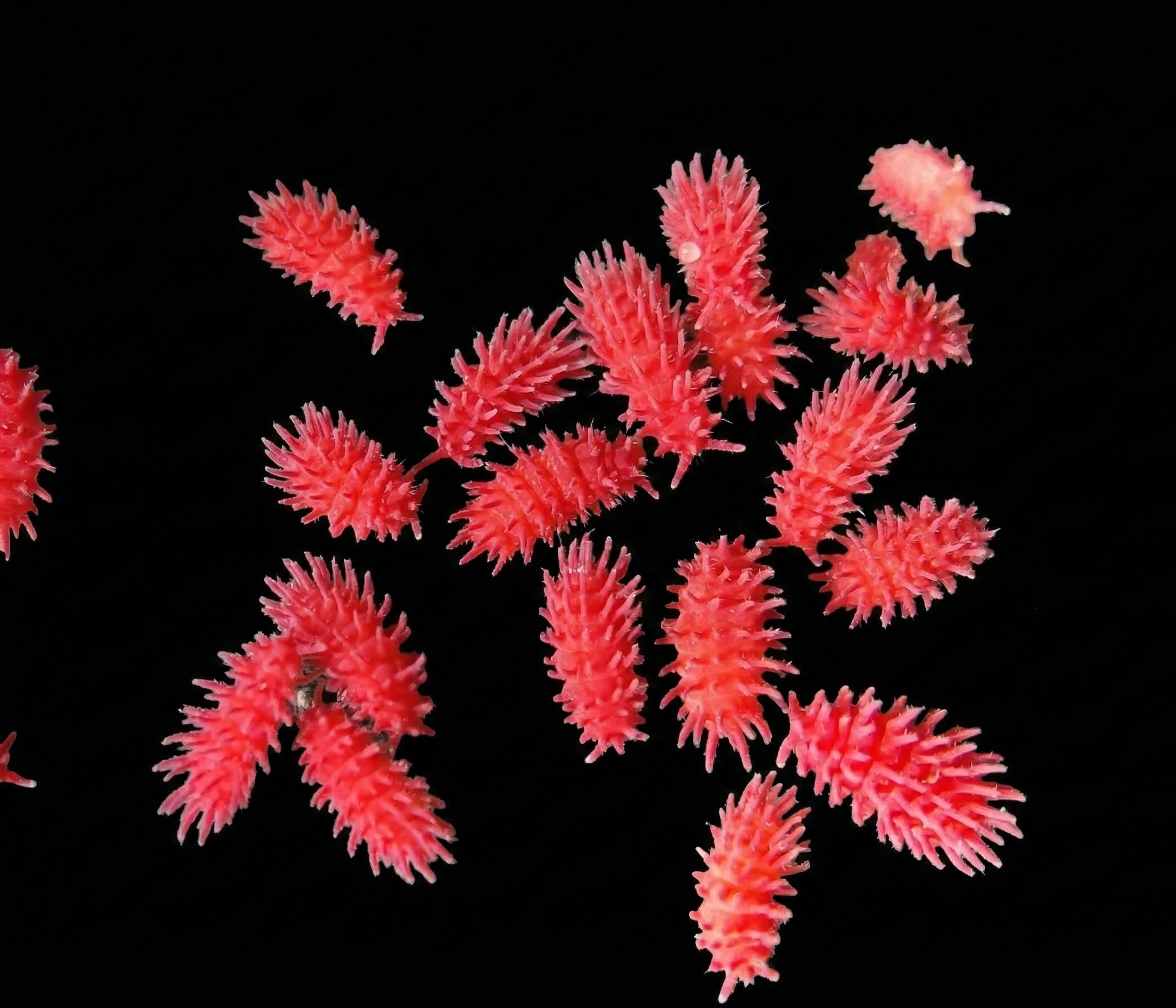


Rambutanura sp. Thai Red Spiky
Leave feedback on the product

Select product variant:
Individual variants may differ in price
Ask about the product

Administratorem danych osobowych jest PHU Krystian Solga. Przetwarzamy je w celu przesłania odpowiedzi na zapytanie. Więcej informacji dotyczących przetwarzania danych osobowych znajduje się w polityce prywatności.
Share the product card



Shipping cost for the selected product
The shipping cost applies to this product (in the selected variant - if applicable). It may change after adding other products to the cart.
Description
Rambutanura sp. Thai Red Spiky
Rambutanura sp., informally known as the "Red Spiky Springtail", is a true "Holy Grail" in the world of micro-terrarium keeping. Unlike most springtails, which serve only a janitorial function, this species is a fully-fledged premium display animal. Originating from the humid rainforests of Southeast Asia, these arthropods stand out with their incredible morphology and vivid coloration, becoming the focal point of any nano-terrarium or mossarium.
| Feature | Description |
|---|---|
| Scientific Name | Rambutanura sp. (Deharveng, 1988) |
| Common Name | None (commonly: Thai Red Spiky Springtails) |
| Origin | Southeast Asia (Thailand, Vietnam) |
| Size | Very large (for a springtail): 3-5 mm |
| Diet | Specialized: Slime molds (Myxomycetophagy) |
| Temperature | 20-28°C (68-82°F) |
| Humidity | Extremely high (90-100%) |
| Difficulty Level | Hard to say for now, will update later :) |
Species Characteristics
Morphology and Appearance: The genus name refers to the rambutan fruit, and it is an apt comparison. The body of Rambutanura is covered with distinct, long projections (tubercles) that give them a unique, "spiky" and matte texture, resembling coral. The coloration is intensely red or carmine. These are slow animals, moving in a dignified manner. In the course of evolution, they completely lost their jumping apparatus (furcula), which makes observing them very easy.
Husbandry Requirements and Environment
Container and Substrate: ?
Climate and Ventilation: Rambutanura does not tolerate humidity fluctuations. The substrate must be constantly moist. Due to the risk of drying out, very limited ventilation (sealed with a micron filter) or its complete absence with regular airing is recommended.
Diet: Food Specialization
This is the most important aspect of keeping this species. Rambutanura possesses modified piercing-sucking mouthparts. Unlike common springtails, it is unable to consume hard, dry food.
Our observations and breeding experiences indicate that these animals seem to be exclusively interested in feeding on slime molds (e.g., Physarum polycephalum). Providing standard springtail food, dry yeast, or rice is ineffective and leads to the starvation of the colony. Breeding success depends on providing access to living slime molds or experimental foods with a gel/paste consistency, although slime molds constitute their natural and preferred diet.
Reproduction and Life Cycle
This species pursues a quality strategy, not quantity. It reproduces slowly, laying small packets of eggs. The development cycle is longer than that of common springtails, which affects the rarity and price of the animals on the market. It requires patience from the keeper.
Reviews
If you've added a review and it doesn't appear on the list, it may be pending moderation.
Leave feedback on the product
 Log in with Google
