



Slime Mold Physarum polycephalum Day Walker
Leave feedback on the product

Wybierz wariant produktu:
Individual variants may differ in price
Ask about the product

Administratorem danych osobowych jest PHU Krystian Solga. Przetwarzamy je w celu przesłania odpowiedzi na zapytanie. Więcej informacji dotyczących przetwarzania danych osobowych znajduje się w polityce prywatności.
Share the product card



Shipping cost for the selected product
The shipping cost applies to this product (in the selected variant - if applicable). It may change after adding other products to the cart.
Description
"Le Blob" Physarum polycephalum — 'Day Walker' Strain
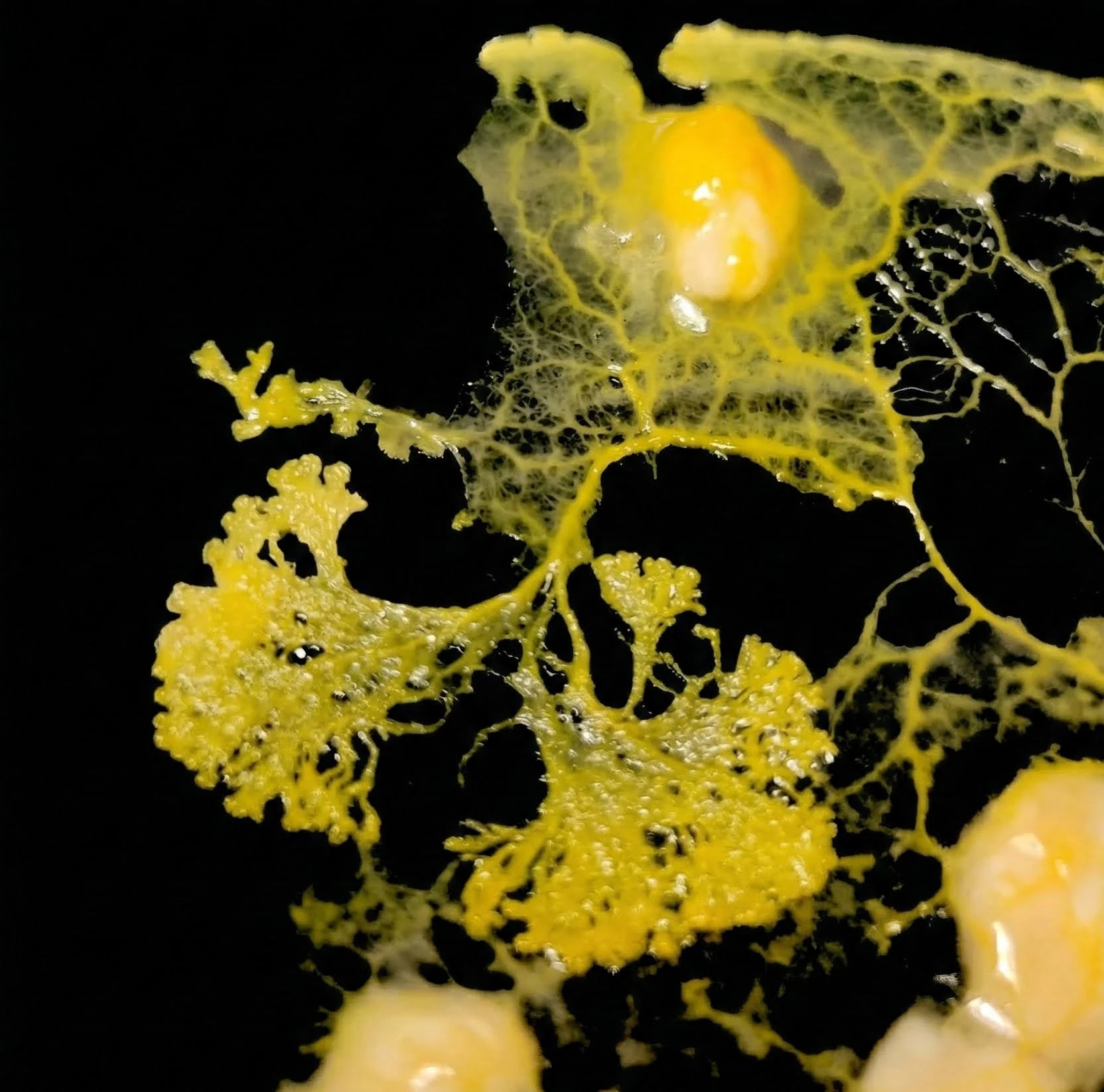
We present Physarum polycephalum, known worldwide as "Le Blob" — the subject of dozens of scientific studies and even experiments on the International Space Station (ISS). It is a fascinating, single-celled slime mold that defies standard classifications. It is not an animal, plant, or fungus (though sometimes mistakenly called a slime fungus), but belongs to the Amoebozoa supergroup. It is a giant, multinucleate single cell displaying astonishing, "intelligent" behaviors despite having no nervous system.
The offered 'Day Walker' strain (also known as "x32") is a unique variety selected and used by researchers at the French Centre national de la recherche scientifique (CNRS) for massive educational projects. Its key and absolutely unique feature is its high tolerance to daylight.
Key Advantage: Why the 'Day Walker' Strain?
Standard, wild strains of Physarum are strongly photophobic — terrified of light. Exposing them to light (especially combined with hunger) triggers irreversible sporulation (the reproductive phase), which ends the active life of the organism. This forces breeding in complete darkness, such as in a closed cabinet.
'Day Walker' solves this problem. This extraordinary slime mold does not react to ambient daylight as a stress signal. Thanks to this:
- You can observe it constantly: It is ideal for placing on a desk, in a classroom, or in an observation terrarium.
- It is ideal for beginners: The greatest threat in "Blob" breeding is mold or bacterial contamination, which is easy to miss in the dark. The ability to constantly observe the 'Day Walker' strain allows you to immediately detect issues and react, making breeding much easier and more forgiving.
| Feature | Description |
|---|---|
| Scientific name | Physarum polycephalum 'Day Walker' (strain x32) |
| Strain origin | Derived from CNRS research strains (France) |
| Key feature | Daylight tolerance (does not sporulate easily) |
| Diet | Dry rolled oats. Our springtail food as an energy boost. |
| Temperature | Room temperature (ideally 20-25°C / 68-77°F) |
| Humidity | Very high (breeding on moist substrate) |
What exactly are you buying?
We ship the slime mold exclusively in its dormant, dried resting state – as a sclerotium. This is a 100% natural resting state that ensures completely safe transport (fully resistant to frost, heat, or shipping delays) and allows you to wake up the culture at any convenient time.
Important – Surface area measurements:
The surface area selected at purchase (e.g. 1 cm², 5 cm², 20 cm²) is the surface area of the slime mold measured BEFORE drying. During the transition into a sclerotium, the slime mold loses water and shrinks by a factor of 10 to several dozen, taking the form of a dry, orange-yellow flake. After placing it on moist agar and adding water, within a few to several hours the slime mold absorbs moisture, wakes up, and regains the surface area you purchased.
Included in the kit:
- Physarum polycephalum 'Day Walker' sclerotium of your chosen surface area (measured before drying),
- A Petri dish with ready-poured agar – no boiling or mixing required, the substrate is ready to awaken the slime mold right away,
- A starter portion of oat flakes, enough for a long period of feeding and starting new cultures.
Extraordinary Biology and "Intelligence" of the Slime Mold
Owning Physarum polycephalum is like having a living research subject. Scientific studies, largely conducted by the French CNRS, have proven that this remarkable slime mold can:
- Solve problems: It can find the shortest path in a maze. In a famous experiment, it recreated Tokyo's optimized rail network using oat flakes as "cities." It operates on "embodied intelligence" – strengthening veins through which cytoplasm flows effectively, while resorbing unused ones.
- Learn (Habituation): It can get used to harmless though unpleasant stimuli (e.g., salt or caffeine), learning to ignore them to reach food faster.
- Transfer "Knowledge": Most astonishingly, a "trained" slime mold can fuse with a "naive" individual and pass on acquired knowledge. Just 3 hours of fusion is enough for the newly joined organism to instantly "know" that salt is harmless.
Memory Mechanism (How does it work?)
CNRS studies revealed that the Blob's "memory" is physical rather than abstract. The organism learns about salt by absorbing and storing it in its cytoplasm. When fusing with a naive individual, this knowledge literally flows through the newly formed veins, immediately programming the second organism.
Breeding and Awakening Step by Step
You receive a complete starter kit, making starting your culture child's play:
- Awakening (Start): Open the Petri dish with ready agar. Place the received sclerotium on the agar surface and add 1–2 drops of clean water directly onto it (or right next to it).
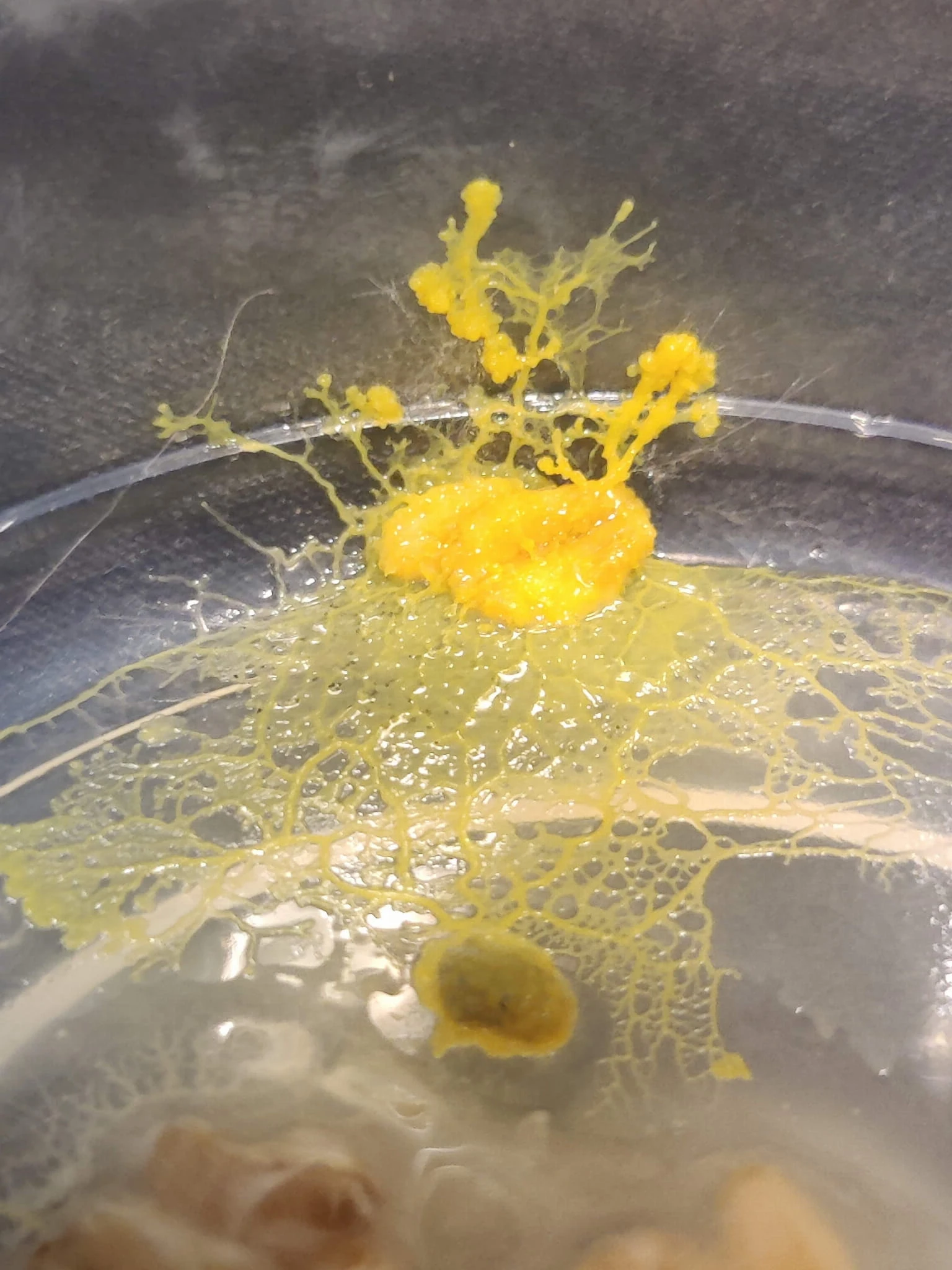
- Waking up: Close the Petri dish. Within a few to several hours, the slime mold will absorb the water, revive, and transform into an active, creeping yellow plasmodium of the purchased surface area.
- Feeding: Once the slime mold wakes up and begins extending yellow veins, place 1–2 dry oat flakes (regular rolled oats, not instant) right next to its active leading edge (do not place flakes directly on top of the organism). Our springtail food can also serve as a quick energy boost.
- Care and hygiene: Feed the slime mold regularly every 1–2 days. To avoid mold, every 7–10 days transfer a colonized oat flake or a small cutout of agar with slime mold onto fresh, clean substrate.
Alternative Breeding Methods
1. Agar Substrate
This is the most aesthetic and recommended method. Mix 2g of agar in 200ml of water. Pour boiling water over the powder and stir for a few seconds until dissolved. Pour the hot liquid into clean dishes (e.g. Petri dishes) and let it set (approx. 20-30 minutes).
2. Breeding on Paper
Instead of agar, the Blob can be bred on moist paper (e.g., unscented paper towels or tissues). It is faster to prepare and makes it easier to dry the plasmodium later to create your own sclerotium.
3. Bioactive Soil Breeding
An interesting method is permanent breeding in a 1-2 liter bioactive terrarium with a few centimeters of soil and springtails. This system avoids frequent subculturing.
How to Store the "Blob" (Creating Your Own Sclerotium)
If you go on vacation, place an active piece on dry paper towel, stop feeding and misting, and place it in the dark. Within 2-3 days it dries into a sclerotium that can be stored for months.
Reviews
If you've added a review and it doesn't appear on the list, it may be pending moderation.
Leave feedback on the product
 Log in with Google

