

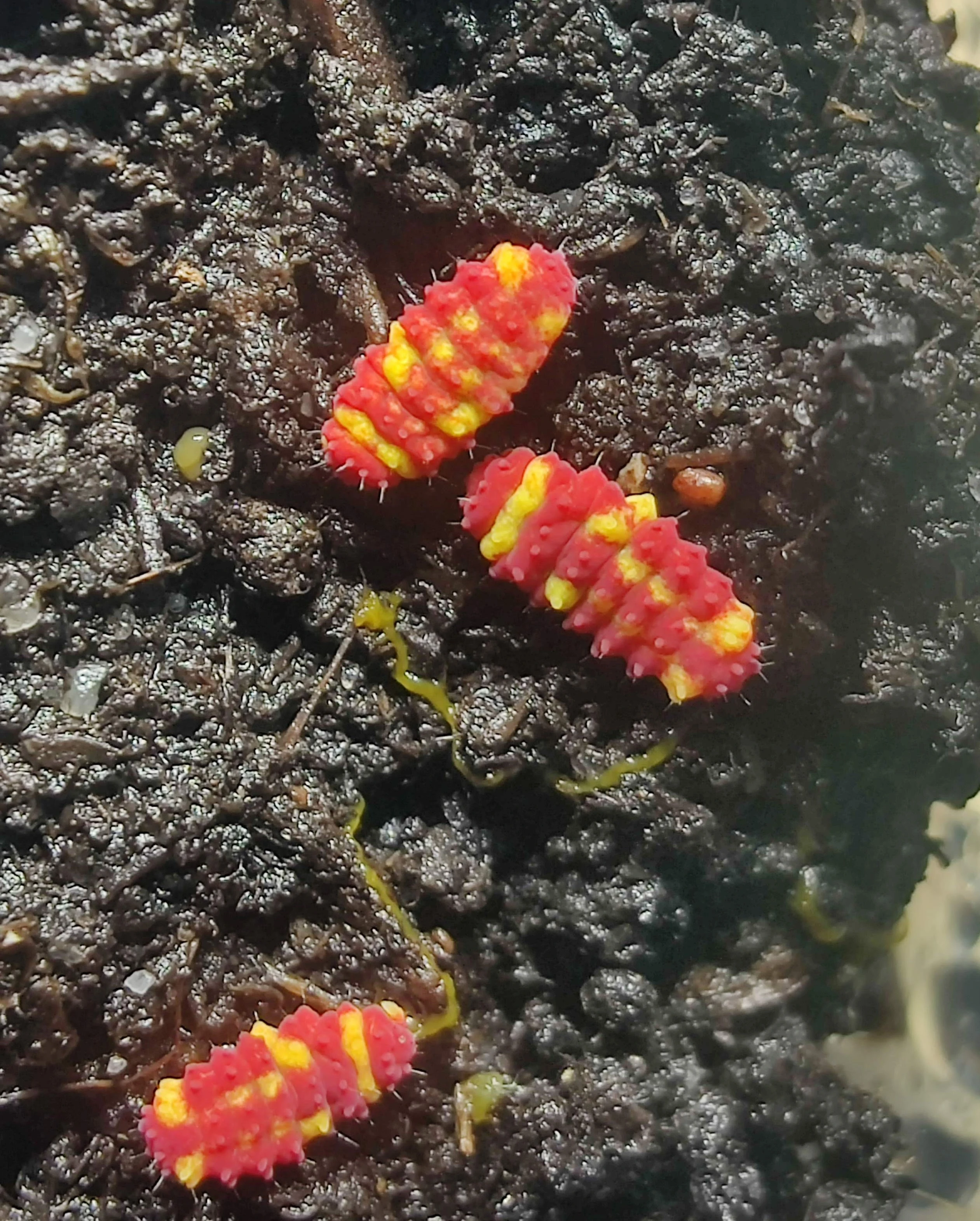


Neanuridae sp. "McDo"
Leave feedback on the product

Select product variant:
Individual variants may differ in price
Ask about the product

Administratorem danych osobowych jest PHU Krystian Solga. Przetwarzamy je w celu przesłania odpowiedzi na zapytanie. Więcej informacji dotyczących przetwarzania danych osobowych znajduje się w polityce prywatności.
Share the product card



Shipping cost for the selected product
The shipping cost applies to this product (in the selected variant - if applicable). It may change after adding other products to the cart.
Description
McDo Springtails (Philippine Neanuridae)
McDo Springtails are an absolute phenomenon in the bioactive terrarium world. Originating from the humid rainforests of the Philippines, these beautiful little animals have wonderfully enriched the market, becoming an incredibly desirable display microfauna. Unlike common and barely visible species, these Philippine beauties impress with their size and incredible coloration. In the breeders' world, they are known primarily as McDo. It is worth noting that terms such as Jollibee, Santa Claus, Redford White, or Thai Red Spiky are names for completely different species.
These animals have gone through a fascinating evolutionary path. They have completely lost their jumping apparatus, which means they move at a dignified, slow pace and will never jump out of your container. Their bodies are covered with fleshy tubercles. They are red with a beautiful, highly contrasting and distinct yellow pattern. This striking aposematism is a natural warning signal to predators, and to us, an aesthetic value of the highest class in a home ecosystem.
| Feature | Description |
|---|---|
| Common name | McDo Springtails |
| Family | Neanuridae |
| Maximum size | Noticeably massive, growing from 3 to even 5 millimeters |
| Container capacity | From 350 milliliters upwards |
| Required ventilation | Best to have none for a small colony, later on it does not matter |
| Substrate | Minimum 2 centimeters of sterile soil at the bottom (can be more) |
| Diet in captivity | Myxophagy (require feeding with live slime mold) |
| Population growth rate | Under ideal conditions from 10 pieces to 1000 in just 2 to 3 months |
Internet myths vs. our proven practice
Browsing the web, you will certainly come across a lot of articles suggesting that Philippine springtails are hellishly difficult to keep and require the creation of incredibly complicated conditions. We want to correct this clearly and firmly. These repeated myths mostly result from the gross ignorance of the sellers themselves. Following most of these complicated pieces of advice will sooner harm and kill a small colony of 10 or 20 individuals than actually help it. Our months-long tests prove something completely opposite. By applying a few elementary rules, you can easily lead a group of just 10 adult individuals to a massive population of 1000 pieces in just two to three months.
Simplicity of the container and sterile substrate
To start a fruitful culture, any container with a capacity of 350 milliliters or more is sufficient. At its bottom, you should pour a layer of at least 2 centimeters of regular soil. It is a good idea to scald the soil or bake it in the oven beforehand. This simple procedure is not absolutely necessary, but it turns out to be extremely helpful if you care about maximizing the breeding results. It eliminates all wild mites and other organisms from the soil that could hunt your springtails or steal their precious food.
When it comes to humidity, this species is really forgiving and accepts almost any conditions, provided you wisely avoid two extremes. The substrate cannot be bone dry, but it also cannot look like a water-flooded mud swamp. McDo springtails are relatively massive creatures. They will simply suffocate in standing water, and what's more, the slime mold itself will not survive when the environment around it is too wet.
The key issue of ventilation and the mythical mold
Many self-proclaimed experts recommend creating meshes and fancy ventilation holes. We recommend something completely opposite. Ventilation is not needed here at all, we even recommend avoiding it, at least until your colony reaches hundreds of adult individuals. Holes cause a very fast and uncontrolled drying of the substrate, which is the most common cause of the collapse of small cultures.
If you keep the culture in a sealed container without ventilation, you only need to remember to efficiently throw away old food scraps. An important thing is worth noting here. Mold itself is not at all harmful to springtails. These animals coexist perfectly with it, as long as the mycelium does not grow to gigantic sizes taking up a significant part of the space.
Myxophagy and the power of Gut Loading
Springtails of the Neanuridae family have undergone such strong specialization that they have completely lost their biting apparatus. They will not eat hard flakes or pellets. Their mouthparts resemble a piercing-sucking probe created to suck out the liquid contents of slime mold cells. For this reason, providing live slime mold once every two weeks is the absolute minimum for their survival, although you can and should do it much more often.
Especially at the beginning of the colony's development, we strongly recommend avoiding feeding with an aggressive daywalker-type slime mold. When this organism is hungry, it can attack and digest springtails. Instead, choose a peaceful slime mold, for example, the one we sell as a slime mold for springtails.
To maximize development, we recommend using the gut loading technique. To accelerate the growth of both individual specimens and the entire colony, we supplement the slime mold itself with our professional food, not the springtails directly. Such a slime mold stuffed with food passes a lot of wonderful nutritional values to the animals. It provides balanced vitamins, valuable algae, fungi, and calcium carbonate. This last ingredient is absolutely essential for hardening and building strong exoskeletons. A well-nourished slime mold guarantees springtails trouble-free molts and stimulates highly explosive reproduction. You will get the best results by giving the slime mold our dedicated food 12 to 24 hours before putting it into the container with the target colony.
Reviews
If you've added a review and it doesn't appear on the list, it may be pending moderation.
Leave feedback on the product
