

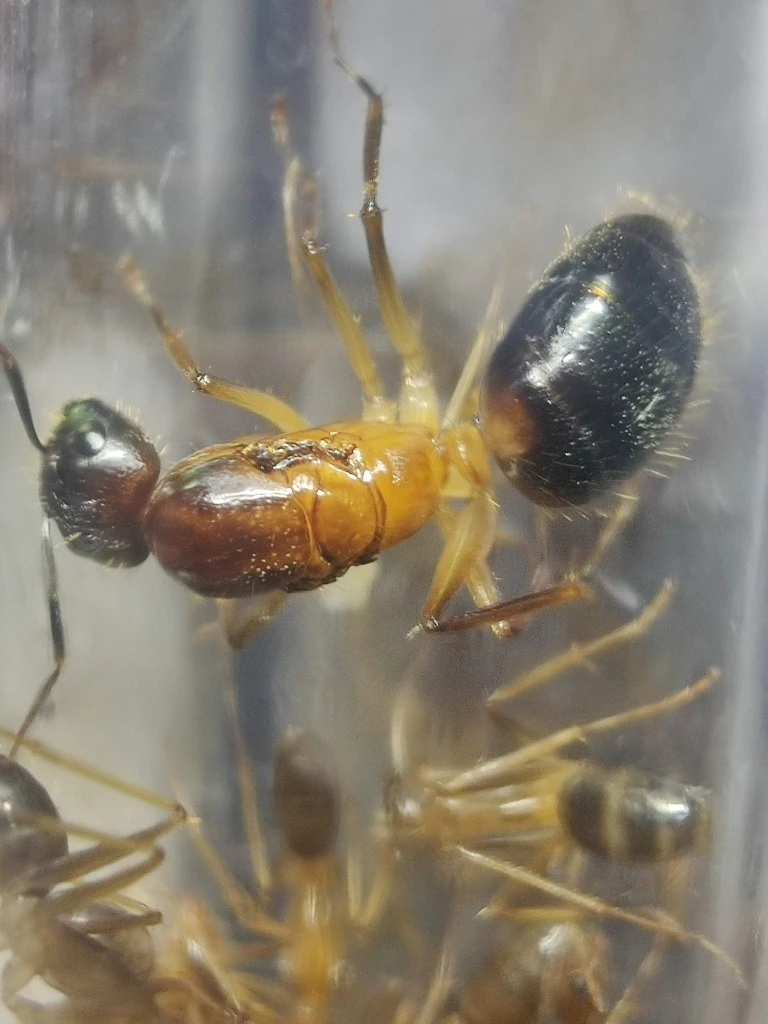


Camponotus pseudoirritans
Leave feedback on the product

Select product variant:
Individual variants may differ in price
Ask about the product

Administratorem danych osobowych jest PHU Krystian Solga. Przetwarzamy je w celu przesłania odpowiedzi na zapytanie. Więcej informacji dotyczących przetwarzania danych osobowych znajduje się w polityce prywatności.
Share the product card



Shipping cost for the selected product
The shipping cost applies to this product (in the selected variant - if applicable). It may change after adding other products to the cart.
Description
Camponotus pseudoirritans - Exotic Majesty, No Hibernation, and Remarkable Polymorphism
Camponotus pseudoirritans is one of the most sought-after, striking, and dynamic ant species originating from the warm, monsoon rainforests of Southeast Asia (primarily Southern China - Guangdong and Guangxi provinces, and tropical Hainan Island). Belonging to the subgenus Tanaemyrmex ("slender carpenter ants"), this insect catches the eye with a stunning tricolor contrast: the deep, pitch-black hue of its massive head and gaster pairs exquisitely with the luminous, amber-honey coloration of the thorax and slender legs.
Unlike native European species, Camponotus pseudoirritans does not require hibernation (diapause). This means stable, uninterrupted colony activity 365 days a year - without cumbersome cooling of test tubes in home refrigerators and without months-long developmental standstills. In a mature colony, workers form a spectacular size continuum: from agile minor foragers (6-8 mm), through intermediate media forms (8-10 mm), to monumental major soldiers measuring up to 14 mm, armed with massive head capsules and mandibles capable of crushing the toughest chitinous armor.
A fascinating phenomenon observed in this species is pronounced physogastry. The flexible intersegmental membranes of the gaster expand after feeding generously on sweet nectar, revealing distinct golden-yellow banding. Offering the ants honey water tinted with safe food coloring allows keepers to observe the creation of so-called "colorful ants" and track in real time the captivating process of trophallaxis - the exchange of liquid food from the social crop between sisters in the nest.
Key Advantages and Unique Features of the Species
- No hibernation (year-round activity): Tropical origin eliminates the need for diapause. The colony continually accepts food, raises brood, and exhibits high activity in the outworld all year round.
- Monumental major caste (soldiers up to 14 mm): The massive, heart-shaped, pitch-black heads of the soldiers contrasting with their amber thorax provide a spectacular subject for macro photography and behavioral observation.
- Obligate symbiosis with Candidatus Blochmannia: Intracellular gut bacteria synthesize essential amino acids for the colony (including tyrosine, critical for cuticle sclerotization) and efficiently recycle nitrogen, allowing the ants to thrive on a carbohydrate-heavy diet.
- Balanced target colony size: A mature colony reaches a population of 2,000 to 4,000 workers. This demographic ceiling ensures impressive foraging traffic in the outworld without the risk of overwhelming domestic space (unlike the massive multi-thousand worker colonies of Camponotus nicobarensis).
- Unique movement mechanics and jumping ability: Workers display remarkable agility - when facing small terrain obstacles, they can perform dynamic hops and leaps, making outworld patrolling exceptionally captivating to watch.
- Exceptional hygiene standards: Organic waste, leftover chitin, and pupal cocoons are consistently deposited in the furthest corners of the outworld, making nest cleanliness effortless to maintain.
Breeding Parameters and Environmental Requirements
| Feature | Description |
|---|---|
| Nest temperature | 24-28°C (75-82°F) (optimally 26-27°C (79-81°F), thermal gradient with one-sided heating recommended) |
| Outworld temperature | 22-30°C (72-86°F) (room temperature, spot heating stimulates foraging activity) |
| Nest humidity | 50-70% (moisture gradient: moist chambers for larvae, dry for cocoons) |
| Outworld humidity | 40-60% (dry environment with good ventilation) |
| Social structure type | Strictly monogynous (strictly one fertile queen per nest) |
| Queen size | 14-15 mm (massive build, dark brown to black with amber sutures) |
| Worker size | 6-14 mm (continuous polymorphism: Minor 6-8 mm, Media 8-10 mm, Major 10-14 mm) |
| Primary diet | Carbohydrates (sugar water, honey) + Insect protein (fruit flies, roaches, soft pupae) |
| Hibernation (Diapause) | No cold hibernation required (optional 2-month room-temperature rest at 19-21°C (66-70°F) in winter) |
| Recommended nests | Our 3D printed nests (recommended), acrylic, ceramic plaster |
| Difficulty level | Easy (starter colonies with workers recommended for beginners) |
Habitat Management: From Test Tube to Modular Formicarium
The most common mistake during the early stages of ant keeping is moving a founding colony into a spacious nest too early. In nature, a solitary queen establishes her colony in a strictly claustral manner (claustral founding), sealing herself tightly inside a confined niche beneath a stone or within dead wood. Excess space dilutes the queen's pheromones, subjecting the ants to chronic stress and prompting them to dump refuse in empty chambers.
Spatial housing development should follow these distinct stages:
- Initial founding stage (up to 15-20 workers): The colony remains strictly in a test tube setup (e.g., 16x160mm glass test tube) with a water reservoir plugged by tightly compressed cotton. The tube can be shielded from light using red film and kept at room temperature (20-22°C (68-71°F)) - do NOT heat the test tube during this stage. Feeding inside the tube is simplified by using a specialized test tube feeder for ants.
- Expanded foraging stage (20-50 workers): Connect the open test tube via a test tube adapter to a mini outworld for ants or place the tube directly inside the outworld. Equip the outworld with a stable feeder for ants, an optional safe ant drinker, and apply an escape prevention barrier (talc - ant barrier).
- Target nest stage (above 50 workers): Moving the colony into a formicarium should only occur once the ants completely fill the test tube. As the primary upgrade, we recommend our modular 3D printed nest.
Balanced Dietary Regimen: Carbohydrates and Protein
The nutritional requirements of the colony follow two distinct metabolic pathways:
- Carbohydrates (energy for adult ants): Workers and the queen require easily digestible simple sugars for muscular activity and metabolic function. The dietary foundation consists of sugar water, pure natural honey for ants diluted with water, or professional balanced nectar formulations. Always serve liquids in micro-droplets on a dedicated feeder for ants, which completely eliminates the risk of drowning.
- Animal protein (building blocks for larvae and oogenesis): Rapidly developing larvae and egg-laying queens require a steady supply of animal protein. During the founding stage, flightless fruit flies (Drosophila hydei) and pre-crushed Turkestan roach nymphs are ideal. For an established colony, mealworms (cut open to expose soft tissues) or soft insect pupae are exceptional choices.
Common Mistakes in Breeding and How to Avoid Them
- Premature heating of a solitary queen in a test tube: During the claustral founding stage, do NOT heat the test tube. A room temperature of 20-22°C (68-71°F) is optimal. Excessive heat in a small, enclosed tube causes chronic stress, heavy water condensation on glass walls, and the risk of the stressed queen eating her own eggs and larvae.
- Premature relocation to a large formicarium: Moving a small colony of fewer than 30-50 workers into a full-sized nest causes foraging paralysis. The ants cannot maintain unused chambers and begin stockpiling refuse inside, leading to severe mold outbreaks and mite infestations.
- Feeding liquids in large, sticky droplets: Placing thick drops of honey or syrup directly onto the substrate risks trapping and suffocating minor workers. Always offer liquid food in micro-droplets or using a stable feeder.
- Attempting to co-found with multiple queens: Camponotus pseudoirritans is strictly monogynous. Attempts to force multi-queen colonies (pleometrosis) result in lethal fights immediately after the first workers eclose. Only one queen can ever inhabit the nest.
Click to expand: Evolutionary Biology, Endosymbiosis with Candidatus Blochmannia, and Defense Mechanisms
The ecological success of ants in the genus Camponotus rests upon a mutualistic relationship of over 30 million years with the intracellular bacterium Candidatus Blochmannia. These microorganisms reside in specialized midgut epithelial cells (bacteriocytes) and are transmitted transovarially by the queen into each laid egg. Functioning as a natural bioreactor, they synthesize essential amino acids (such as phenylalanine and tyrosine, which is critical for the proper sclerotization of the new cuticle) and recycle metabolic nitrogen from urea. Consequently, the colony can maintain robust development even during temporary shortages of animal protein.
Throughout evolutionary history, ants of the subfamily Formicinae lost their stinger, evolving instead a highly developed acid gland that produces formic acid. When threatened, Camponotus pseudoirritans workers curl their gaster forward and can spray formic acid accurately over distances of several centimeters. Beyond deterrence, formic acid plays an indispensable sanitary role - workers spread it across chamber walls to suppress entomopathogenic fungal spores. For alarm communication, this species employs substrate-borne vibration or drumming - rhythmically tapping their gaster against hard nest surfaces to propagate vibratory signals that mobilize major soldiers to defend the queen's chamber within seconds.
Frequently Asked Questions (FAQ)
Click to expand: Does Camponotus pseudoirritans require hibernation in a refrigerator?
No. As a tropical and subtropical species from southern regions of Asia, Camponotus pseudoirritans lacks physiological adaptations for sub-zero or near-freezing temperatures. Placing the colony in a refrigerator will cause fatal nervous system collapse. We only suggest an optional 2-month room-temperature rest at 19-21°C (66-70°F) during winter, achieved by disconnecting the heating element while maintaining continuous access to honey and fresh water.
Click to expand: Can I house two queens together in one nest?
Absolutely not. Camponotus pseudoirritans is strictly monogynous. Attempts at artificial multi-queen founding (pleometrosis) result in lethal fights between queens as soon as the first workers eclose. Only a single fertile queen can reside in the colony.
Click to expand: Why are pupae kept in the driest nest chambers?
This is a completely natural and healthy behavioral response. While delicate eggs and larvae require higher humidity (50-70%) to prevent osmotic dehydration, pupae encased in spun silk cocoons require a warm, dry microenvironment. Providing a one-sided heating gradient allows workers to maintain ideal climatic zoning for brood care.
Click to expand: When should I offer the first food to a solitary queen?
The queen founds claustrally, metabolizing her own wing flight muscles and fat bodies to sustain herself and raise her first brood. Before the first workers (nanitics) eclose, do not feed her or disturb her founding chamber. Offer the first micro-drop of honey and a tiny fruit fly only after the first 2-3 workers have emerged.
Click to expand: Do these ants eat seeds like harvester ants?
No. Camponotus pseudoirritans is an opportunistic predatory and honeydew-feeding species. Despite the formidable mandibles of the major soldiers, this species possesses neither the digestive enzymes nor the behaviors required to crack, process, or digest seeds. Scattering seeds in the outworld will simply result in them being ignored or rotting on the substrate.
Reviews
If you've added a review and it doesn't appear on the list, it may be pending moderation.
Leave feedback on the product
 Log in with Google
