

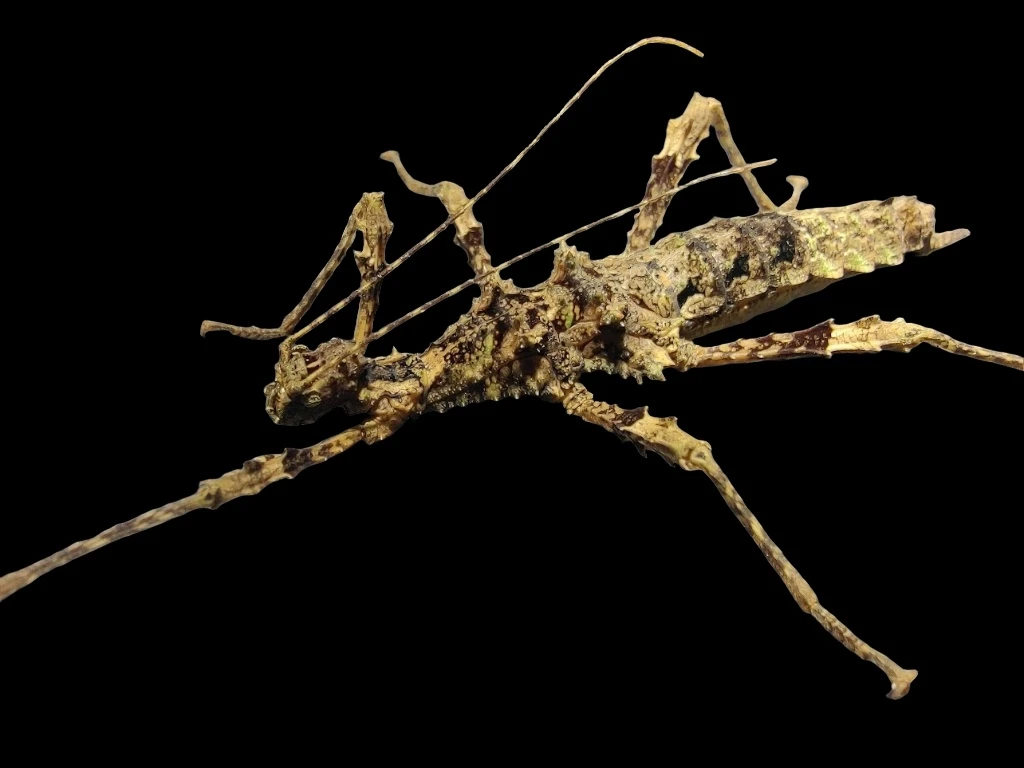


North Luzon stick insect (Trachyaretaon echinatus)
Leave feedback on the product

Select product variant:
Individual variants may differ in price
Ask about the product

Administratorem danych osobowych jest PHU Krystian Solga. Przetwarzamy je w celu przesłania odpowiedzi na zapytanie. Więcej informacji dotyczących przetwarzania danych osobowych znajduje się w polityce prywatności.
Share the product card



Shipping cost for the selected product
The shipping cost applies to this product (in the selected variant - if applicable). It may change after adding other products to the cart.
Description
North Luzon Stick Insect (Trachyaretaon echinatus) - Armored stick insect from the Philippines ideal for beginners
Trachyaretaon echinatus from the North Luzon strain is an exceptionally hardy and spectacular insect that forgives most beginner mistakes. It impresses with its massive exoskeleton resembling carved bark and complete lack of aggression, making it an excellent choice for a first exotic pet. Thanks to thelytokous parthenogenesis, you do not need a male - every offered female will lay viable eggs from which the next generation will hatch.
- Bulletproof genetics: The species thrives in typical room conditions, requiring no heating mats or heat cables.
- Females guaranteed: Parthenogenesis means that the culture consists of 100% females, eliminating the issue of surplus males.
- Spectacular camouflage: The robust, spiny armor perfectly mimics decaying wood and lichens, offering fascinating observations in the home terrarium.
- Easy diet: A herbivorous species that thrives on common, easily available blackberry and raspberry leaves.
| Feature | Description |
|---|---|
| Scientific name | Trachyaretaon echinatus |
| Origin | Philippines - Luzon Island |
| Dimensions | females 7.5-9 cm |
| Terrarium | min. 20x20x30 cm vertical |
| Temperature | 20-24°C (68-75°F), room temperature |
| Humidity | 70-75% |
| Diet | blackberry, raspberry, oak, rose, ivy leaves |
| Reproduction type | Thelytokous parthenogenesis - 100% females |
| Breeding difficulty | Very easy / Beginner |
| Activity | Crepuscular and nocturnal |
Variant selection and first steps with the purchased stage
In our offer you will find nymphs at the L4-L5 stage, which are already fully established and robust, while still offering the keeper a wonderful opportunity to witness the final molts and reach adulthood. After unboxing the package, give the insects time to acclimate at room temperature. The first step during the 24-48 hours after transport should be hydrating the animals by gently misting the enclosure walls with lukewarm water, allowing them to quench their thirst. Do not forget to immediately provide fresh blackberry twigs to restore their energy reserves.
What terrarium and microclimate to prepare for Trachyaretaon echinatus?
The terrarium for Trachyaretaon echinatus must be vertically oriented and have a height of at least three times the body length of an adult insect. Efficient ventilation (preferably gravity-based) and a constantly moist substrate (coco fiber or peat) with a minimum depth of 3-5 cm, which females use for egg-laying, are essential.
In practice, this means an enclosure measuring at least 20x20x30 cm for 2-3 adult individuals. A thick substrate layer serves a dual purpose - not only does it allow natural oviposition (egg-laying), but it also acts as a humidity buffer, slowly releasing moisture into the air. The interior should be enriched with vertical branches and cork bark slabs, which increase living space and facilitate safe hanging molts.
What to feed the North Luzon stick insect and how to organize the food supply?
The staple diet of Trachyaretaon echinatus consists of green leaves of evergreen bramble (blackberry), which can easily be found even under snow all year round. After cutting, food stems should always be placed in a small vase of water, whose opening must be tightly plugged with cotton wool to prevent insects from accidentally drowning.
Besides blackberry, these stick insects readily accept raspberry, oak, rose, and common ivy leaves. Cut branches placed in a container with water will stay fresh for up to two weeks, drastically minimizing maintenance routines. Make sure before collecting food that the leaves come from locations far from roads and agricultural fields where chemical pesticides may have been applied.
Common breeding mistakes and how to avoid them
- Lethal toxicity of early spring shoots: Light green young shoots and buds of blackberry accumulate deadly amounts of glycosides and tannins in spring. Feed your insects only firm, mature, full-sized leaves (they do not need to be from last year, but must not be soft new growth), otherwise you risk mass die-offs.
- Dismolting caused by dry air: A drop in humidity below 65-70% RH causes the exuvia to dry out against the insect's body. This prevents successful emergence, resulting in lost limbs or death. Mist the enclosure regularly.
- Drowning of young nymphs: Placing food branches in an open water container risks drowning your insects. The vessel's opening must be securely plugged with cotton wool or paper towels.
- Insufficient substrate depth: Using only paper towel or a layer of substrate that is too shallow (less than 3-5 cm) prevents adult females from inserting their secondary ovipositor into the ground for safe oviposition. Coco fiber should always remain slightly moist.
Click to expand: Taxonomic history, Hennemann's revision (2023), and PSG 452 culture list
The captive breeding history of this fascinating insect dates back to 2008, when Dave Navarro collected the first specimens on Luzon Island. A year later, Bruno Kneubühler successfully established and distributed them within the European phasmid hobby. For many years, the species circulated under provisional names. Only an extensive taxonomic revision by Frank H. Hennemann in 2023, published in the journal Faunitaxys, clarified its taxonomy. Hennemann formally assigned the popular cultured strains "North Luzon" and "Imugan Falls" to the species Trachyaretaon echinatus. In the same publication, he also described the closely related taxon Trachyaretaon bresseeli, listed in the Phasmid Study Group register under PSG 326, while our North Luzon culture received the number PSG 452.
Click to expand: Exoskeleton biomechanics, seismic sense, and tarsal adhesion apparatus
Trachyaretaon echinatus is an evolutionary masterpiece of biological engineering. These insects possess a highly sophisticated subgenual organ located in the tibiae, capable of detecting minute environmental vibrations transmitted through the hemolymph. This allows the insect to react instantly to approaching threats, most often triggering catalepsy (thanatosis), where it stiffens into immobility, perfectly mimicking a dead twig. Equally fascinating is the tarsal adhesive apparatus. Flawless locomotion across smooth surfaces is achieved through the synergy of sharp tarsal claws and adhesive pads: the arolium situated between the claws and euplantulae distributed along the tarsomeres, providing grip at the microscopic level.
Frequently Asked Questions (FAQ)
Click to expand: Can the North Luzon stick insect bite or spray an irritating aerosol?
No, Trachyaretaon echinatus is completely harmless and docile. It has no venomous apparatus, does not bite in self-defense, and does not emit any irritating chemical substances or defensive sprays. Its sole and primary survival strategy is camouflage.
Click to expand: Do I need to buy a pair to get eggs and offspring?
No. The "North Luzon" strain reproduces in culture exclusively via thelytokous parthenogenesis. This means that every adult female lays fertile eggs on her own without mating, from which new female nymphs will hatch after a few months of incubation.
Click to expand: Why does the stick insect stiffen and play dead when handled?
This is a natural defense mechanism known as catalepsy or thanatosis. Under stress (such as being picked up), the insect's nervous system signals its muscles to stiffen. To predators, an immobile, stick-like object is no longer an appealing target. Simply place the insect back down undisturbed, and it will resume activity within minutes.
Click to expand: What can I feed my stick insects in the middle of freezing winter?
The best and completely free solution is to locate wild blackberry brambles (Rubus fruticosus), which are evergreen. Even under a heavy snow blanket and during sub-zero temperatures, their leaves remain green, firm, and nutrient-rich - ideal for cutting and feeding in a home enclosure.
Reviews
If you've added a review and it doesn't appear on the list, it may be pending moderation.
Leave feedback on the product
 Log in with Google
