

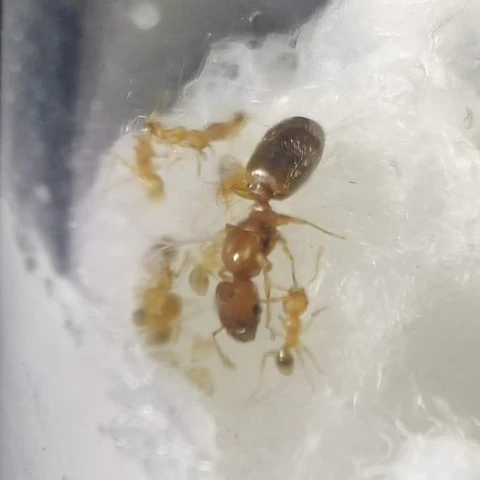
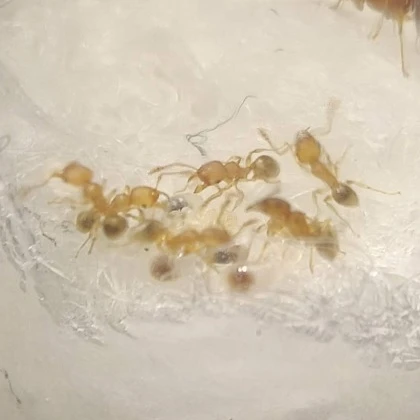


Pheidole parva
Leave feedback on the product

Select product variant:
Individual variants may differ in price
Ask about the product

The controller of your personal data is PHU Krystian Solga. We process them to respond to your inquiry. More information regarding personal data processing can be found in our privacy policy.
Share the product card


Shipping cost for the selected product
The shipping cost applies to this product (in the selected variant - if applicable). It may change after adding other products to the cart.
Description
Pheidole parva - spectacular micro-scale dimorphism with a powerful major soldier caste
Pheidole parva exhibits one of the most striking caste dimorphisms in the ant world. Tiny minor workers contrast with powerful major soldiers possessing massive heads that account for nearly half their body weight. The absence of intermediate forms, lack of hibernation, and living food reservoirs (repletes) make this species a true gem in ant keeping.
- Spectacular caste dimorphism: Extreme anatomical contrast between tiny minor workers and major soldiers without any intermediate forms.
- No hibernation (365 days of activity): Tropical species that develops continuously all year round at stable room temperature or with supplemental heating.
- Living food reservoirs (Repletes): Specialized minor workers store liquid carbohydrates in distended gasters and share them via trophallaxis.
- Facultative polygyny and polydomy: Ability to form multi-queen colonies and divide nests, ensuring rapid colony growth.
| Scientific name | Pheidole parva (Mayr, 1865) |
| Difficulty level | Easy (requires a 100% escape-proof formicarium) |
| Queen size | 4.5 - 6 mm (dark brown mesosoma with black gaster) |
| Worker size (minor) | 1.2 - 2 mm (honey-yellow, matte with dense micro-sculpture) |
| Soldier size (major) | 2.5 - 3.5 mm (orange-brown, heart-shaped head) |
| Nest temperature | 24 - 28°C (75 - 82°F) (optimally 25 - 27°C (77 - 81°F), below 22°C (72°F) development ceases) |
| Outworld temperature | 24 - 29°C (75 - 84°F) (natural thermal gradient) |
| Nest humidity | 65 - 80% (high humidity protects minors from desiccation) |
| Outworld humidity | 50 - 70% (dry substrate with good ventilation) |
| Hibernation (diapause) | None (tropical species, year-round development) |
| Diet | Liquid carbohydrates (honey, nectar), feeder insects, supplementary chia and poppy seeds |
| Starting nest type | Test tube with water chamber, eventually an escape-proof 3D printed nest with plaster chamber or with an additional modular gypsum unit |
Choosing a variant and first steps with the selected stage
When choosing Pheidole parva, you receive a 100% fertile queen in a test tube with a moisture reservoir. Depending on the selected variant from the dropdown list, you can start your colony from a solitary queen, a young colony with initial workers, or an established colony numbering dozens or even hundreds of workers, providing an immediate biological buffer and a spectacular start. To ensure ideal adaptation for your ants after transit, follow the step-by-step procedure below:
Step 1: Calm thermal acclimation - after unboxing, keep the test tube in a dark place at 20-22°C (68-72°F) without heating for 24 hours undisturbed to minimize transit stress.
Step 2: Safe energy feeding - for colonies with workers, provide a micro-drop of carbohydrates on the edge of the cotton plug or use a safe test tube feeder. Keep a solitary queen in the claustral founding stage without food or heating until the first workers emerge.
Step 3: Gradient heating - once workers are present, place a heat mat with a thermostat strictly under the front section of the test tube (near the entrance), maintaining 25-27°C (77-81°F), while leaving the water reservoir section in the cooler zone so expanding heated air does not flood water through the cotton.
Step 4: Connecting an outworld or moving in - until reaching at least 30-50 workers, the test tube remains the primary nest. Connect it to an external mini outworld. Plan the transition to the first module, such as a compact 3D nest with a plaster floor, only once the tube is well populated (if purchasing a larger colony, connect the test tube directly to an outworld and the target nest from day one).
What initial formicarium and conditions to provide for a Pheidole parva colony?
Tiny Pheidole parva workers require a strictly escape-proof 3D printed formicarium with a plaster chamber or an additional modular gypsum unit, alongside stable nest humidity at 65 - 80%. In the outworld, apply a dry talc barrier, and maintain a temperature of 25 - 27°C (77 - 81°F) using a heat mat with a thermostat heating a single zone.
The high surface-area-to-volume ratio in tiny minor workers means they can dehydrate in just a few hours in dry conditions. The mineral substrate must continuously supply elevated humidity. For a growing colony, we recommend our proprietary 3D modular nest paired with a gypsum hydration module. Cork or wooden nests are unsuitable due to rapid drying and the risk of ants chewing tunnels. Secure the outworld rims with a barrier of dry talc.
What to feed Pheidole parva and how to organize the colony diet?
The diet of Pheidole parva relies on constant access to liquid carbohydrates served in safe feeders and fresh insect protein offered every 1 - 2 days. Major soldiers mechanically crush chitinous insect exoskeletons and soft oily seeds, supplying vital nutrients to fast-growing larvae and the queen.
Liquid carbohydrates provide daily energy. Natural honey or sugar syrup works excellently. Due to the tiny size of minor workers (1.2 - 2 mm), large, deep droplets on smooth surfaces should be avoided, as liquid surface tension can easily trap a worker. Serve liquids using convenient outworld feeders, such as our heart-shaped ant feeder, which gives ants secure footing, while workers store surplus sugars within the bodies of living food reservoirs (repletes).
Animal protein fed every 1 - 3 days (flightless fruit flies, Turkestan cockroach hatchlings, small crickets, or cut mealworms - for small colonies always freshly killed and cut open) stimulates the production of major soldiers and prevents workers from eliminating surplus queens. Unlike Pheidole pallidula, this species ignores hard grass and grain seeds, accepting only soft oily seeds (poppy, chia, hulled sesame) once a week as a supplement.
How fast does a Pheidole parva colony develop and does it require hibernation?
A Pheidole parva colony grows at an exponential rate, reaching from several hundred up to 2 000 workers in the first year of keeping. As a tropical species, it does not undergo diapause and develops continuously 365 days a year at 25 - 27°C (77 - 81°F), while a drop below 22°C (72°F) completely halts brood development.
At optimal temperatures, the cycle from egg to adult takes 4 - 6 weeks (egg 10 - 14 days, larva 10 - 14 days, naked pupa 12 - 16 days). Below 24°C (75°F), development slows down to 8 weeks, which is why hibernation is completely excluded. Mature polygynous colonies reach up to 10 000 workers, displaying the ability for polydomy and colony budding. Peak foraging activity occurs after dusk (around 9:00 PM), protecting minors from desiccation and competition.
Common mistakes in keeping and how to avoid them
- Desiccation of the nest chamber: Minors can dehydrate in just a few hours. Regularly hydrate the gypsum module of your formicarium and provide a permanent water source in the outworld, such as an ant drinker.
- Formicarium gaps and missing talc: Workers can slip through gaps exceeding 0.2 mm. Choose precisely fitted 3D printed nests, a tight-fitting outworld lid, and regularly refresh the talc barrier along the outworld rim (mineral oil is ineffective).
- Serving liquids in open droplets: Liquid surface tension is a deadly trap for micro ants. Use feeders that provide secure footing while feeding, such as our heart-shaped feeders for the outworld.
- Unnecessary hibernation attempts: This tropical species does not undergo diapause. A temperature drop below 22°C (72°F) halts brood development and weakens colony health.
Taxonomic framework, microscopic diagnostics, and tramp ant biology
The species Pheidole parva was described in 1865 by Gustav Mayr from Ceylon (Sri Lanka). It belongs to the tribe Attini (subfamily Myrmicinae). Junior synonyms include: Pheidole bugi, Pheidole sauteri, Pheidole parva var. decanica, Pheidole flavens var. farquharensis, Pheidole rinae var. mala, Pheidole rinae tipuna, Pheidole rinae subsp. hongkongensis, and Pheidole parvicorpus (Eguchi, 2001). A 2025 taxonomic revision confirmed that the Cypriot population previously identified as Pheidole fadli is in fact Pheidole parva.
Majors feature a head distinctly longer than broad (0.96 - 1.07 mm x 0.85 - 0.92 mm), deeply cordate and emarginate at the occiput, distinguishing them from Pheidole jonas. The head lacks longitudinal striae, and the antennal scape falls short of the posterior margin of the head by an eye length. Minors are completely matte with dense micro-reticulate sculpturing.
As a classic tramp ant, the species has been introduced across the globe, including the Seychelles, Mauritius, Réunion, the Arabian Peninsula, Cyprus, the Bahamas, Florida, and European botanical greenhouses. It successfully competes against invasive ants such as Paratrechina longicornis and Linepithema humile. In Taiwan, it serves as a natural prey source for the Chinese pangolin (Manis pentadactyla).
Frequently asked questions (FAQ)
Is a Pheidole parva bite or sting felt by humans?
No. Both tiny minor workers and major soldiers have mouthparts far too small to pierce human skin. This species is 100% safe for home ant keeping.
Can multiple queens coexist in a single colony?
Yes. The species features facultative polygyny. Mature colonies readily house multiple egg-laying queens in one nest, boosting egg production and accelerating colony growth.
What do major soldiers use their huge heads for?
The massive head capsule accommodates powerful mandibular muscles. Majors mechanically crush insects and seeds, and use their heads to plug nest entrances (phragmosis), guarding the colony against intruders.
When should the colony be moved from a test tube into a formicarium?
We recommend moving the colony once it reaches at least 30 - 50 workers, when the test tube becomes crowded. Moving into a large nest too early causes stress and encourages mold growth on leftover food.
Does Pheidole parva eat seeds like Messor harvester ants?
No. Unlike true harvester ants, this species ignores hard cereal and grass grains. It only accepts small, oily seeds (poppy, chia, sesame) as an occasional supplement.
Looking for a compact colony with powerful major soldiers that thrives 365 days a year without hibernation? Choose your preferred Pheidole parva colony variant with workers from the dropdown list for the fastest start, add it to your cart, and enjoy the fascinating spectacle of caste division in your home formicarium!
Shipping and live arrival guarantee
During cold weather, we insulate every package with a professional HeatPack warmer to maintain the ideal temperature throughout transit.
Live animals are dispatched exclusively Monday through Thursday to eliminate any risk of packages being held in courier hubs over the weekend.
We take full responsibility for safe transit. We guarantee that your ants arrive healthy and in prime condition.
Reviews
If you've added a review and it doesn't appear on the list, it may be pending moderation.
Leave feedback on the product

