

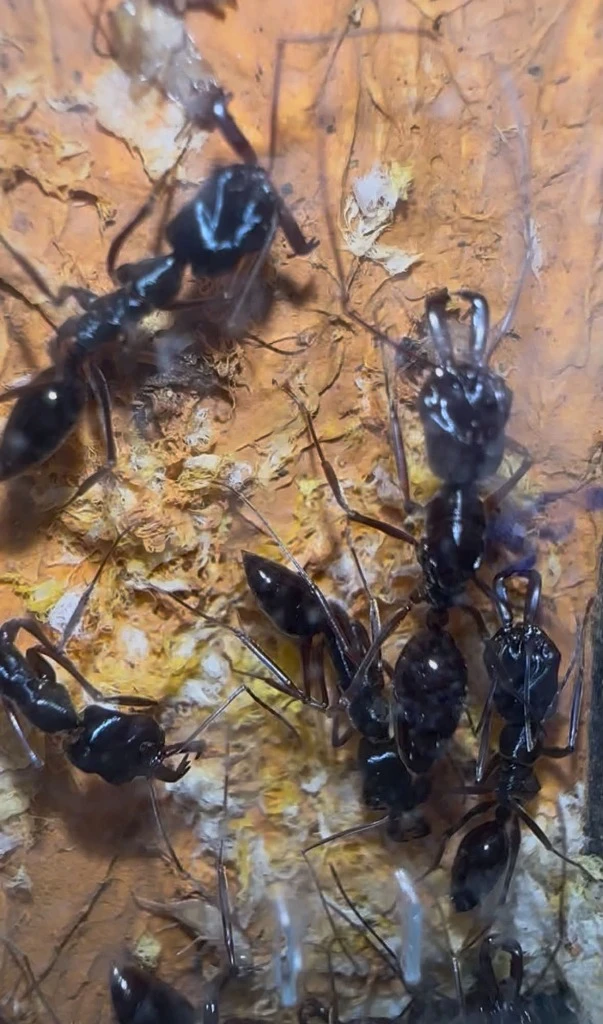


Odontomachus monticola
Leave feedback on the product

Select product variant:
Individual variants may differ in price
Ask about the product

The controller of your personal data is PHU Krystian Solga. We process them to respond to your inquiry. More information regarding personal data processing can be found in our privacy policy.
Share the product card


Shipping cost for the selected product
The shipping cost applies to this product (in the selected variant - if applicable). It may change after adding other products to the cart.
Description
Odontomachus monticola - Biological Catapult with 180° Trap-Jaws Snapping at Over 200 km/h
Looking for exotic predatory ants whose strike ends with a clearly audible snap? Odontomachus monticola (commonly known as the mountain trap-jaw ant) locks its tubular mandibles open at a 180° angle like a cocked crossbow and snaps them shut in a fraction of a millisecond, stunning prey and launching into spectacular recoil jumps. Large workers (10-14 mm) hunt individually by sight in an open outworld, while the compact mature colony size (200-500 workers) lets you observe breathtaking ambushes with the naked eye without the risk of outgrowing a home 3D printed formicarium.
- Biological catapult - 180° trap-jaws (0.16 ms and over 200 km/h): The spring-loaded mandible latch releases in 0.16 ms (1000-2300x faster than the blink of a human eye), reaching speeds of 60-64.3 m/s (126-230 km/h), an acceleration of 100,000 g, and an impact force 300-500x greater than the ant's body weight.
- Ballistic escape jumps and recoil defense (bouncer defense): Striking the jaws against a hard substrate or an intruder's exoskeleton catapults the ant (escape jump) several to over a dozen centimeters into the air and flings the attacker away from the nest.
- Solitary visual hunters (10-16 mm): Large workers (10-14 mm) and the queen (13-16 mm) with a dark blackish-brown to matte black exoskeleton hunt individually using vision and antennae, without laying pheromone trails.
- Compact colony (200-500 workers) and montane hardiness: Originating from montane forests (up to 1500 m a.s.l.), this species thrives at room temperatures, while carnivorous larvae equipped with dorsal adhesive tubercles digest solid protein into amino-acid-rich liquids consumed by the workers and queen.
| Species | Odontomachus monticola (Emery, 1892) |
| Taxonomy | Ponerinae, Ponerini (Odontomachiti, rixosus group) |
| Distribution | South, East, and Southeast Asia: India, Nepal, Bangladesh, Myanmar, Thailand, Laos, Vietnam, Malaysia, Indonesia (Borneo), China (>40°N, north of Beijing), Taiwan, Japan |
| Caste size | Queen: 13-16 mm, Workers (monomorphic): 10-14 mm (10-13 / 11-14 mm), Males: 6-11 mm |
| Structure and founding | Monogyny or polygyny (multi-queen colonies, typically 2-4 queens), gamergates, semi-claustral |
| Colony size and lifespan | 200-500 workers (max. 700-800), queen lifespan 5-10 years |
| Temperature | Founding queen: 20-22°C (68-72°F), Nest: 24-28°C (75-82°F) for tropical / 21-25°C (70-77°F) for montane, Outworld: 21-28°C (70-82°F) |
| Humidity and hibernation | Nest: 60-85%, Outworld: 50-70%. Hibernation: none (tropical) / optional 4-8 weeks at 12-16°C (54-61°F) for montane |
| Nest and difficulty | From min. 20-30 workers: 3D printed, gypsum, Ytong, bioactive. Level: intermediate (easier when starting with a colony with workers) |
Choosing a Variant and First Steps with Your Selected Stage
By selecting your preferred stage of Odontomachus monticola from the dropdown menu, you determine the pace of your starting colony: a queen only founds her nest semi-claustrally (requiring protein feeding 2-3 times a week, quiet conditions, and about 6-9 weeks to incubate the first generation), a small colony with workers lets you skip the most delicate two-month waiting period and provides a high safety buffer, while an established colony (or multi-queen colony) guarantees immediate, spectacular hunting in the outworld and rapid colony growth.
- Step 1: Acclimatization - Place the test tube with your colony in a dark spot for 24 hours undisturbed at 20-22°C (68-72°F) without supplemental heating (inspect a founding queen at most once a week to protect her from stress and oophagy, which is egg-eating).
- Step 2: Substrate inside the test tube - Place a pinch of moist coco fiber, peat, or fine quartz sand mixed with clay inside the test tube as mandatory scaffolding for the larvae to spin their cocoons.
- Step 3: Starter setup (tubs and tubes) - Place the open test tube inside an outworld lined with a thin layer of substrate, a band of dry talcum powder along the upper rims, and a tight-fitting micro-ventilated lid.
- Step 4: First meal - After 24 hours, offer a freshly killed, cut feeder insect (Turkestan cockroach nymphs or flightless fruit flies) and a small drop of honey water on cotton inside a shallow test tube feeder.
What Formicarium and Conditions Does Odontomachus monticola Need to Start?
A young Odontomachus monticola colony should develop in a substrate-lined test tube placed inside an outworld until it reaches a minimum of 20-30 workers. As a permanent home, 3D printed nests with a hydration or gypsum chamber work best, maintaining 60-85% humidity and a temperature of 24-28°C (75-82°F) or 21-25°C (70-77°F) for the montane ecotype.
In the wild, this species avoids open savannas, inhabiting moist leaf litter, rotting logs, tea plantations, and montane forests (up to 1200-1500 m a.s.l. as well as north of Beijing and in the Tokyo metropolitan area), which gives it high resilience to indoor home conditions. In soil down to 20 cm deep and beneath moss-covered stones, the ants excavate a single vertical shaft with smooth brood chambers. In a permanent 3D printed nest, gypsum nest, Ytong nest, or bioactive setup, apply one-sided heating (covering 20-30% of the nest area - the moist zone serves eggs and larvae, while the warmer and drier zone serves cocoons) along with a mandatory layer of moist coco fiber or sand on the chamber floors and in the outworld.
What to Feed Odontomachus monticola and How Do They Hunt?
The staple diet of Odontomachus monticola consists of insect protein offered 2-4 times a week (flightless fruit flies, Turkestan cockroach nymphs, pinhead crickets, cut mealworm larvae) alongside carbohydrates served 2-3 times a week (diluted natural honey water or sugar syrup) in shallow 3D ant feeders or on cotton inside ant drinkers.
Workers hunt alone (solitary hunters) using their eyes and antennae both during the day and after dusk, without laying pheromone trails or using group recruitment. For small colonies and a founding queen (fed 2-3 times a week), offer pre-killed and cut feeder insects, whereas for larger colonies you can introduce live, active insects up to 10 mm onto an open surface in the outworld so that feeder insects cannot burrow into deep substrate.
Although adult ants do not exchange liquid food with one another (no adult-to-adult trophallaxis), captured prey is delivered directly to the carnivorous larvae, which are equipped with mandibles, spines, and dorsal adhesive tubercles (used by workers to stick larvae onto chamber walls and ceilings). The larvae act as the colony's external digestive stomach: they digest solid insect protein and, through larva-to-worker trophallaxis, secrete amino-acid-rich nutritive fluids consumed by adult workers and the queen. The full brood development cycle takes 6-9 weeks (45-65 days): egg 10-16 days, larva (3 instars) 20-30 days, pupa in cocoon 14-20 days.
Common Mistakes in Antkeeping and How to Avoid Them
- Lack of loose substrate: In a sterile test tube or bare acrylic nest, larvae cannot anchor their silk threads, resulting in naked pupae that die or get eaten.
- Nest desiccation or leftover prey: A drop in humidity below 60% destroys eggs and larvae, while uneaten insect remains in high humidity attract mold and mites - remove leftovers from the outworld after 24-48 hours.
- Deep liquid droplets: Because of their long mandibles (55% of head length), workers drink with their jaws locked open - serve liquids on cotton or in shallow 3D ant feeders to prevent ants from getting sticky and drowning.
- Premature nest move and overheating the founding queen: Moving a colony with fewer than 20-30 workers into a large formicarium or heating a founding queen above 20-22°C (68-72°F) causes severe stress and egg-eating.
LMSA Biomechanics, Caste Morphometrics, Taxonomy, and Venom Toxinology
LMSA biomechanics, neurobiology, and microbiome: In the LMSA (Latch-Mediated Spring Actuation) system, mandibles opened to 180° lock into a ball-joint (equipped with socket micro-projections and a clypeal latch), while bulky adductor muscles elastically deform the head capsule and internal tendons (apodemes). Two trigger hairs per jaw (600-1200 μm) connect to giant sensory neurons (axon 15-20 μm) and motor neurons in the subesophageal ganglion (an 8-cell circuit with a 3-10 ms loop), and a fast trigger muscle (with sarcomeres resembling cicada tymbal organs) releases the jaws in 0.16 ms (genus Odontomachus 0.13-0.5 ms, angular acceleration 10^8 rad/s^2, power output 4.3x10^4 - 5.6x10^4 W/kg). The hollow mandibles also act as a resonating chamber for alarm stridulation, while serotonergic modulation suppresses the strike reflex toward nestmates, enabling fine motor control for handling eggs, digging, and volitional jumps triggered via the antennae. In 2024 biocontrol trials against black cutworm caterpillars (Agrotis ipsilon), workers achieved up to 98.67% predation efficacy against active surface larvae while ignoring immobile eggs and subterranean prey, and 16S rRNA sequencing (2021) revealed a dominance of Mesoplasma (up to 97.7%) and Wolbachia in the crop, midgut, and infrabuccal pockets (IBP), confirming larva-to-worker trophallaxis.
Taxonomy, distribution, and cryptic species complex: Described by Emery (1892) from Myanmar (Carin Biapo, Carin Asciuii Ghecu) within the basal Asian clade of the rixosus group (n=15, 2n=30, divergence from Anochetus 52.5-64.8 Mya, Greek odous/odontos - tooth, mache - battle, Latin monticola - mountain dweller, English Mountain trap-jaw ant / Japanese trap-jaw ant, Japanese Agito-ari). Junior synonyms: O. m. formosae Forel, 1912, O. m. hainanensis Stitz, 1925, O. m. longi Forel, 1900, O. m. major Forel, 1913, O. m. pauperculus Wheeler, W.M., 1921, and the probable Chinese synonym O. circulus. Misidentifications of northern Chinese populations as O. haematodus (Teranishi, 1936) were corrected by Yasumatsu (1962), while Yoshimura, Onoyama, and Ogata (2007) separated populations from Okinawa and Okinoerabu (Ryukyu Archipelago, formerly Myrtoteras kuroiwae Matsumura, 1912) as a distinct valid species, O. kuroiwae. That revision demonstrated that the taxon forms a cryptic species complex (sometimes labeled in the trade as Odontomachus cf. monticola), explaining differences between tropical and montane/temperate ecotypes in social structure (monogyny vs polygyny) and overwintering (in India it inhabits Arunachal Pradesh, Assam, the Andaman and Nicobar Islands, and the Himalayas in Uttarakhand above 1500 m a.s.l., and in Japan Yakushima up to 1200 m a.s.l., Kyushu, Shikoku, and western Honshu - Osaka, Oita, from where climate warming enabled expansion into Tokyo). Related species include O. rixosus, O. simillimus, O. goumang (China, larger head HL 3.55-4.02 mm, longitudinal vertex striation, convex propodeum), O. xizangensis (Tibet, smooth and shiny mesopleuron vs rugose and striated mesopleuron/mesepisternum in O. monticola), the Neotropical Odontomachus chelifer, and the subterranean Ponera coarctata.
Caste morphometrics and venom toxinology (MS/MS): Workers (HL 2.56-3.23 mm, HW 2-2.57 mm, CI 75.2-82.8, SL 2.63-3.16 mm, SI 117.5-132.7, EL 0.29-0.41 mm, WL 3.34-4.21 mm, palpal formula 4,4, ML 1.45-1.83 mm with an acute apical tooth, a subapical tooth that wears down with age, intercalary teeth, and 8-11 preapical denticles, deep extraocular furrow, concave posterior head margin, transversely/concentrically striated pronotum with dense pubescence, mesonotum and propodeum, petiole with an acute apical spine PtHI 168-212.7 and blunt subpetiolar process, matte 3rd gastral tergite without striation or erect hairs). Queens (WL 4.14-4.25 mm, PtH 1.6 mm, PtHI 216.2, distinct ocelli, developed mesoscutum and scutellum, steeply rising 1st gastral segment). Males (WL 2.95-3.24 mm, HL 1.13-1.23 mm, CI 120.3-125.4, huge compound eyes EL 0.8-0.87 mm, yellowish-brown wasp-like body, forewing veins C, R, Rs1, 2r-m, cu-a with loss of Rs2, documented gynandromorphs). Transcriptomic and MS/MS peptidomic venom analyses identified 92 peptides and proteins (45.1% of gland expression), where 98.5% of toxin reads consist of antimicrobial pilosulin-like peptides (1-6) and ponericins (which disinfect captured prey inside the nest), supported by ICK peptides, phospholipases A2, dipeptidyl peptidase IV, and hyaluronidases.
Frequently Asked Questions (FAQ)
Is a mandible strike or sting from Odontomachus monticola dangerous?
These ants are not aggressive toward humans outside of nest defense. A mandible snap against a finger is completely harmless and feels like a light pinch, whereas a sting delivers a burning pain slightly stronger than a honeybee sting, followed by localized swelling and a few days of itching (harmless to non-allergic individuals). Performing maintenance tasks in the outworld using straight or curved tweezers ensures complete comfort and safety.
Why can these ants jump and how do I escape-proof the outworld?
A ballistic recoil jump after snapping the jaws against the substrate is a defensive reflex on the outworld floor. Large, heavy Ponerinae workers are poor climbers on smooth surfaces, so combining a layer of dry talcum powder along the upper rims with a tight-fitting micro-ventilated lid provides complete security and maintains proper air humidity.
What happens in an Odontomachus monticola colony if the queen is lost?
In an orphaned colony, workers engage in ritualized dominance tournaments (antennal boxing and biting), after which dominant individuals activate their ovaries and take over reproduction as gamergates. If fertilized queen-laid eggs remain in the nest, the colony can also rear replacement queens, safeguarding the continuity of the colony.
Does Odontomachus monticola require hibernation (diapause)?
The tropical ecotype from Southeast Asia requires no hibernation and develops actively year-round at room temperature or 24-28°C (75-82°F). Only for populations originating from cooler montane and temperate regions (such as Northern China or Japan) can you provide an optional mild winter rest for 4-8 weeks at 12-16°C (54-61°F) if the colony naturally slows down brood production in autumn.
Want to hear the snap of mandibles striking at over 200 km/h and watch ballistic hunters in action? Select your preferred variant - choose a colony with workers to enjoy outworld ambushes from day one, add Odontomachus monticola to your cart, and experience the fascinating micro-world of predatory Ponerinae ants!
Shipping and Live Arrival Guarantee
During cold weather, we include a professional HeatPack warming pad to maintain the proper transit temperature.
Live animals are shipped exclusively Monday through Thursday to prevent parcels from being held over the weekend.
We take full responsibility for safe transit, guaranteeing that your animal arrives healthy and in top condition.
Reviews
If you've added a review and it doesn't appear on the list, it may be pending moderation.
Leave feedback on the product
