

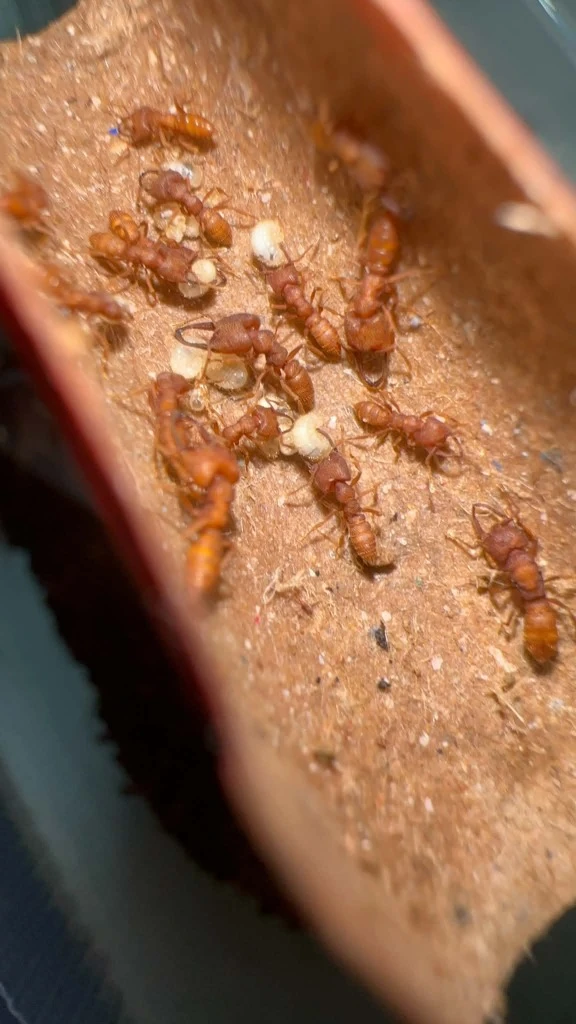


Mystrium camillae
Leave feedback on the product

Select product variant:
Individual variants may differ in price
Ask about the product

The controller of your personal data is PHU Krystian Solga. We process them to respond to your inquiry. More information regarding personal data processing can be found in our privacy policy.
Share the product card


Shipping cost for the selected product
The shipping cost applies to this product (in the selected variant - if applicable). It may change after adding other products to the cart.
Description
Mystrium camillae - The famous Dracula ant with the world's fastest mandibles (320 km/h)
Meet a living legend of myrmecology and the ultimate biomechanical record-holder in the animal kingdom. Mystrium camillae, famously known as the Dracula ant (or Vampire ant), wields snap-jaw mandibles that strike at 320 km/h (90 m/s) in just 23 microseconds - 5000 times faster than the blink of a human eye. Combined with larval hemolymph feeding, a cryptic lifestyle in the rainforests of Asia and Australia, and zero hibernation requirements, this species guarantees extraordinary year-round observations.
- Fastest biological movement on Earth (320 km/h): The mandibles operate like snapping fingers (LaMSA system) - the ant presses their tips together to flex the chitinous shafts, then slides one jaw across the other with an acceleration of one million g, stunning prey inside tight tunnels.
- The Dracula ant phenomenon (Larval Hemolymph Feeding - LHF): Adult ants have a narrow esophagus and can only ingest liquids - hunted insects are consumed by carnivorous larvae, while workers and the queen gently pierce the larval cuticle to drink droplets of hemolymph without harming their brood.
- Soil coat, thanatosis, and 3 worker subcastes: Spatulate setae bind humus particles into camouflaging body armor, and when disturbed the ants feign death (thanatosis). Colonies feature 3 cooperative subcastes of blind workers: minor nurses (3.3 mm), intermediate media, and major hunters (up to 6-8 mm).
- Active 365 days a year in a compact colony: Their equatorial origin eliminates winter diapause, while the mature colony size (50-200 workers) means the entire nest fits comfortably inside a single modular 3D printed formicarium.
| Scientific name and synonyms | Mystrium camillae Emery, 1889 (synonyms: Mystrium oculatum Xu, 1998, Mystrium camillae javana Karavaiev, 1925) |
| Common name and subfamily | Dracula ant, Vampire ant - subfamily Amblyoponinae, tribe Amblyoponini |
| Origin and habitat | Southeast Asia, Yunnan, India, New Guinea, northern Australia (rotting wood and humus of equatorial rainforests) |
| Colony structure, coloration, and caste size | Polygynous / oligogynous (1-5 queens) - queen 7-10 mm (dark brown to brownish-black with glossy bands on gastral tergites), workers 3.3-6 mm, 5-8 mm including mandibles (minor, media, major - matte brick-red and orange-brown to dark brown), males 5-7 mm (reddish-brown to black) |
| Mandible kinematics | Snap-jaw system (LaMSA): strike duration 23 microseconds, linear velocity up to 90 m/s (320 km/h), acceleration 1 000 000 g |
| Temperature | Nest 24-27°C (75-81°F) - optimal 24-26°C (75-79°F), lone queen and small colony up to 5 workers 20-22°C (68-72°F) without heating, outworld 25-29°C (77-84°F) with tolerance of 21-30°C (70-86°F) |
| Humidity and hibernation | Nest 75-90% (optimal 75-85%, range 65-90%), outworld 65-80% (50-80%), no hibernation (active 365 days a year) |
| Diet | Exclusively small invertebrates 2-3 times a week (flightless fruit flies, springtails, cricket nymphs, Turkish red runner cockroach nymphs, termites) - obligate predator (does not consume sugar or honey) |
| Development and colony size | 8-12 weeks from egg to worker (avg. 9-10 weeks at 25-26°C (77-79°F)), queen lifespan 10-15 years, mature colony 50-200 workers (avg. 58 in nature) |
| Recommended nest and difficulty | Approx. 1 L container with a thin layer of peat and springtails on the bottom (test tube placed directly in the outworld) or above 30 workers a small 6x6 3D printed nest with a gypsum floor and substrate - intermediate / advanced level |
Selecting a variant and first steps with your colony
Use the dropdown menu above to choose the developmental stage suited to your preferences. A lone queen founds her nest semi-claustrally, meaning she requires tiny feeder insects and drinks hemolymph from her first larvae. Selecting a variant with a worker pack (or a polygynous multi-queen colony established by nest fission) provides a strong biological safety buffer, immediate division of labor between minor nurses and major hunters, and instant observation of larval hemolymph feeding.
Ants of the genus Mystrium exhibit a reflex of defensive thanatosis (playing dead) and often lie motionless after transit - subtle antennal twitches confirm they are alive, so follow the step-by-step procedure below:
- Step 1: Acclimation and ending thanatosis - Place the closed test tube in darkness (under a cover or red protective film) at 20-22°C (68-72°F) without a heating mat for 24-48 hours so the ants recover from defensive immobility.
- Step 2: Substrate verification and first meal - Ensure there is a pinch of moist peat, soil, clay, or quartz sand inside the test tube (essential for larvae to spin cocoons). After 24 hours, offer a flightless fruit fly or a Turkish red runner cockroach nymph (2-3 mm) - this species does not eat sugar or honey.
- Step 3: Introducing a thermal gradient - For larger colonies, raise the temperature to 24-26°C (75-79°F) by placing a low-wattage heating mat (4 W with a thermostat) under at most 1/4 of the nest or near the test tube entrance (at least 25 mm away from the water reservoir). Never heat a lone queen or a small colony of up to 5 workers.
- Step 4: Target setup or 3D printed nest - The colony is best kept in an approximately 1-liter container with a thin layer of moist peat and springtails on the bottom, laying the open test tube directly in the outworld. If you prefer a dedicated formicarium, plan the move only once the colony exceeds 30 workers into a small 6x6 3D printed nest with a gypsum floor and a pinch of peat, soil, or sand scattered on the chamber floors.
What formicarium and setup does Mystrium camillae need to start?
For Mystrium camillae, the ideal setup is an approximately 1-liter container with a thin layer of moist peat and springtails on the bottom, where the test tube housing the ants rests directly on the substrate (or a test tube connected to a small outworld). If you opt for a structured formicarium, wait until the colony surpasses 30 workers before moving them into a small 6x6 3D printed nest with a gypsum floor lined with a bit of peat or soil, maintaining 75-85% humidity and 24-26°C (75-79°F) year-round.
Keeping the colony in a 1-liter peat container is exceptionally convenient - resident springtails continuously clean up organic debris and mold (so you never have to worry about waste buildup) while simultaneously serving as natural live prey that the ants actively hunt. Keep in mind, however, that in deeper substrate the ants may abandon their test tube and burrow into the peat - spread only a thin layer across the bottom so they cannot excavate tunnels outside the tube. In the wild, this hypogeic species inhabits moist humus, rotting logs, and microhabitats under moss and stones, showing nomadic tendencies by migrating whenever rotting wood dries out. In captivity, provide a darkened nest, a 12/12h light cycle in the outworld, micro-ventilation, and 75-90% chamber humidity without standing water (always hydrate with demineralized water). A thin layer of loose particulate substrate on the chamber floors (peat, soil, clay, or quartz sand) is mandatory both inside the test tube and in a 3D printed nest - it does not obscure the top viewing pane while giving larvae anchor points to spin their dark brown cocoons (newly eclosed callow workers are straw-colored before turning brick-red or dark brown) and supplying adults with particles for their camouflaging soil coat. Because minor workers (body length 3.3 mm, pronotal width 0.47 mm, head width 0.85 mm) can squeeze through gaps smaller than 0.5 mm, choose precision-fitted 3D printed nests with gypsum hydration, a snug-fitting lid, and a dry talcum powder barrier along the outworld rims.
What to feed Mystrium camillae and how does larval hemolymph feeding work?
The diet of Mystrium camillae consists exclusively of animal protein offered 2-3 times a week: flightless fruit flies, springtails, Turkish red runner cockroach nymphs, cricket nymphs, and halved mealworm larvae (4-6 mm). As an obligate predator, this species completely ignores honey, sugar water, and carbohydrate syrups.
The name Dracula ant comes from Larval Hemolymph Feeding (LHF), a specialized form of non-destructive parental cannibalism. Adult ants possess a constricted petiole and narrow esophagus (allowing them to swallow only liquids) and lack a social crop or oral-to-oral trophallaxis, so during a hunt (preying on centipedes, termites, and springtails in nature) major hunters stun prey with an audible mandible snap that flings the target 0.5-3 cm, paralyze it with their sting, slit its intersegmental membranes, and place their carnivorous larvae directly onto the carcass to digest solid protein using proteolytic enzymes. When hungry, a worker or the queen strokes a larva with her antennae, makes a tiny slit on the 4th or 5th abdominal segment, and drinks a droplet of exuding hemolymph (filtering out solid particles in the infrabuccal pocket and expelling them as a white infrabuccal pellet). The microscopic wound clots into a tiny dark scar - the larva survives unharmed and pupates normally while supplying the queen with sterile amino acids (workers consume brood only under extreme starvation, whereas pupae that die inside cocoons are routinely fed to larvae). Always cut larger feeder insects (such as mealworms) in half, and remove uneaten remains with tweezers after at most 24 hours to prevent mold and mite outbreaks.
Common mistakes in antkeeping and how to avoid them
- Sterile nest without loose substrate: Omitting peat, soil, clay, or sand from the test tube and nest chambers prevents larvae from spinning cocoons and deprives workers of material for their camouflaging soil coat.
- Attempting hibernation or chilling below 20°C (68°F): This equatorial species does not hibernate - cold temperatures trigger physiological shock and worker mortality within days, and permanently damage stored sperm inside the queen's spermatheca, rendering her sterile.
- Heating a small colony or offering honey: Keep a lone queen and small colonies of up to 5 workers at 20-22°C (68-72°F) without a heating mat (for larger colonies, never place the mat under the test tube water reservoir), and instead of ignored honey or sugar, feed exclusively tiny feeder insects and springtails.
- Gaps wider than 0.5 mm and leftover prey: Minor workers (pronotum 0.47 mm) escape through gaps in bolted acrylic nests, and decaying leftovers quickly mold in high humidity - use precision-fitted 3D printed nests, a dry talcum powder barrier, and remove food remnants after 24 hours.
Snap-jaw mandible biomechanics and the 320 km/h speed record (LaMSA system)
The mechanism was first noticed by Mark Moffett (1986), investigated by Wulfila Gronenberg (1998), and fully characterized in December 2018 by Fredrick J. Larabee, Adrian A. Smith, and Andrew V. Suarez (Royal Society Open Science) using 480 000 fps high-speed cameras, microCT scanning, and finite element analysis (FEA). Unlike classic trap-jaw ants (Odontomachus, Anochetus, and Myrmoteras, which cock their jaws open at 180-280 degrees), Mystrium camillae employs a contact-latch snap-jaw (LaMSA) mechanism analogous to snapping human fingers. During the loading phase (0.66-3.7 s), the ant presses the tips of its closed mandibles together on a pivot ridge and narrows the intermandibular gap by 20% - a contraction force of 0.35 N bows each mandible by 3.5 degrees (deflecting the base by 79.1 micrometers, Young's modulus 2.75 GPa, Poisson's ratio 0.3, von Mises stress 159 MPa in majors and 176 MPa in minors), storing 25.7 microjoules of elastic energy in majors and 23.2 microjoules in minors (compared to 11.9 microjoules in Stigmatomma pallipes).
Once static friction is overcome, an asynchronous slide occurs (with a 21.9 microsecond offset between jaws) lasting as little as 22.9 microseconds (mean 50.2 microseconds: 14.6 microseconds in minors and 34.8 microseconds in majors - 5000x faster than a human eye blink and 1000x faster than a finger snap). Linear velocity reaches 90 m/s (320-321 km/h, majors 86.9 m/s, minors 93.3 m/s), outstripping Odontomachus (64 m/s), the mantis shrimp (31 m/s), and the froghopper (4.7 m/s), with an angular velocity of 2.4 x 10^8 deg/s, angular acceleration of 1.5 x 10^16 deg/s^2, linear acceleration of 9.3-14.5 x 10^6 m/s^2 (one million g), and power density of 2.5-5.0 x 10^6 W/kg. Inside cramped wooden galleries where jaws cannot open wide, the strike flings prey 0.5-3 cm and stuns it before stinging (if the jaw hits an immovable wall, the recoil launches the ant backward).
Caste morphology, taxonomy, the Mystrium oculatum synonym, and reproduction
The subquadrate head (CI 88-105, HL 0.81-1.75 mm, HW 0.85-1.64 mm) bears anterolateral spines and broadened occipital lobes housing massive adductor muscles (musculus adductor mandibulae - 50% of head mass), while the linear mandibles (ML 0.52-1.75 mm) carry a double row of 19-30 denticles (dorsal true teeth and larger ventral denticles), a curved ventral apical tooth, and conical clypeal setae (convex labrum lacking a median carina). Female antennae consist of 12 segments ending in a 4-segmented club (SL 0.50-1.00 mm, SI 54-64), males have 13 segments, and the palp formula is 4,3 (with a projection on the 2nd labial segment, WL 0.91-1.49 mm, PW 0.47-0.80 mm). Workers are functionally blind (0-1 ommatidia), queens have compound eyes and 3 ocelli, and males feature reniform eyes (75% of the head side), prominent ocelli, reduced single-toothed mandibles, a dark pterostigma, a serrated aedeagus, and no pygostyles. The pronotum displays reticulate sculpture (rugoreticulum, camillae species group), a steeply convex lateral propodeal face distinguishes the species from Mystrium barrybressleri, the petiole has a supra-axial helcium (queen PtI > 210), abdominal segment IV bears a cinctus constriction, sternite VII carries 1-2 lateral spines, and the metapleural gland orifice opens posterodorsally (the 3 worker subcastes minor, media 1-2 mg, and major communicate via antennal touch, substrate vibrations, cuticular hydrocarbons, and tandem running without volatile alarm pheromones or toxin gene duplications while retaining the conserved GR3 region per Morgan et al., 2003).
The genus Mystrium Roger, 1862 (from Greek mystrion - small spoon, type species Mystrium mysticum, tribe Amblyoponini in subfamily Amblyoponinae of the poneromorph group, formerly Ponerinae, per Saux et al., 2004, Boudinot 2015) comprises 14 valid species: 10 Malagasy, 1 African (Mystrium silvestrii), and 3 Indo-Australian (Mystrium camillae, Mystrium leonie, Mystrium maren). The species was described by Carlo Emery (1889) from Bhamo in Myanmar (specimens collected by Leonardo Fea in 1885-1886, lectotype worker in MSNG Genoa and 4 paralectotypes in MSNG, MHNG, MNHN designated by Yoshimura and Fisher, 2014). Across its range from India, the Andaman Islands, Myanmar, Thailand, Vietnam, and Yunnan through Malaysia (Danum Valley, Maliau Basin, Lambir Hills), Singapore, Brunei, the Philippines (Luzon), and Indonesia (Java, Sumatra, Borneo, Papua) to New Guinea and northern Australia, taxonomic revisions (Brown, 1960, Bihn and Verhaagh, 2007, Yoshimura and Fisher, 2014) synonymized Mystrium camillae javana Karavaiev, 1925 (Mt. Kalkberg near Tjampea, Java) and Mystrium oculatum Xu, 1998 (Yunnan, 840 m a.s.l., also misspelled as Mystrium coulatum). The karyotype is n=16, 2n=32 (Tjan et al., 1986, Mariano et al., 2015), and nitrogen isotope profiles (delta 15N) place the species at the apex of the subterranean food web (in stark contrast to Camponotus gigas) as a specialized predator of centipedes (Chilopoda: Geophilomorpha and Scolopendromorpha). Unlike Malagasy species (Mystrium mysticum, Mystrium oberthueri, Mystrium voeltzkowi, which have wingless ergatoid queens), Mystrium camillae (and Mystrium rogeri) retains a distinct queen caste (F. Ito Java collection, Molet and Fisher, 2006-2009): fully winged (alate) queens that found colonies semi-claustrally after rainy-season nuptial flights, and short-winged (brachypterous) queens that establish new nests through dependent colony fission, with both queens and workers possessing 8 ovarioles (workers have an empty vestigial spermatheca, yet in orphaned colonies they lay unfertilized haploid eggs that develop into males).
Frequently Asked Questions (FAQ)
Are Mystrium camillae ants dangerous to humans and can they sting?
This species is completely safe to keep in captivity. The 320 km/h snap-jaw strike cannot pierce human skin and merely bounces the ant backward. Workers and queens do possess a functional sting (if pinched between fingers, the sting feels similar to a mild wasp sting), so performing all outworld maintenance with standard tweezers ensures 100% safety.
Why do the ants lie motionless and look dead when I open the parcel?
This is defensive thanatosis (playing dead). Vibrations during transit cause ants coated in soil particles to tuck in their legs and freeze like tiny clumps of earth. Subtle antennal twitches confirm they are alive - left undisturbed in darkness at 20-22°C (68-72°F), they will resume normal activity within a day.
What is the difference between Mystrium camillae and Mystrium oculatum sold in Europe?
They are the exact same biological species. The name Mystrium oculatum Xu, 1998 from Yunnan was formally synonymized under Mystrium camillae Emery, 1889 in modern taxonomic revisions (Bihn and Verhaagh, 2007, Yoshimura and Fisher, 2014), although several Western European shops still list it under the older name.
Does this species require hibernation and how large does a mature colony grow?
Mystrium camillae originates from equatorial rainforests, so it does not hibernate and remains active 365 days a year. A mature colony numbers 50-200 workers, meaning that throughout the 10-15 year lifespan of the queen it fits comfortably inside a single compact 3D printed formicarium.
Ready to witness the fastest predator on Earth and the fascinating ritual of the Dracula ant firsthand? Select a variant with a worker pack for a safe start and immediate hunting action, add Mystrium camillae to your cart, and enjoy year-round observation of one of the most extraordinary evolutionary phenomena in the world of ants!
Shipping and Live Arrival Guarantee
During cold weather, we include a professional HeatPack warming pad to maintain the proper transit temperature.
Live animals are shipped exclusively Monday through Thursday to prevent parcels from being held over the weekend.
We take full responsibility for safe transit, guaranteeing that your animal arrives healthy and in top condition.
Reviews
If you've added a review and it doesn't appear on the list, it may be pending moderation.
Leave feedback on the product
