

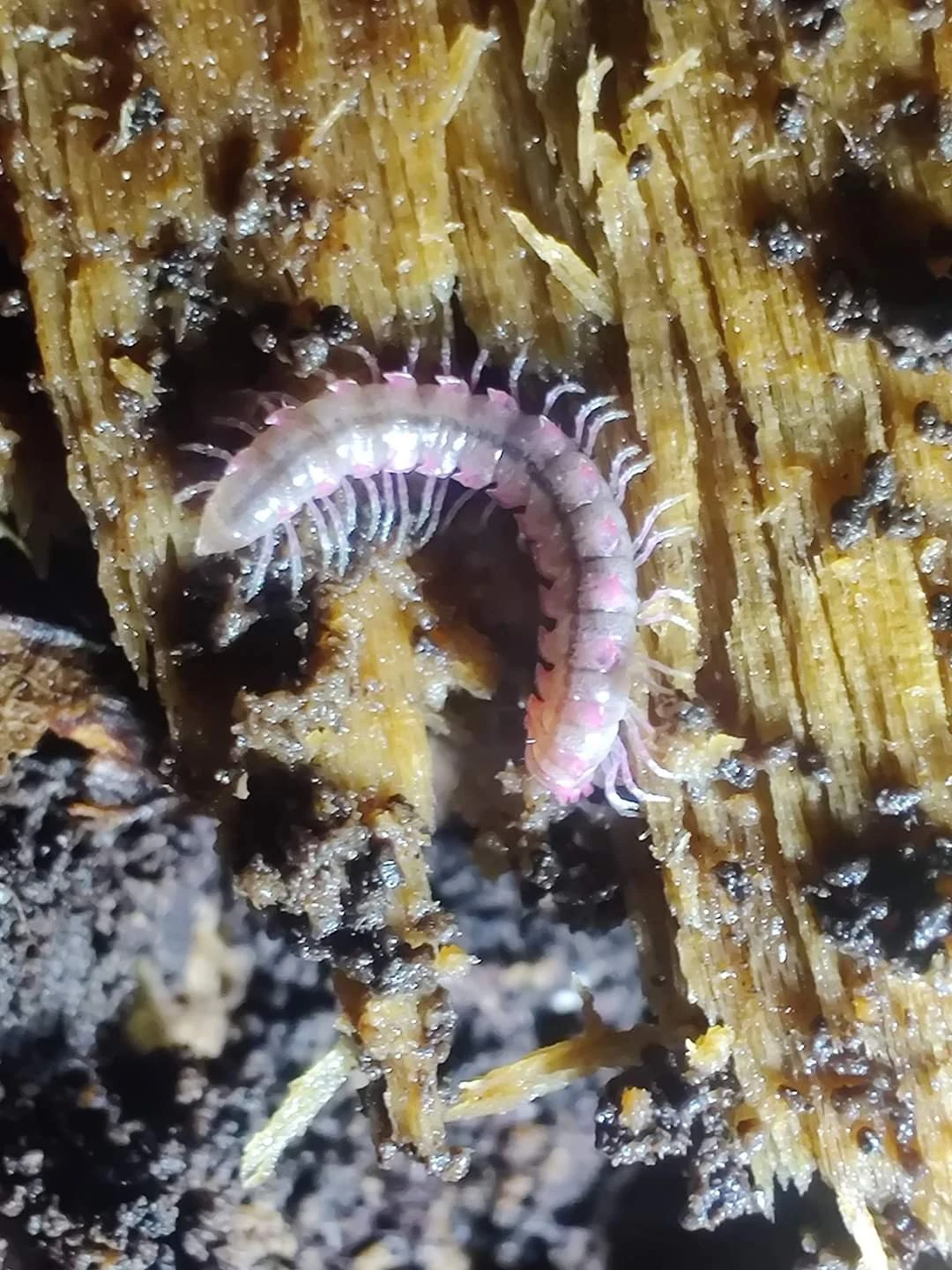


Desmoxytes planata
Leave feedback on the product

Select product variant:
Individual variants may differ in price
Ask about the product

Administratorem danych osobowych jest PHU Krystian Solga. Przetwarzamy je w celu przesłania odpowiedzi na zapytanie. Więcej informacji dotyczących przetwarzania danych osobowych znajduje się w polityce prywatności.
Share the product card



Shipping cost for the selected product
The shipping cost applies to this product (in the selected variant - if applicable). It may change after adding other products to the cart.
Description
Desmoxytes planata - Striking Pink Dragon Millipede
Desmoxytes planata, known as the Pink Dragon Millipede, is one of the most spectacular millipedes available in our terrarium store. It features striking lateral projections resembling dragon wings and an intense contrast between pastel pink and the deep black of its dorsal segments. Unlike many reclusive species, this energetic arthropod readily climbs decorations and remains active on the surface of the enclosure day and night.
- Spectacular exoskeleton sculpture: Paranota projections give the body a fierce, dragon-like silhouette that catches the eye in any terrarium.
- Outstanding display activity: These millipedes love exploring branches, bark flats, and background walls rather than spending their entire lives buried in the substrate.
- Ideal format for nano-vivariums: Compact dimensions of 20-35 mm make them perfect inhabitants for small nano-cube enclosures.
- Self-sustaining mini-colony: Highly gregarious species that regularly completes its reproductive cycle when provided with properly prepared substrate.
| Feature | Description |
|---|---|
| Scientific name | Desmoxytes planata (Pocock, 1895) |
| Common name | Pink Dragon Millipede |
| Origin | Pantropical species (originally Andaman Islands, introduced across Southeast Asia) |
| Target size | Length 20-35 mm (adult females up to 38 mm), width 2.0-3.2 mm |
| Lifespan | 1-2 years (fast generational turnover in a self-sustaining colony) |
| Breeding temperature | 22-26°C (72-79°F) during the day, 20-22°C (68-72°F) at night (gentle side heating only) |
| Humidity | 75-85% (substrate consistently moist but never waterlogged) |
| Minimum enclosure size | 20x20x10 cm for a group of 10, 30x30x15 cm for an expanding colony |
| Dietary staple | Substrate rich in hardwood white-rot wood, decayed oak or beech leaves, and a constant calcium source (CaCO3) |
| Care level | Easy to moderate (proper biological substrate composition is key) |
Variant Selection and First Steps with Your Desmoxytes planata Colony
At Ants Invasion, we offer Desmoxytes planata in carefully selected starter packs of 10 individuals, with larger packs recommended for larger bioactive setups. These millipedes are highly social animals - purchasing a balanced group ensures both sexes are present, promotes pheromonal stimulation, and leads to rapid breeding. Although individual adults live for 1-2 years, in suitable substrate the colony becomes fully self-sustaining, providing an unbroken succession of generations.
Upon receiving your shipment, allow the animals 24 hours of quiet acclimatization at room temperature: 20-22°C (68-72°F) without aggressive heat mat warming. Introduce the millipedes gently into a pre-established, mature enclosure with a deep layer of moist forest substrate. Allow them to move off the transport bark pieces on their own into the moist leaf litter, where they will immediately begin feeding on beneficial fungal mycelium and microflora.
Enclosure and Substrate Setup for Desmoxytes planata
For a group of 10 specimens, an enclosure or container measuring 20x20x10 cm with fine mesh ventilation is optimal. The substrate layer, 5-6 cm deep, must consist of 50% soft oak or beech white-rot wood, 35% decomposed leaves, 10% humus, and 5% calcium. A heat mat must only be mounted on a side wall.
Substrate in millipede keeping is not mere bedding, it makes up more than 90% of their daily diet. Remember that pure peat or coco coir is completely sterile and devoid of nutrition for them. An ideal foundation is our dedicated millipede substrate mixed generously with natural white-rot wood from deciduous trees. Cover the surface with whole oak and beech leaves, mold-resistant cork bark pieces, and a clump of absorbent Sphagnum moss. The millipedes love climbing on the bark, while the deep, moist bottom layer enables them to construct safe molting chambers.
Diet and Nutrition for the Pink Dragon Millipede
The primary food of the millipede is white-rot wood and the bacterial and fungal microflora that thrives within moist forest substrate. Millipedes cannot digest fresh wood without fungal breakdown. Calcium in the form of cuttlebone must always be available. Supplement the diet once a week with a slice of zucchini, squash, or mushroom.
Biochemical studies show that millipedes in the Paradoxosomatidae family feed primarily on fungal hyphae and bacterial biomass growing on moist oak wood. Because their mineral-rich exoskeleton requires substantial mineral salts, a constant source such as powdered cuttlebone or feed lime is essential to provide bioavailable calcium carbonate. Once a week, you can offer a slice of blanched carrot, zucchini, pumpkin, or a small piece of banana. Always remove uneaten vegetable and fruit scraps with tweezers after 24 hours to prevent mold outbreaks and fruit fly infestations.
Common Care Mistakes and How to Avoid Them
- Sifting and digging through the substrate: Millipedes shed their exoskeleton inside delicate underground chambers constructed from fecal pellets and silky secretions. Sifting or pressing the substrate crushes these fragile chambers and kills molting individuals. Never dig through an established enclosure.
- Using sterile peat or coco coir: Pure peat and coconut coir contain zero nutritional value for millipedes. Kept on such bedding, millipedes starve even if offered fresh vegetables. Always use a substrate rich in soft white-rot wood and fermented deciduous leaf litter.
- Bottom heating: When a terrarium becomes overly warm or dry, millipedes instinctively burrow down into the substrate. A heat mat attached to the bottom creates a lethal thermal trap. Heat the enclosure only through a side wall regulated by a thermostat.
- Discarding substrate after the natural death of adults: Adult generations often reach the end of their natural lifespan around the same time. Seeing dead adults, many beginners panic and throw away the substrate. In reality, the substrate contains dozens of eggs and microscopic larvae. Maintain moisture over the following months and you will be rewarded with hundreds of offspring.
Click to expand: Taxonomic framework, defensive biology, and species revision
The species Desmoxytes planata was scientifically described in 1895 by the renowned British zoologist Reginald Innes Pocock under the original name Pratinus planatus. In historical literature, it also appeared under junior synonyms such as Desmoxytes coniger and Euphyodesmus vector. A landmark taxonomic revision conducted in 2018 by Dr. R. Srisonchai and colleagues in the journal ZooKeys confirmed that D. planata is the type species for the genus Desmoxytes sensu stricto.
In the pet trade, this species is frequently confused with the rare endemic Desmoxytes purpurosea, described in 2007 as the Shocking Pink Dragon Millipede. The true D. purpurosea occurs exclusively on limestone rock outcrops in Thailand and features an entirely bright fuchsia-pink coloration. The captive-bred Desmoxytes planata offered in specialist breeding features a dark brown to black dorsal surface, which contrasts dramatically with its coral-pink lateral projections (paranota) and legs.
Along the sides of their bodies, these millipedes possess microscopic defensive pores known as ozopores. Under heavy mechanical stress, gland compression activates the enzyme hydroxynitrile lyase (HNL), breaking down chemical precursors to release a subtle scent of bitter almonds and marzipan. In nature, this serves to deter invertebrate predators, but given the miniature size of the animal, it is entirely harmless to humans under home terrarium conditions.
Frequently Asked Questions (FAQ)
Click to expand: Is the Pink Dragon Millipede venomous, does it bite, or does it pose any danger to household members?
Desmoxytes planata is a completely harmless herbivore and detritivore. It lacks venom apparatus, does not bite, and poses no risk whatsoever to people or household pets. When severely stressed, it may release a microscopic droplet of aromatic liquid with a characteristic sweet scent of almonds and marzipan, which deters ants in the wild. Standard hand washing with warm water and soap after enclosure maintenance is all that is recommended.
Click to expand: How can I prevent harmful mold from developing in the moist substrate?
A warm and humid environment encourages fungal spores, which in excess can coat the antennae and walking legs of millipedes. The most effective, fully biological solution is adding white springtails. They feed on mold and decaying organic debris without posing any risk to millipede eggs or adults.
Click to expand: Can I house Pink Dragon Millipedes together with isopods in the same terrarium?
Cohabitation is possible, but requires careful species selection. We strongly advise against cohousing millipedes with large, aggressive, highly protein-hungry isopods from the genus Porcellio (such as Porcellio laevis or Porcellio scaber), which may attack a soft molting millipede if protein is scarce. If you plan a multi-species terrarium, choose smaller, gentle woodland isopods or stick strictly to cohabitation with springtails.
Ready to admire miniature dragons actively climbing the decorations in your terrarium? Select your starter pack, add Desmoxytes planata to your cart, and enjoy the mesmerizing sight of coral pink alongside the fascinating life of a self-sustaining colony!
Shipping and Live Arrival Guarantee
Every animal is professionally packaged for transit, and during colder weather, we include a HeatPack warming pad in the parcel. We guarantee live arrival. Live animal orders are dispatched from Monday to Thursday to ensure safe arrival before the weekend.
Reviews
If you've added a review and it doesn't appear on the list, it may be pending moderation.
Leave feedback on the product
 Log in with Google
