

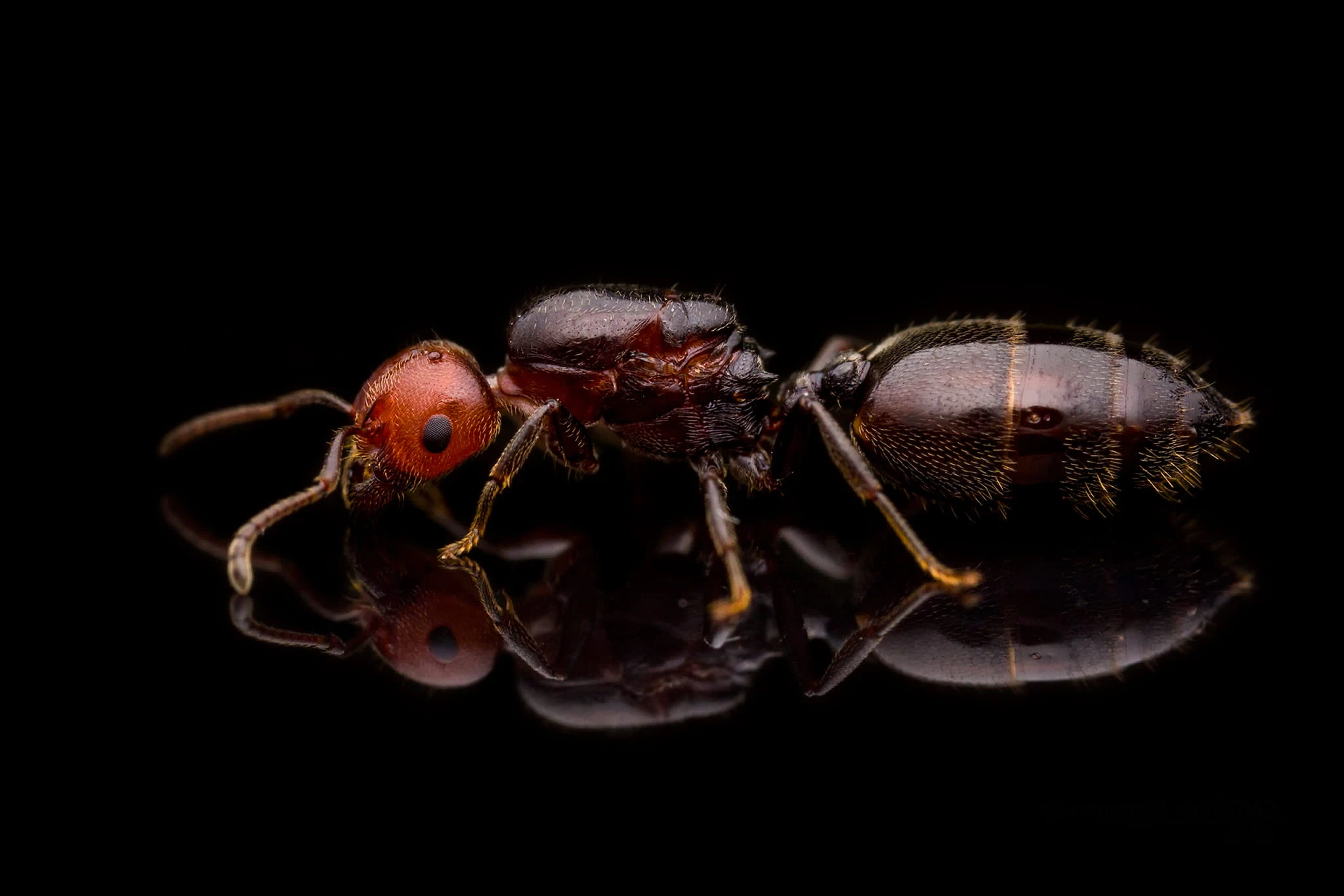


Crematogaster scutellaris
Leave feedback on the product

Wybierz wariant produktu:
Individual variants may differ in price
Ask about the product

Administratorem danych osobowych jest PHU Krystian Solga. Przetwarzamy je w celu przesłania odpowiedzi na zapytanie. Więcej informacji dotyczących przetwarzania danych osobowych znajduje się w polityce prywatności.
Share the product card



Shipping cost for the selected product
The shipping cost applies to this product (in the selected variant - if applicable). It may change after adding other products to the cart.
Description
Crematogaster scutellaris - Mediterranean acrobat ants with scarlet heads
Crematogaster scutellaris, widely known as the red-headed acrobat ant, is undoubtedly one of the most spectacular, dynamic, and captivating species inhabiting the Mediterranean basin. The striking contrast between its bright cherry-red head and its shiny, jet-black thorax and heart-shaped gaster immediately captures the attention of any terrarium enthusiast. In nature, this vibrant coloration serves as a classic aposematic signal, warning potential competitors of the sophisticated and lethally effective biochemical arsenal harbored within this arboreal warrior.
Observing a colony in a domestic setting is a true spectacle of biomechanics and advanced social behaviors. In moments of excitement or territorial defense, workers instantly flex their heart-shaped gaster vertically upward and raise it over their heads, adopting a combat posture reminiscent of a miniature scorpion. Remarkable agility, rapid recruitment along scent trails, exquisite carton nest building skills, and formidable hunting dynamics have earned this species legendary status in modern antkeeping.
| Feature | Description |
|---|---|
| Scientific name | Crematogaster scutellaris |
| Common name | Red-headed acrobat ant, Valentine ant |
| Breeding difficulty | Low to moderate (highly hardy species, excellent for motivated beginners) |
| Queen size | 7.0 - 11.0 mm (typically 8.0 - 9.0 mm) |
| Worker size | 3.0 - 5.0 mm (monomorphic caste with extreme agility) |
| Coloration | Bright red to cherry-red head, deep black thorax and heart-shaped gaster |
| Distribution | Southern Europe, Mediterranean basin, North Africa |
| Natural nesting habitat | Arboreal (dead wood, bark of cork oaks and pines, oak galls, carton structures) |
| Recommended formicarium | 3D printed nests with guaranteed escape-proof fit, cork nests, and wooden nests |
| Nest temperature | 22 - 28°C (72 - 82°F) (distinct thermal gradient recommended) |
| Outworld temperature | 22 - 30°C (72 - 86°F) (elevated temperature stimulates foraging activity) |
| Nest humidity | 50 - 70% (spacious dry area required with strictly localized point-hydration) |
| Outworld humidity | 30 - 50% (completely dry environment with separate clean water drinker) |
| Hibernation / Diapause | Yes, 2 - 4 months at 10 - 15°C (50 - 59°F) (refrigerators at 4°C / 39°F strictly prohibited) |
| Diet | Sugars (e.g. sugar or honey water), protein via feeder insects, fresh fruit for mature colonies |
| Development cycle | Approximately 30 days from egg to adult worker at 26°C (79°F) |
| Escape prevention | Dry talc barrier evenly applied along upper outworld rims |
Biochemical superiority: Dufour's gland and acrobat biomechanics
The evolutionary dominance of Crematogaster scutellaris relies on ingenious anatomy and unique chemical weaponry. The petiole attaches to the first gastral segment on its dorsal surface rather than its anterior face. This biomechanical configuration provides unmatched flexibility, enabling the ant to instantly curve its entire gaster upward and forward over its head. The worker's stinger has undergone evolutionary reduction into a flattened spatulate pad. It is not used to mechanically pierce chitinous armor, but functions as a precision brush for topically applying contact venom.
The defensive system of this species is an advanced natural chemical synthesis plant. The massively enlarged Dufour's gland stores stable hydrocarbon precursors that, during an attack, instantly mix with enzymes released from the poison gland. This reaction, occurring directly outside the ant's body, rapidly synthesizes highly electrophilic, acutely toxic aldehydes. A microscopic droplet applied to the antennae or mouthparts of a rival triggers instant nervous paralysis, convulsions, and death. In nature, Crematogaster scutellaris is a highly dominant competitor that aggressively takes over protein sources, showing fierce hostility against species such as Myrmica rubra or soldiers of Pheidole pallidula. Furthermore, this secretion exhibits potent antibacterial and antifungal properties (inhibiting pathogens like Beauveria bassiana), effectively sanitizing the humid interior of wooden nests.
Arboreal craftsmanship: carton nests and fungal reinforcement
In Mediterranean woodlands, the red-headed acrobat ant primarily nests in dead branches, deep crevices of cork oak and pine bark, and abandoned oak galls left by cynipid wasps. When available space becomes insufficient for an expanding super-colony, workers exhibit remarkable architectural abilities, constructing elaborate carton nests.
Workers chew wood fibers, mixing them with saliva and mineral particles to build durable chamber walls resembling the papery architecture of hornet nests. Remarkably, symbiotic fungal mycelia frequently weave throughout the carton structure, acting as natural composite rebar that drastically bolsters mechanical resistance against wind and heavy rain. Mature colonies can reach populations of 10,000 to over 30,000 workers and frequently operate under polydomy, establishing networks of interconnected satellite nests across neighboring trees.
Formicarium management: arid microclimate and proper ventilation
When housing this species in artificial setups, one must faithfully recreate its dry arboreal biotope. Because these ants naturally thrive in airy, sun-warmed, dry wood, their formicarium must never be constantly soaked. Excessive moisture is the primary pitfall encountered by keepers.
The nest must feature an extensive, completely dry zone with strictly localized hydration confined to a single chamber. Visible condensation on glass panels is an immediate alarm indicating over-watering. For housing, 3D printed nests with guaranteed escape-proof tolerances excel, alongside natural cork nests (where workers can chew out and expand galleries) and sturdy wooden nests (which they generally cannot chew through). Proper outworld ventilation is paramount. Smaller colonies (up to approximately 1,000 workers) do exceptionally well in standard 10x10 cm outworlds with basic ventilation. However, once colonies reach massive sizes, stressed workers release volatile alarm pheromones and aldehyde vapors. For large colonies, high-flow mesh lids or completely open outworlds secured by a talc barrier are strongly recommended to prevent toxic gas buildup. A clean layer of dry talcum powder remains the gold standard for containment.
Open systems and free-range keeping: potted plants and bonsai trees
Their strictly arboreal instincts and strong territorial loyalty make Crematogaster scutellaris a premier candidate for innovative free-range setups on living potted plants, citrus trees, or cultivated bonsai. Scent trails traveling up the trunk and carton nests constructed within the branches create a breathtaking living display.
Maintaining an open system requires strict security guidelines:
- Moat barrier system: Position the potted plant on a dry central pedestal inside a broad, water-filled tray. Add a few drops of dish soap to break water surface tension, ensuring ants cannot walk across the surface.
- Root ball moisture management: Keep the potting soil moderately and consistently moist (using drip or wick irrigation). If soil dries out, ants will burrow into root structures, damaging root hairs and creating hydrophobic soil channels that wither the plant. Maintaining moist soil compels these dry-loving ants to occupy artificial arboreal nests mounted in the canopy.
- Aphid mutualism: In open setups, ants instinctively protect and herd aphids or scale insects for honeydew. To prevent pests from harming the tree, provide abundant sugar feeders in the canopy and manage excess aphids mechanically with a damp cloth or potassium soap solution.
- Natural scent barriers: Ground cinnamon or dry diatomaceous earth applied around window sills and table perimeters create effective sensory and physical boundaries.
Balanced nutrition and feeding dynamics
High metabolism and constant activity require steady supplies of energy and protein:
- Carbohydrates: The staple diet consists of sugars (e.g. sugar or honey water) provided regularly in micro-droplets or gravity drinkers.
- Proteins: Vital for the queen's egg production and rapid larval growth. Offer small colonies freshly pre-killed and crushed feeder insects (fruit flies, pinhead crickets, small roaches). Large colonies eagerly tackle live feeder insects, showcasing organized swarm attacks and topical venom delivery.
- Variety: Large, mature colonies also appreciate small offerings of sweet, fresh fruit slices.
Claustral founding: solitary queen in a test tube
A newly mated queen establishes her colony claustrally, remaining sealed in her chamber and raising her first brood entirely on internal fat reserves and wing muscle histolysis.
Crucial keeping rule: Never apply heating mats to a solitary founding queen. Excessive heat accelerates metabolic burnout, starving the queen before workers eclose. Maintain the test tube at a comfortable room temperature of 20 - 22°C (68 - 72°F) in complete darkness and undisturbed stillness. Stress triggers egg cannibalism. Complete egg-to-worker development takes approximately 30 days. Connect the test tube to a small outworld and begin feeding only after first workers emerge.
Safe winter diapause without chill shock
Although native to southern Europe, annual winter diapause is essential to preserve the queen's longevity, ovarian health, and future egg-laying vigor.
Diapause should last 2 to 4 months (typically November through February/March) at stable temperatures of 10 - 15°C (50 - 59°F). Never place Mediterranean colonies inside standard domestic refrigerators at 4°C (39°F), which causes lethal cold shock. Cool cellars, unheated pantries, or wine coolers are ideal. Clean drinking water must remain accessible throughout the entire dormant period.
Keeper responsibility and containment standards
In parts of southern Europe, this species can act as a structural pest by excavating galleries in foam insulation, polyurethane panels, or damp construction timbers.
In domestic antkeeping, absolute containment is guaranteed by high-precision formicaria and properly maintained talc barriers on outworld walls.
Common mistakes and how to avoid them
- Over-watering nest chambers: Induces mold outbreaks and larval mortality. Keep hydration minimal and localized.
- Poor outworld ventilation: In high densities, defensive volatile vapors can accumulate and harm the colony.
- Over-chilling below 10°C (50°F): Low temperatures are fatal to Mediterranean species.
- Heating solitary founding queens: Causes premature metabolic depletion and queen mortality.
- Neglecting talc barriers: Agile workers easily scale bare acrylic and glass.
Why choose Crematogaster scutellaris?
The red-headed acrobat ant represents the pinnacle of captivating antkeeping. Explosive colony growth, gorgeous coloration, and dramatic scorpion-like defensive postures deliver endless fascination. If you seek hyperactive arboreal predators with astounding biology, this species exceeds all expectations.
Our ant store supplies healthy, carefully selected queens with workers, alongside high-precision 3D printed nests and antkeeping accessories to ensure your colony thrives for years to come. Choose Crematogaster scutellaris and embark on a world-class myrmecological journey today!
Reviews
If you've added a review and it doesn't appear on the list, it may be pending moderation.
Leave feedback on the product
 Log in with Google
