

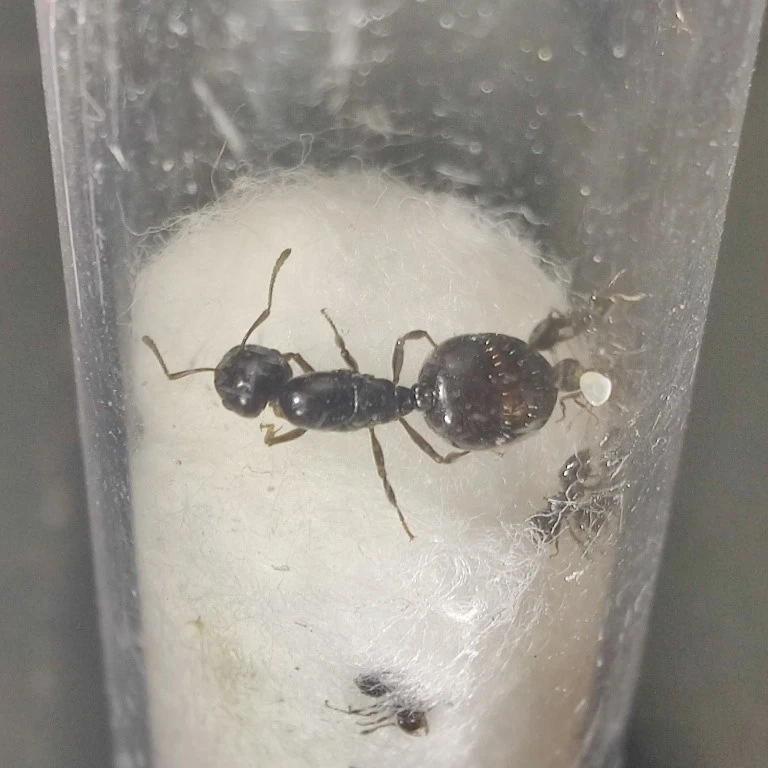


Crematogaster auberti
Leave feedback on the product

Select product variant:
Individual variants may differ in price
Ask about the product

Administratorem danych osobowych jest PHU Krystian Solga. Przetwarzamy je w celu przesłania odpowiedzi na zapytanie. Więcej informacji dotyczących przetwarzania danych osobowych znajduje się w polityce prywatności.
Share the product card



Shipping cost for the selected product
The shipping cost applies to this product (in the selected variant - if applicable). It may change after adding other products to the cart.
Description
Crematogaster auberti - Black acrobat ant defending itself like a scorpion
Crematogaster auberti is a fascinating acrobat ant species from Southern Europe that captivates keepers with its remarkable defense mechanism. When threatened, workers raise their heart-shaped gaster vertically over their heads like miniature scorpions, putting on a spectacular natural display. Unlike its arboreal relatives, this is a rock-dwelling species, making it exceptionally resilient and easy to keep in a home formicarium.
- Acrobatic defense posture: The distinctive upward curving of the heart-shaped gaster is one of the most spectacular defensive reactions in the insect world.
- Rock-dwelling biotope: Thrives in 3D printed nests, gypsum nests, and Ytong aerated concrete setups without needing wood or cork.
- Mild diapause: Requires only a few weeks of cool rest at 12-16°C (54-61°F), without complex wintering in a household refrigerator.
- Rapid feeding response: Quickly establishes organized pheromone trails and enthusiastically recruits nestmates to every drop of sweets.
| Scientific name | Crematogaster auberti (Emery, 1869) |
| Origin | Southern Europe (Spain, Italy, France) and North Africa |
| Queen size | 8.5-9.5 mm |
| Worker size | 3-4.5 mm (monomorphic) |
| Coloration | From dark chocolate brown to glossy jet black |
| Colony type | Monogyne (single queen in a mature nest) |
| Maximum colony size | From several hundred to 8,000-10,000 workers |
| Queen lifespan | Up to 15 years |
| Nest temperature | 22-26°C (72-79°F) (optimally 24-25°C (75-77°F) with a gradient) |
| Outworld temperature | 24-28°C (75-82°F) (warm foraging area) |
| Nest humidity | 50-65% (brood chambers with access to a dry zone) |
| Outworld humidity | 40-60% (dry substrate with a permanent drinker) |
| Dietary foundation | Carbohydrates (natural honey, syrups) + protein (small feeder insects) |
| Hibernation (diapause) | Yes, mild diapause for 6-8 weeks at 12-16°C (54-61°F) |
| Recommended formicaria | 3D printed nests, Ytong aerated concrete, gypsum nests |
| Care level | 2/5 (easy, recommended for beginners with basic knowledge) |
Choosing a variant and first steps with your new colony
When selecting a Crematogaster auberti colony, you can choose between a solitary queen or a package with her first workers. Starting with a queen alone offers the unmatched satisfaction of watching the first nanitics emerge. Meanwhile, a variant with several workers provides a stronger biological buffer, more stable growth rates, and immediate foraging activity in the outworld.
Step 1: Calm acclimatization - After receiving your parcel, place the test tube in a dark, quiet spot at 21-23°C (70-73°F) for 24 hours without disturbance. This allows the queen to settle after transport and secure her egg batches.
Step 2: First feeding - After 24 hours, offer a tiny drop of food on a miniature tray or use a dedicated test tube feeder. A drop of natural honey or colored syrup serves as an excellent energy source. If larvae are present in the test tube, provide a pre-killed, freshly cut fruit fly.
Step 3: Moving into a formicarium - The ants should remain in the test tube until the colony reaches at least 20-30 workers. Only at this density should you connect the test tube with tubing to a small outworld or move the ants into a compact 3D printed nest. Moving them too early into a spacious nest causes stress and can halt egg laying.
Which formicarium works best for Crematogaster auberti?
Modular 3D printed nests, gypsum nests, and Ytong aerated concrete setups work best for Crematogaster auberti. In nature, this species nests beneath sun-warmed stones, which means it does not require wood or cork. However, it does require a stable humidity gradient within the nest and a completely dry outworld.
When choosing a formicarium, select a design with a precise hydration system. Workers relocate delicate brood to chambers with 50-65% humidity, while pupae are happily kept in warmer, drier sections of the nest. The outworld should remain completely dry, ideally with a thin layer of sand, though sand is optional. An outworld drinker is essential unless you use alternative drinkers, such as our modular drinkers attached directly to the nest or outworld side. Because workers are agile climbers, coat the outworld rims with a dry layer of talc and secure it with a tight-fitting lid featuring fine mesh.
What to feed Crematogaster auberti and how to plan their diet?
The diet of Crematogaster auberti relies on constant access to easily digestible carbohydrates and regular supplies of animal protein. Adult workers draw energy from honey solutions and nectars, whereas developing larvae and the queen need amino acids from soft feeder insects provided 2-3 times per week.
The energetic core consists of drops of honey, sugar syrup, or specialized ant nectars. Due to the small size of the workers, liquids should be served in small droplets or on dedicated accessories, such as our heart-shaped ant feeder, which protects the ants from accidental drowning. Excellent protein options include flightless fruit flies, Turkish roach nymphs (red runners), small crickets, and small mealworm larvae.
How to properly manage winter diapause for acrobat ants?
As a southern species, Crematogaster auberti does not require deep hibernation at near-freezing temperatures. Instead, it undergoes a natural, mild resting diapause lasting 6 to 8 weeks at 12-16°C (54-61°F), usually taking place from December through late January.
Before lowering the temperature, gradually turn off heating and withhold protein food 10-14 days in advance so that larvae can empty their digestive tracts. Throughout this cool resting period, provide the colony with constant access to fresh water and offer a small drop of sugar solution once every 2-3 weeks. This controlled rest prevents reproductive exhaustion in the queen and stimulates vigorous egg production in early spring.
Common care mistakes and how to avoid them
- Premature move into a formicarium: Introducing a small group of just a few workers into a large nest leads to trash accumulation in unused chambers, queen stress, and colony decline. Keep the ants in their test tube until they reach at least 20-30 workers.
- No drinker in the outworld: Despite their resilience in dry climates, workers foraging under heating can dehydrate rapidly. Always provide a permanent drinker with clean water in the outworld.
- Offering large liquid droplets without a feeder tray: Small workers can easily drown in a single drop of honey. Administer liquid foods in tiny droplets or on dedicated feeders. Thanks to their thoughtful design, our ant feeders allow you to serve larger portions at once without endangering worker safety.
Defensive anatomy, stridulatory organ, and Paussus beetle mimicry
The remarkable defensive posture of Crematogaster auberti stems from its unique anatomy. While in most ants the petiole connects to the gaster axially, in the genus Crematogaster this junction is located on the dorsal surface. This structure allows workers to freely flip their heart-shaped gaster vertically upward and forward over the head. The sting in these ants has evolved into a spatulate paddle, which workers use to smear defensive secretions from Dufour's gland and venom gland with pinpoint accuracy. This sticky fluid repels and immobilizes competing insects while remaining completely harmless to human skin. Furthermore, these ants possess a stridulatory organ on their gaster used for vibrational communication. These acoustic signals are so distinctive that parasitic beetles of the genus Paussus (such as Paussus favieri) have evolved to acoustically mimic the vibrations of the queen, gaining unhindered entry into the nest.
Frequently Asked Questions (FAQ)
Is acrobat ant venom dangerous to humans?
No. The defensive secretions produced by Crematogaster auberti pose no threat to human health. The modified sting apparatus is flattened and cannot pierce human skin. The ants use this contact secretion exclusively against other arthropods, making routine outworld maintenance entirely safe.
Can Crematogaster auberti live in a cork or wooden nest?
While many species in this genus are arboreal, Crematogaster auberti is a saxicolous and soil-nesting species. It thrives significantly better in Ytong aerated concrete setups, gypsum nests, and modular 3D printed nests. Cork nests are possible but require very tight humidity regulation, as cork dries out quickly or risks molding under excess moisture.
How does Crematogaster auberti differ from Crematogaster scutellaris?
The primary differences lie in coloration and nesting biology. Crematogaster scutellaris features a striking red head contrasting with a black body and nests inside dead hardwood. In contrast, Crematogaster auberti is uniformly dark (ranging from rich brown to glossy jet black) and nests naturally in rock crevices and under stones, making it exceptionally well suited to standard mineral and synthetic formicaria.
Looking for a fascinating, active colony with extraordinary defensive behavior? Choose your preferred Crematogaster auberti variant from the dropdown above, select your essential accessories, and enjoy observing spectacular acrobat ants in your own home.
Shipping and live arrival guarantee
During cold weather, we insulate every parcel with a professional HeatPack warmer to maintain optimal travel temperatures.
Live ants are shipped exclusively Monday through Thursday to eliminate the risk of weekend delays in sorting facilities.
We take full responsibility for safe transit. We guarantee your ants will arrive alive and healthy.
Reviews
If you've added a review and it doesn't appear on the list, it may be pending moderation.
Leave feedback on the product
