

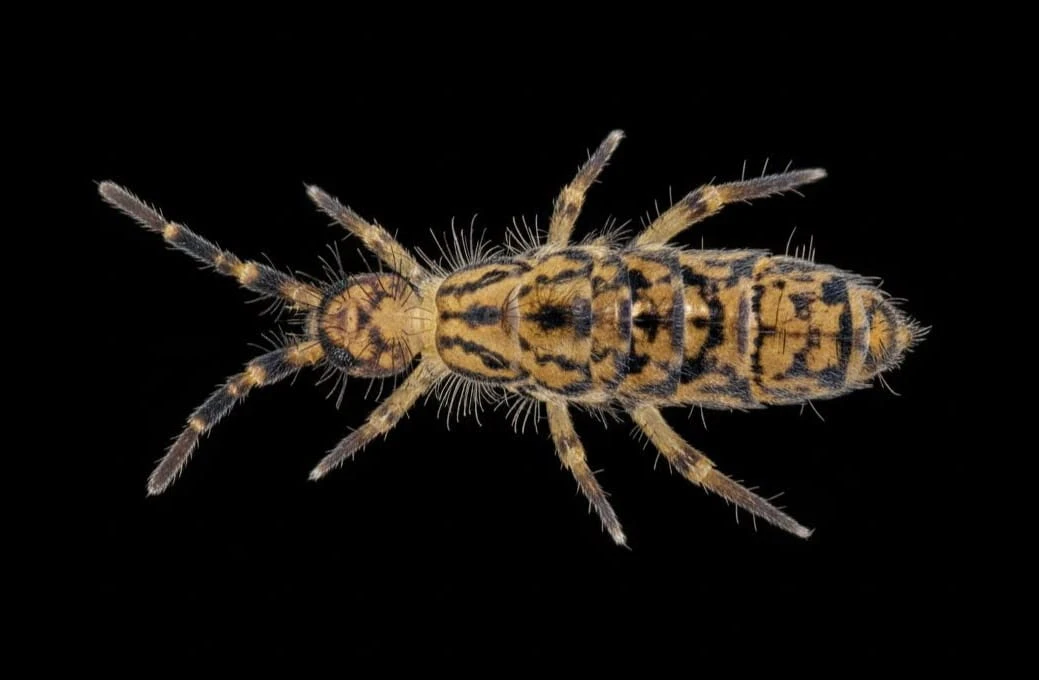


Orchesella villosa
Leave feedback on the product

Select product variant:
Individual variants may differ in price
Ask about the product

Administratorem danych osobowych jest PHU Krystian Solga. Przetwarzamy je w celu przesłania odpowiedzi na zapytanie. Więcej informacji dotyczących przetwarzania danych osobowych znajduje się w polityce prywatności.
Share the product card



Shipping cost for the selected product
The shipping cost applies to this product (in the selected variant - if applicable). It may change after adding other products to the cart.
Description
Orchesella villosa (Hairy Springtail) - The "Woolly Mammoth" of the Springtail World
In the fascinating microcosm of invertebrates, Orchesella villosa emerges as a true titan. Known as the "Woolly Mammoth" or "Hairy Springtail," this species immediately catches the eye with its impressive size (up to 10 mm with antennae) and unique, dense hairiness. Its Latin name villosa means "hairy," which perfectly describes its appearance.
Unlike typical, hidden clean-up crews, the Hairy Springtail is an excellent display species. Due to its size and tendency to stay on the surface, it adds dynamism and a natural look to the terrarium. It is an ideal choice for the keeper who values not only functionality but also aesthetics and the ability to observe microfauna.
Why is Orchesella villosa an Exceptional Choice?
- Impressive Size: One of the largest springtails in the hobby, reaching up to 10 mm in length including antennae. Perfectly visible to the naked eye.
- Display Species: Actively patrols the surface of the substrate, leaves, and bark, serving as a "living decoration" for the bioactive terrarium.
- Attractive Appearance: Dense "fur" and variable, spotted coloration in shades of purple and brown distinguish it from other springtails.
- Versatile Diet: As a detritivore, it feeds not only on mold but also on mycelium, algae, and decaying organic matter.
- Ideal for Synergy: Perfectly complements the action of smaller species (like Folsomia candida), creating a multi-level and more natural cleaning system.
Keeping in a Terrarium - A Complete Guide
Breeding Container and Ventilation
The key to success is providing adequate space and ventilation. The solution is a vertical container with a capacity of at least 300 ml and a height of at least 6 cm (excluding substrate). Holes, steel mesh, or even a paper tissue (e.g., a 3x2 cm rectangle) glued into an opening in the lid work perfectly for ventilation. Adding a piece of bark or a stick with lichens is advisable, as they like to perch high up.
Substrate and Humidity
Regarding the substrate, anything that holds moisture well will work (e.g., peat, coconut fiber). A thin layer of 1-2 cm is sufficient.
The substrate should be moist most of the time. However, this species is quite resistant to periodic drying out. It is worth noting that recommendations for creating a humidity gradient mainly apply to wild-caught individuals. Our population, bred for many generations, thrives perfectly without any gradient, which greatly simplifies keeping.
Temperature and Diet
- Temperature: A very tolerant species. It thrives perfectly at room temperature (15-32°C (59-90°F)).
- Diet: Omnivorous. The base can be yeast or other specialized foods. They multiply like crazy on our springtail food, but also readily eat other products like fish food or high-protein supplements.
Our Population - Guarantee of Resilience
Our population of Orchesella villosa has been captive-bred for many generations. To diversify the gene pool, single individuals from the wild have been added several times. As a result, the line is very stable and exceptionally resistant to husbandry errors, making it much easier to maintain than wild individuals.
Orchesella villosa vs. Folsomia candida (Standard White Springtails)
| Feature | Orchesella villosa (Woolly Mammoth) | Folsomia candida (White Standard) |
|---|---|---|
| Size | Large (up to 10 mm with antennae) | Small (1-4 mm) |
| Visibility | Very high (display species) | Very low (hidden in substrate) |
| Main Role | Aesthetics, observation, CUC supplement | Purely functionality (CUC) |
| Keeping Difficulty | Medium (Our population: Easy) | Very easy (tolerates "swamp") |
| Reproduction Rate | Moderate (sexual) | Explosive (parthenogenetic) |
Orchesella villosa is the ideal choice for the hobbyist who values aesthetics and natural behaviors. It is an excellent complement to standard clean-up crews, adding life and dynamism to the terrarium.
Reviews
If you've added a review and it doesn't appear on the list, it may be pending moderation.
Leave feedback on the product
 Log in with Google
