

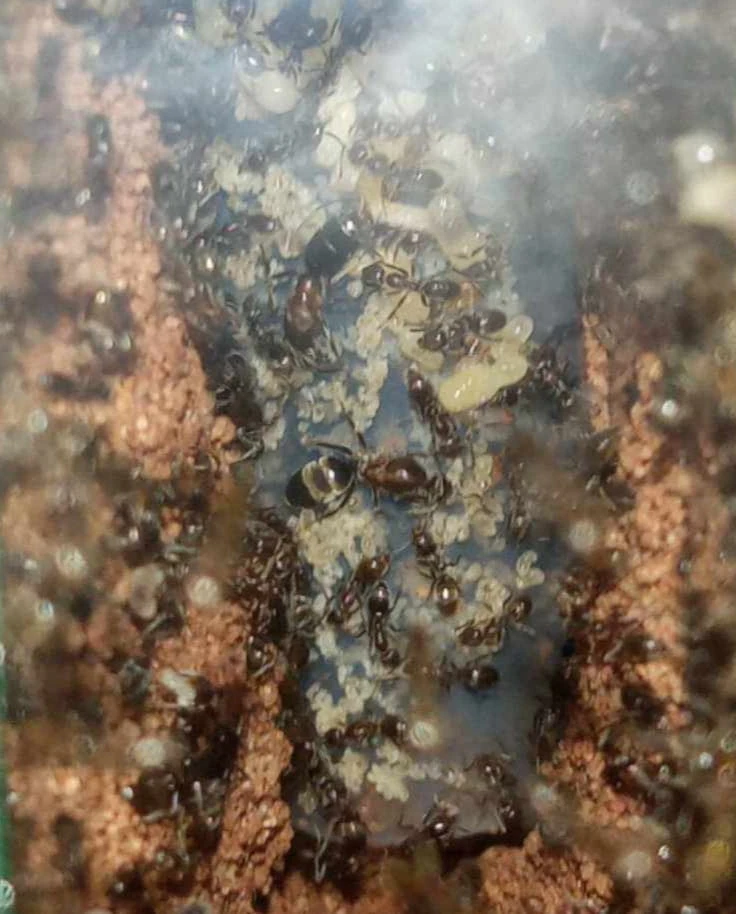


Linepithema humile
Leave feedback on the product

Select product variant:
Individual variants may differ in price
Ask about the product

The controller of your personal data is PHU Krystian Solga. We process them to respond to your inquiry. More information regarding personal data processing can be found in our privacy policy.
Share the product card



Shipping cost for the selected product
The shipping cost applies to this product (in the selected variant - if applicable). It may change after adding other products to the cart.
Description
Linepithema humile, commonly known as the Argentine ant, is one of the most invasive species in the world, ranking among the Global Invasive Species Database top 100 worst invaders. Originating from the subtropical regions of South America, primarily Brazil and Argentina, they have spread across the globe aided by human commerce and transport. These highly adaptable insects have successfully colonized virtually every region with a suitable Mediterranean or subtropical climate.
Argentine ants are extraordinary in their social organization, notable for forming massive supercolonies containing millions of queens and billions of non-aggressive workers cooperating seamlessly. The most famous European supercolony stretches over 6,000 kilometers (3,700 miles) along the coast of Southern Europe, spanning Portugal, Spain, France, and Italy.
Their exceptional efficiency in locating and securing food resources, coupled with relentless determination and mass coordination, grants them a decisive competitive advantage over native fauna in conquered habitats.
Their ability to rapidly mobilize massive numbers of workers is vital when competing with other dominant ants, such as Tapinoma magnum, resulting in intense and legendary territorial ant wars.
In terms of habitat, Linepithema humile is remarkably versatile, thriving in both urban and wild settings. In human settlements, they frequently nest near artificial structures utilizing discarded resources, while in nature they occupy warm spaces beneath stones and logs that provide ideal thermal conditions for brood rearing.
Their diet is equally adaptable, readily feeding on sugary liquids such as honey, nectar, and sugar water, as well as protein from diverse feeder insects. When capturing prey, they execute a distinctive "eagle spreading" maneuver, stretching and pinning the limbs of their target to swiftly immobilize and subdue it.
With their unparalleled adaptability and collective efficiency, Linepithema humile represents an extraordinary biological study in how species successfully conquer and thrive across diverse worldwide ecosystems.
Reviews
If you've added a review and it doesn't appear on the list, it may be pending moderation.
Leave feedback on the product
