

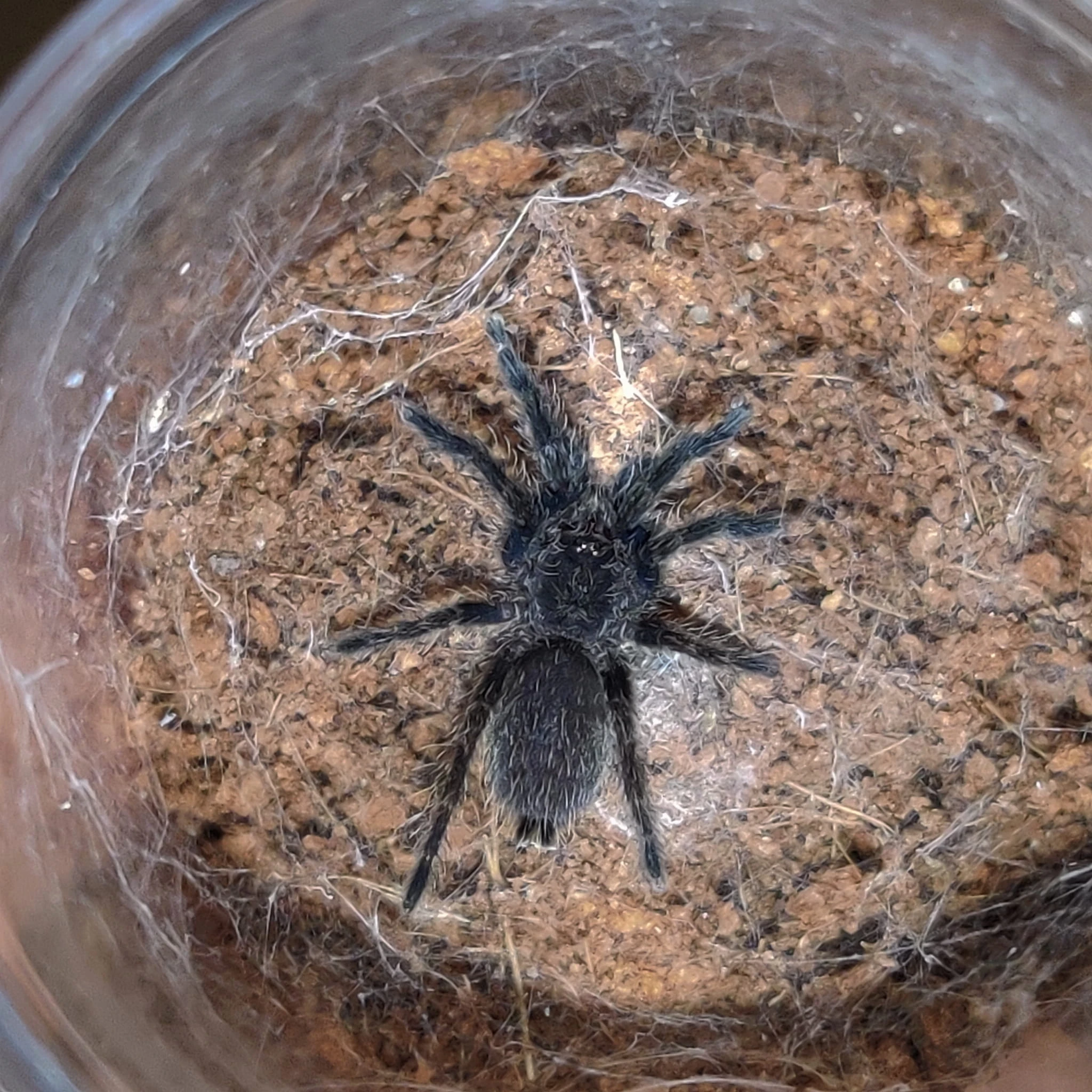


Ceratogyrus meridionalis
Leave feedback on the product

Select product variant:
Individual variants may differ in price
Ask about the product

Administratorem danych osobowych jest PHU Krystian Solga. Przetwarzamy je w celu przesłania odpowiedzi na zapytanie. Więcej informacji dotyczących przetwarzania danych osobowych znajduje się w polityce prywatności.
Share the product card



Shipping cost for the selected product
The shipping cost applies to this product (in the selected variant - if applicable). It may change after adding other products to the cart.
Description
Ceratogyrus meridionalis – The Hornless Ghost from the Horned Tarantula Family
In the world of terrarium keeping, where the most striking is often sought after, Ceratogyrus meridionalis is a choice for true connoisseurs. In a genus famous for possessing a characteristic horn on the carapace, this species is a fascinating exception – it lacks one. Its beauty lies not in bright colors, but in the subtle elegance of gray, black, and gold shades. This is not a spider you watch; it's a project you observe. Its secretive, subterranean nature turns the terrarium into a stage for a spectacle of instinctive engineering, and every rare moment the spider appears at the entrance of its burrow is a reward for patience and understanding of its wild nature.
Why is Ceratogyrus meridionalis a Connoisseur's Choice?
- Unique Appearance: This is the "hornless" representative of the horned tarantulas. Its coloration is a subdued but elegant mix of gray, black, and golden-mustard tones.
- Master of Underground Engineering: This is not a "pet hole," but an active architect. Observing it dig deep tunnels and line them with dense webbing is the main attraction of keeping it.
- Old World Temperament: As a representative of African baboon tarantulas, it is very fast and defensive. It poses a satisfying challenge for the experienced keeper.
- Fast Growth: Under appropriate conditions, this species grows very quickly, and observing its development from a small spiderling to a powerful adult is extremely rewarding.
- Exclusively for the Advanced: Owning this species is a testament to a deep understanding and respect for the nature of Old World tarantulas.
Temperament and Safety – Essential Knowledge
This must be emphasized strongly: Ceratogyrus meridionalis is a species intended exclusively for intermediate and advanced keepers. Its character is the quintessence of Old World tarantula traits.
- Venom: Potent, and bites are very painful. Effects may include intense pain, swelling, and severe muscle cramps.
- Speed and Defensiveness: This is an extremely fast spider. Its first reaction to a threat is to flee into its burrow, but when cornered, it will unhesitatingly assume a threat posture and attack. It can produce hissing sounds (stridulation) as a final warning.
- "No Touch" Rule: Handling this species is categorically discouraged. All activities within the terrarium must be performed using long, at least 30-centimeter tweezers, with utmost caution.
Keeping in a Terrarium – A Complete Guide
Terrarium – An Underground Kingdom
For this species, the depth of the container is far more important than its surface area. For an adult specimen, an enclosure of 10-20 liters is sufficient. The most important element is the substrate depth. A layer of a coconut fiber and peat mix at an absolute minimum of 20-25 cm thick must be provided. This allows the spider to dig a deep burrow, which is fundamental to its sense of security and reduces defensive behaviors.
Temperature and Humidity – The Gradient Technique
- Temperature: The optimal range is 22-28°C (72-82°F). Standard room temperature will be sufficient in most cases.
- Humidity: Should be 50-70%. Instead of misting the entire terrarium, one corner of the substrate should be kept moist, e.g., by regularly and generously overflowing the water dish. This creates a "humidity gradient," allowing the spider to self-regulate.
Feeding
This is a voracious species with a strong hunting instinct. Juveniles are fed 2 times a week, adults once a week. The diet should consist of appropriately sized feeder insects (crickets, cockroaches). To encourage the spider to show itself more often, a moderate feeding schedule can be used, which will entice it to wait at the entrance of its burrow.
Ceratogyrus meridionalis at a Glance
| Scientific Name | Ceratogyrus meridionalis |
| Origin | Malawi, Mozambique |
| Lifestyle | Fossorial (Burrowing) |
| Venom Strength | Potent, medically significant |
| Temperament | Defensive, very fast |
| Urticating Hairs | Absent |
| Lifespan | Females 10-15 years, males 2-4 years |
| Target Size | up to 15 cm leg span |
| Difficulty Level | Intermediate / Advanced |
Ceratogyrus meridionalis is a unique species for the conscious keeper, who, in return for respect and proper conditions, will be rewarded with years of fascinating observation.
Reviews
If you've added a review and it doesn't appear on the list, it may be pending moderation.
Leave feedback on the product
