

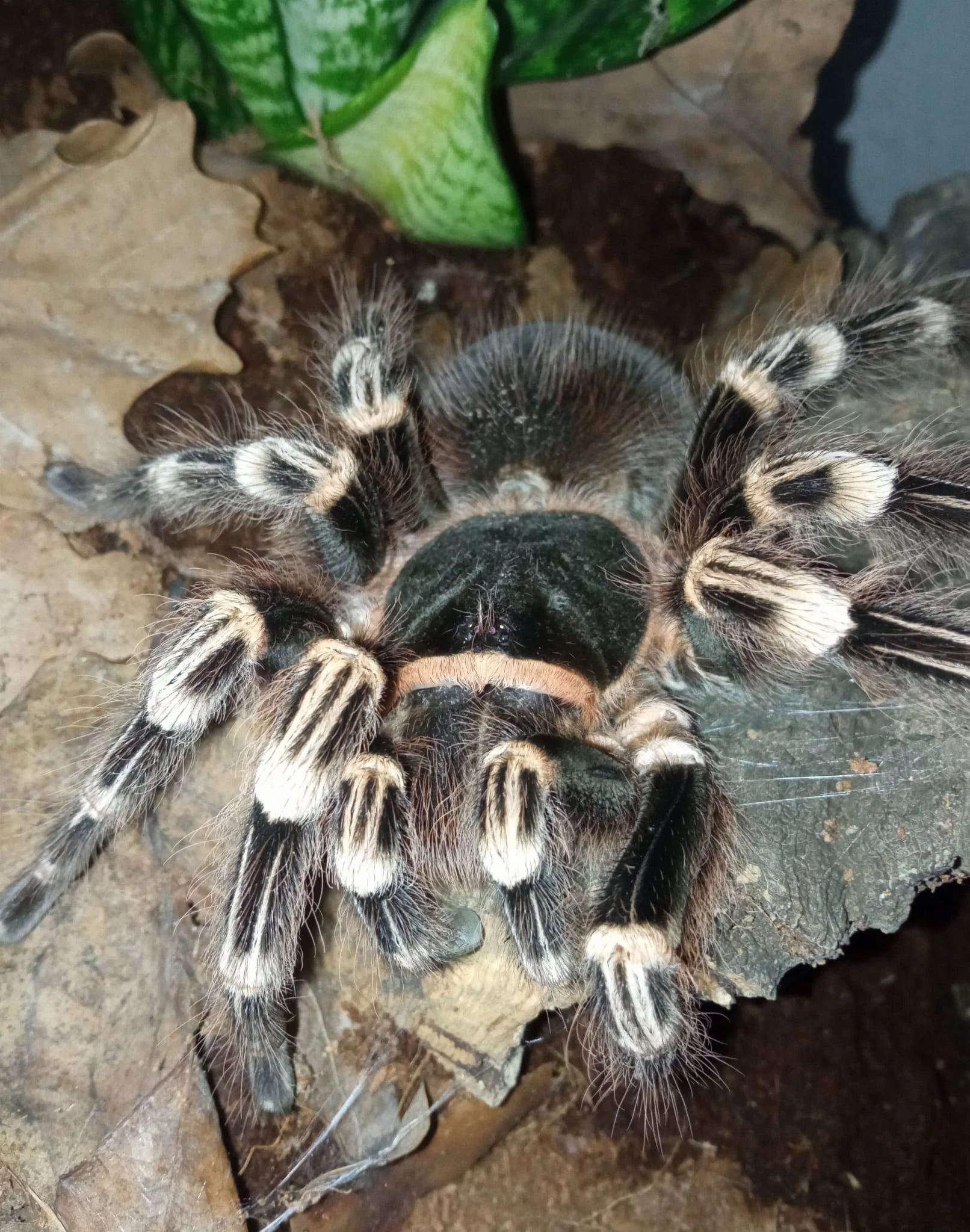


Acanthoscurria geniculata
Leave feedback on the product

Select product variant:
Individual variants may differ in price
Ask about the product

Administratorem danych osobowych jest PHU Krystian Solga. Przetwarzamy je w celu przesłania odpowiedzi na zapytanie. Więcej informacji dotyczących przetwarzania danych osobowych znajduje się w polityce prywatności.
Share the product card



Shipping cost for the selected product
The shipping cost applies to this product (in the selected variant - if applicable). It may change after adding other products to the cart.
Description
Acanthoscurria geniculata - Spectacular giant whiteknee tarantula with a legendary appetite
Acanthoscurria geniculata is a true icon of the global tarantula hobby and one of the most sought-after terrestrial species from the Amazon basin. It captivates with deep, velvety black coloration contrasted by crisp snow-white leg banding and dense, reddish setae on the abdomen. An ideal choice for any keeper looking for a massive, bold tarantula with rapid growth rates and a spectacular feeding response.
- Impressive adult size: Mature females reach an imposing diagonal leg span of 18-22 cm with a body length of up to 10 cm, commanding immediate attention with their heavy build.
- Superb display animal: Unlike many reclusive burrowing species, this tarantula spends plenty of time out in the open, actively patrolling its enclosure.
- Explosive feeding response: A legendary, lightning-fast strike triggered by prey vibrations turns every feeding into a thrilling demonstration of predatory instinct.
- Fast growth and early coloration: Spiderlings grow rapidly and develop their trademark black-and-white contrast within their first few molts.
| Scientific name | Acanthoscurria geniculata (C. L. Koch, 1841) |
| Common names | Giant whiteknee tarantula, Brazilian whiteknee tarantula |
| Origin and biotope | Brazil (Amazon basin) - lowland tropical rainforests |
| Lifestyle | Terrestrial, opportunistic burrower creating spacious retreats |
| Adult size | 18-22 cm leg span (female body length 8-10 cm, males 6-7 cm) |
| Enclosure dimensions | Minimum 40x30x30 cm or 45x45x30 cm for an adult specimen |
| Optimal temperature | 24-28°C (75-82°F) during the day with a natural night drop to 20-22°C (68-72°F) |
| Substrate humidity | 70-80% with an asymmetric moisture gradient |
| Lifespan | Females up to 15-20 years, males approx. 3-4 years (6-12 months post-ultimate molt) |
| Defensive mechanisms | Urticating hairs Type I and Type III, threat display with stridulation |
| Venom potency | Mild, comparable to a wasp or bee sting (medically insignificant) |
| Difficulty level | Great choice for confident beginners and experienced keepers alike |
| Legal status | Not subject to CITES registration - 100% legal without official permits |
Choosing your stage and first steps with your new tarantula
Depending on the stage selected from the dropdown menu, you will receive a young spiderling, a juvenile, or an adult specimen. All tarantulas are shipped in secure, well-ventilated vials or professional transport tubs with moist substrate. To ensure a smooth, stress-free transition into its new home, follow this straightforward step-by-step setup:
Step 1: Gentle temperature acclimatization - After unboxing, keep the sealed shipping container for 24 hours at room temperature (20-22°C (68-72°F)) in a quiet, shaded spot. Avoid placing it directly over a heat mat, which could cause thermal shock and unnecessary stress.
Step 2: Choosing secure housing - Increase enclosure volume gradually as the tarantula molts and grows. Tiny spiderlings feel most secure in small containers of 30-50 ml (vials or portion cups). Juveniles graduate to intermediate tubs, while a fully grown adult requires a permanent terrestrial terrarium measuring at least 40x30 cm or 45x45 cm with a substrate depth of at least 10-15 cm.
Step 3: First meal after travel - Offer food only after the spider has settled into its new enclosure for at least 24 hours. Always follow the rule of thumb that feeder insect length should measure 50% to a maximum of 100% of the tarantula's abdomen length. For tiny spiderlings, a single, active feeder nymph measuring 2-3 mm is ideal and poses zero risk to the baby.
What enclosure and substrate are best for Acanthoscurria geniculata?
For an adult female Acanthoscurria geniculata, a horizontal terrarium with a footprint of 40x30 cm or 45x45 cm and a height of up to 30 cm is ideal. A deep substrate layer of at least 10-15 cm is essential to cushion potential falls and allow natural burrowing, preventing fatal abdomen ruptures.
In the wild, this Amazonian predator excavates deep burrows reaching up to 100 cm into the forest floor to escape midday heat. An optimal substrate blend consists of peat, coconut coir, and a touch of clay or vermiculite to help burrow walls hold their shape. A curved piece of cork bark provides a natural hide beneath which the tarantula will readily dig its primary retreat.
The enclosure requires effective cross-ventilation and a stable, shallow water dish kept fresh at all times. Maintain relative humidity at 70-80% by moistening lower substrate layers in one corner while keeping top surfaces partly dry. In humid setups, introducing white springtails as a cleanup crew provides invaluable bio-sanitation, constantly breaking down microscopic organic debris and preventing mold growth.
What do giant whiteknee tarantulas eat and how to manage their diet?
The diet of Acanthoscurria geniculata consists of live feeder insects sized 50-100% of the spider's abdomen length. Feed young spiderlings 2-3 times per week with small roach nymphs, while juveniles and adults thrive on adult Dubia roaches or crickets once every 7-14 days.
Renowned for an insatiable appetite, this species rarely turns down a meal, meaning keepers must monitor body condition closely. Regularly compare the width of the abdomen to the cephalothorax (carapace). If the abdomen swells noticeably wider than the carapace and resembles a tight, rounded sphere, pause feeding for 2-3 weeks to prevent excess weight gain that can impede mobility and raise injury risks.
Suitable staple feeders for growing juveniles and adults include Turkish roaches, Dubia roaches, crickets, and adult locusts. Always offer prey using long terrarium tweezers measuring 25-30 cm. Remove uneaten prey remains promptly to keep the enclosure clean and deter unwanted mites.
Common care mistakes and how to avoid them
- Overly tall enclosure without deep substrate: A heavy terrestrial tarantula climbing glass walls can lose its footing. A fall from more than a few inches onto hard decor risks a fatal abdomen rupture. Always fill at least half the enclosure height with deep substrate.
- Feeding too soon after a molt: Freshly molted fangs are soft, pale, and easily broken. Hold off on feeding for 48 hours with young spiderlings, 3-7 days with juveniles, and 10-14 days with mature adults until chelicerae fully sclerotize and harden to pitch black.
- Under-tank heating with a heat mat: Tarantulas instinctively burrow deeper to escape heat. Heat coming from beneath disorients the spider and causes dangerous dehydration. If supplemental warmth is needed, mount the heating pad exclusively on a side wall.
- Bare-hand handling: While their venom is mild, an adult female boasts formidable fangs exceeding 1.5 cm that can deliver a painful mechanical puncture. Furthermore, startled individuals readily kick urticating hairs. Conduct all routine maintenance safely using long tweezers.
Taxonomic history, revisions, and synonymy
Acanthoscurria geniculata was first scientifically described in 1841 by German arachnologist Carl Ludwig Koch under the original name Mygale geniculata, based on a holotype collected in Brazil's Rio Branco region. Thirty years later, in 1871, Austrian naturalist Anton Ausserer revised the taxon and designated this species as the type species for the newly erected genus Acanthoscurria, which today encompasses dozens of South American taxa.
Modern taxonomy was thoroughly clarified in 2014 through a comprehensive revision of Amazonian species within the genus by Paula, Gabriel, Indicatti, Brescovit, and Lucas. The study confirmed that Acanthoscurria transamazonica, described by Piza in 1972, is morphologically identical to Acanthoscurria geniculata and stands as its junior synonym. It also unraveled a long-standing hobby conundrum regarding Acanthoscurria brocklehursti. Research established that this historical taxon is actually synonymous with Acanthoscurria theraphosoides, and spiders circulating under that name in the European hobby were predominantly color morphs or captive-bred lines of Acanthoscurria geniculata.
Architecture of Type I and Type III urticating hairs and stridulatory apparatus
As a New World theraphosid belonging to the subfamily Theraphosinae, Acanthoscurria geniculata has evolved an advanced passive defense mechanism in the form of urticating setae on the dorsal abdomen. Scanning electron microscopy (SEM) reveals two distinct, highly specialized hair types. The central abdominal patch is dominated by long Type III setae measuring 0.3-1.8 mm with penetrating barbs. These evolved primarily against vertebrate predators, causing intense itching, localized inflammation, and respiratory irritation in mammals.
Surrounding the central patch are shorter Type I setae measuring 0.2-0.6 mm. Their dense, hook-like barbs form an effective mechanical barrier against invertebrate intruders such as predatory ants and parasitic fly larvae. Female tarantulas weave thousands of these Type I setae into the silk matrix guarding their egg sac, creating an impenetrable insect deterrent. When cornered, the spider can also emit an audible warning hiss using its stridulatory apparatus by rubbing modified bristles between the trochanter and leg bases.
Additionally, Acanthoscurria tarantulas are subjects of significant biochemical research. Scientists have identified specialized protease inhibitors within their digestive system that protect delicate internal tissues, while gomesin - a potent antimicrobial peptide isolated from their hemolymph - continues to inspire pharmacological studies.
Frequently asked questions (FAQ)
Is Acanthoscurria geniculata venom dangerous to human health?
The venom of the giant whiteknee tarantula is considered mild and poses no significant threat to human health, barring extremely rare personal allergies to arthropod venom proteins. Physiologically, a bite is comparable to a bee or wasp sting, causing brief localized pain and mild swelling. The main concern lies in the physical bite from their formidable fangs, which can cause a painful mechanical puncture if handled recklessly. Using long tweezers measuring 25-30 cm ensures complete safety during all routine enclosure maintenance.
Does this species require CITES documentation or legal registration?
No. Acanthoscurria geniculata is not listed under CITES (Washington Convention) appendices nor restricted by European Union wildlife trade regulations. You are purchasing a 100% legal pet that requires no official paperwork, registry filings, or bureaucratic permits.
How do you identify an upcoming molt (pre-molt phase)?
An impending molt is signaled by food refusal lasting anywhere from 1-2 weeks in juveniles to 1-2 months in mature females. The tarantula becomes less active, seals off its burrow entrance with silk and substrate, and any kicked mirror patch on its abdomen (bald spot) turns progressively darker. Right before ecdysis, this area takes on a deep, glossy, inky-black sheen, indicating newly developed, melanin-rich setae beneath the old exoskeleton. Never leave feeder insects in the enclosure during this stage, and keep substrate humidity stable.
Is Acanthoscurria geniculata suitable as a first tarantula?
This species is an outstanding choice for confident beginners looking for a more engaging, fast-growing display tarantula than slow-moving species like Tliltocatl or Brachypelma. It exhibits robust environmental tolerance, exceptional feeding vigor, and bold visibility. It simply requires standard responsible husbandry: working with long tweezers, avoiding hands-on handling, and providing generous substrate depth.
Looking for a spectacular tarantula with stunning contrast that stays active and visible on display? Select your preferred stage from the dropdown menu above, set up your enclosure, and start an exciting journey with one of the most iconic predators of the Amazon.
Shipping and live arrival guarantee
During cold weather, packages are secured with professional HeatPack warmers to maintain a stable travel temperature.
Live animals are shipped exclusively Monday through Thursday to prevent parcels from idling in courier hubs over the weekend.
We take complete responsibility for safe transit, ensuring your animal arrives healthy and thriving.
Reviews
If you've added a review and it doesn't appear on the list, it may be pending moderation.
Leave feedback on the product
