

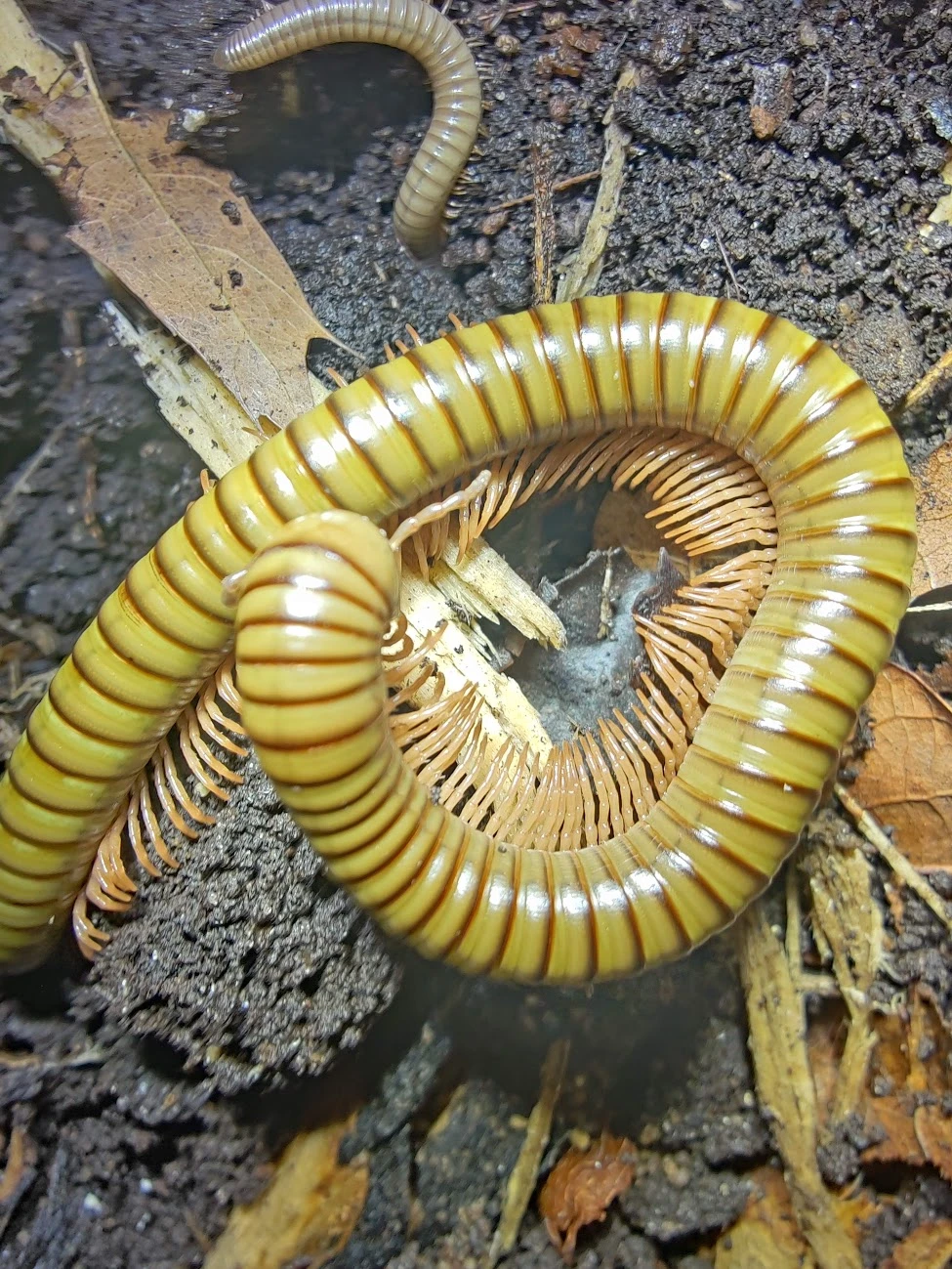


Spirostreptus gregorius
Leave feedback on the product

Wybierz wariant produktu:
Individual variants may differ in price
Ask about the product

Administratorem danych osobowych jest PHU Krystian Solga. Przetwarzamy je w celu przesłania odpowiedzi na zapytanie. Więcej informacji dotyczących przetwarzania danych osobowych znajduje się w polityce prywatności.
Share the product card



Shipping cost for the selected product
The shipping cost applies to this product (in the selected variant - if applicable). It may change after adding other products to the cart.
Description
Spirostreptus gregorius - Majestic African Olive Millipede
Imagine a slice of a humid African rainforest where an ancient organism reminiscent of a miniature armored living train glides through the shaded forest floor. Spirostreptus gregorius (syn. Analocostreptus gregorius), commonly known as the African olive millipede, is undoubtedly one of the most fascinating and rewarding species in exotic invertebrate keeping. Its glossy, cylindrical exoskeleton in deep woodland olive shades contrasts beautifully with rows of vibrant pinkish-orange walking legs moving in rhythmic waves across the enclosure floor. They are true recycling titans in nature, tirelessly breaking down dead organic matter into nutrient-rich soil humus. While these millipedes appear like sturdy armored tanks, they possess surprising climbing agility, eagerly exploring vertical branches and cork bark as semi-arboreal creatures.
Observing their peaceful daily rhythm is a genuine pleasure for any terrarium enthusiast seeking natural harmony. They are completely safe terrarium animals, ideally suited for hobbyists looking to establish a thriving tropical bio-active ecosystem. As detritivores, they play a crucial role in nutrient recycling, and their gentle nature and captivating biomechanics make them a true centerpiece in any vivarium. If you are looking to expand your collection with gentle, long-lived exotic invertebrates, this African millipede is an exceptional choice.
| Feature | Description |
|---|---|
| Common Name | African Olive Millipede |
| Scientific Name | Spirostreptus gregorius (syn. Analocostreptus gregorius) |
| Origin | Central and Western Africa (Angola, DR Congo) |
| Adult Size | 12-15 cm / 4.7-6.0 inches (approx. 67-69 diplosegments) |
| Activity | Crepuscular and nocturnal (negative phototaxis), semi-arboreal |
| Diet | Detritivore: white rotting hardwood, decaying oak/beech leaves, vegetables, fruits, calcium and animal protein |
| Temperature | 22-26°C (72-79°F), tolerated range 20-28°C (68-82°F) |
| Humidity | 60-75% (with a distinct moisture gradient) |
| Substrate Depth | Minimum 10-15 cm / 4-6 inches (vital for safe molting) |
| Lifespan | 5-7 years (sexual maturity reached in 2.5-3 years) |
| Care Level | Easy (great for beginners) |
Morphology, Biometrics and Defensive Behavior
Adult specimens of Spirostreptus gregorius reach a notable length of 12-15 cm with a remarkably slender, cylindrical body structure. Their exoskeleton consists of approximately 67 to 69 mineralized diplosegments, each bearing two pairs of walking legs. The body color is a glossy deep olive-green accented by darker rings at the segment joints, sharply contrasting with warm brown antennae and vibrant pinkish-orange legs. Sexual dimorphism is clearly visible in mature individuals – males feature modified legs on the 7th segment transformed into specialized reproductive gonopods, creating a noticeable thickened ring.
These millipedes employ a two-step passive defense strategy. When startled, they curl into a tight geometric spiral (conglobation), protecting their delicate head and ventral limbs under the thick dorsal armor. Under persistent distress, repugnatorial glands along their flanks secrete a pungent liquid to deter predators. This chemical defense is non-toxic to humans and contains no venom – washing hands thoroughly with soap after handling is all that is required.
Ecdysis Physiology and Anamorphic Growth
Growth in millipedes follows the fascinating biological principle of anamorphosis. Newly hatched juveniles possess only a few body rings and legs; with each successive molt (ecdysis), new diplosegments and leg pairs are added near the posterior end of the body. Molting is the most critical event in a millipede's life. Sensing an approaching molt, the animal stops feeding on the surface and burrows deep into the substrate to construct a smooth, reinforced molting chamber, where it may remain undisturbed for several weeks.
Inside the chamber, the millipede sheds its tight old cuticle. Immediately post-molt, its body is soft, pale, and entirely helpless, requiring several days for the new exoskeleton to harden and absorb calcium carbonate. Once mobile, the ravenous millipede consumes its discarded shed (exuviae) to rapidly reclaim valuable minerals. Never dig up the substrate when a millipede is underground! Disrupting a molting chamber exposes the soft body to mechanical crushing and fatal deformities.
Bioactive Substrate: The Core of Diet and Shelter
For millipedes of the genus Spirostreptus, the substrate represents over 80% of their total caloric intake. Providing barren coconut fiber or plain peat moss leads to starvation. A nutritious substrate mix must be built upon three essential components:
- Decaying White Rot Hardwood: The primary energy source. Oak, beech, or birch wood pre-digested by white-rot fungi becomes soft as a sponge and provides readily digestible cellulose and carbohydrates. Strictly avoid resinous softwoods (pine, fir) and toxic walnut wood (juglone).
- Crushed Hardwood Leaf Litter (Flake Soil): Oak and beech leaves form the bulk litter layer, supporting healthy gut and soil microbiomes.
- Constant Calcium Buffer: Millipedes require substantial calcium carbonate to build and reinforce their thick cuticle. Mix feed lime or crushed oyster shell into the substrate and keep natural cuttlebone accessible.
Digested substrate is excreted as uniform pellets (frass), which serve as rich organic plant fertilizer. When the substrate becomes predominantly frass after many months, refresh 30-50% of the volume with new white wood and leaf litter.
Dietary Supplementation and Protein Needs
In addition to nutritious soil, offer supplementary fresh foods. Slices of raw carrots, zucchini, cucumber, sweet potato, and apples are eagerly consumed. Always remove uneaten fresh fruit and vegetable remnants after 24-48 hours to prevent mold proliferation and fungus gnat outbreaks. Fresh tree lichens on cork bark are also a highly prized carbohydrate treat.
Regular animal protein is vital to prevent cannibalism during molts. When experiencing protein deficits during active growth phases, surface-active millipedes may attack and chew on vulnerable, freshly molted tankmates. Supply dried Gammarus shrimp, fish flakes, bee pollen, or beetle insect jelly once or twice weekly to satisfy their nutritional demands.
Vivarium Setup and Microclimate Management
A group of several individuals thrives in a glass terrarium or well-ventilated enclosure with a base of at least 30-40 x 20-30 cm. The height should be 30-50 cm to accommodate a deep 10-15 cm substrate layer alongside vertical climbing branches. Effective ventilation covered with ultra-fine mesh is necessary to prevent escapes and keep out phorid flies.
Maintain relative humidity between 60-75% with a distinct moisture gradient by heavily misting one side of the enclosure while keeping the opposite side slightly drier. Optimal temperatures range from 22-26°C (72-79°F). Never install heating mats underneath the bottom of the enclosure! Millipedes instinctively burrow downward to escape heat and find moisture; bottom heating traps and dehydrates them in their molting chambers. Always position heating elements on the side wall above substrate level.
Bioactivity, Cleanup Crew and Live Plants
In humid woodland environments, establishing a bioactive cleanup crew maintains ecological hygiene. Springtails (such as Folsomia candida) are the ideal partners, diligently consuming mold spores and food decay without posing any threat to molting millipedes.
Caution Regarding Isopods: Strictly avoid housing millipedes with aggressive, fast-breeding isopod species (such as Porcellio laevis or Porcellionides pruinosus). Protein-hungry isopods will burrow into molting chambers and consume soft, defenseless millipedes. Only dwarf, docile isopods (such as small Cubaris) may be safely cohoused. Live plants should feature sturdy, thick foliage (e.g., Sansevieria, Philodendron, Nephrolepis), and their roots should be protected.
Common Keeping Mistakes to Avoid
- Digging up the substrate: Disturbing underground molting chambers results in fatal exoskeleton damage. Absences lasting 3-5 weeks are completely normal molting cycles.
- Under-tank heating mats: Heating from below overheats and dehydrates burrowing millipedes.
- Shallow substrate: A layer under 10 cm prevents proper chamber formation and causes failed molts.
- Lack of protein and calcium: Fruit-only diets cause cuticle deformities and trigger cannibalism during ecdysis.
- Sterile coco peat substrate: Lack of rotting wood and leaf litter results in gradual nutritional starvation.
Spirostreptus gregorius is a stunning, long-lived resident for any woodland vivarium. With a deep bed of decaying hardwood, plentiful calcium, and undisturbed peace during molts, these peaceful giants will thrive for many years.
Reviews
If you've added a review and it doesn't appear on the list, it may be pending moderation.
Leave feedback on the product
 Log in with Google
