

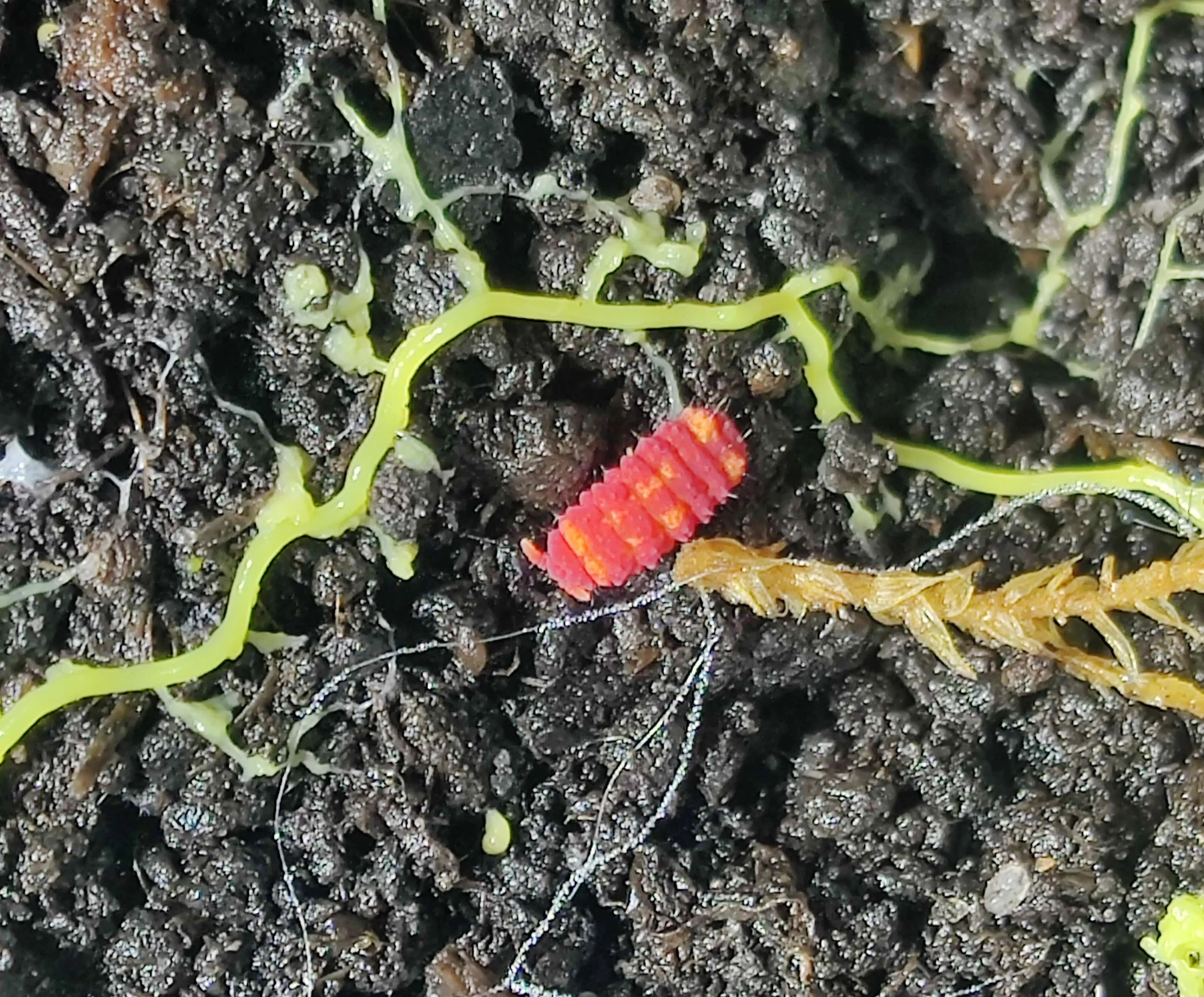


Neanuridae sp. "Jollibee"
Leave feedback on the product

Select product variant:
Individual variants may differ in price
Ask about the product

The controller of your personal data is PHU Krystian Solga. We process them to respond to your inquiry. More information regarding personal data processing can be found in our privacy policy.
Share the product card



Shipping cost for the selected product
The shipping cost applies to this product (in the selected variant - if applicable). It may change after adding other products to the cart.
Description
Jollibee Springtails (Philippine Neanuridae)
Jollibee springtails are a true gem in the world of terrarium keeping. Originating from the humid rainforests of the Philippines, these beautiful creatures have wonderfully enriched the market, introducing a category of luxury display microfauna. Unlike common species that function as an invisible cleanup crew, these Philippine beauties are full-fledged and incredibly coveted display animals. They impress with both their massive size and their stunning coloration.
These animals have undergone a fascinating evolution, as a result of which they have completely lost their jumping organ. This means that upon opening the container, they will never jump out, but will move majestically and slowly across the substrate. Their body surface is covered with distinct, fleshy tubercles. Jollibee springtails are gorgeously colored. The dominant color is a deep red broken by a beautiful, subtle, and very vivid yellow or orange pattern located most often around the antennae and on the tip of the abdomen. The color contrasts are noticeably gentler compared to McDo springtails, giving them a warm, almost plush appearance that provides wonderful aesthetic value in a home terrarium.
| Feature | Description |
|---|---|
| Common name | Jollibee Springtails |
| Family | Neanuridae |
| Maximum size | Noticeably massive, growing up to 5 millimeters |
| Container capacity | From 350 milliliters and up |
| Required ventilation | For a small colony ideally none, at later stages it does not matter |
| Substrate | Minimum 2 centimeters of sterile soil at the bottom (can be more) |
| Diet in breeding | Myxophagy (require feeding with live slime mold) |
| Population growth rate | Under ideal conditions, from 10 specimens to 1,000 in just 2 to 3 months |
Internet Myths vs. Our Proven Practice
Browsing terrarium forums, you will certainly come across plenty of articles suggesting that Philippine springtails are exceptionally difficult to keep and require incredibly complex conditions. We want to clearly and firmly correct this. These repeated myths stem largely from the blatant lack of knowledge of the sellers themselves. Following most of these complicated tips is more likely to harm and kill a small colony of 10 or 20 specimens than actually help it. Our months of testing prove quite the opposite. By applying just a few elementary and strict rules, you can easily grow a group of 10 adult specimens into a massive population of 1,000 in just two to three months.
Container Simplicity and Sterile Substrate
To start a fruitful culture, any container with a capacity of 350 milliliters or more will successfully suffice. On the bottom of the container, spread a layer of at least 2 centimeters of ordinary soil. The golden rule to facilitate an easy start is proper preparation of this substrate. It is advisable to scald or bake the soil in an oven beforehand. This procedure is not strictly necessary, but it proves extremely helpful. It eliminates all wild mites and intruders from the soil that could hunt your springtails or steal their precious food.
When it comes to maintaining humidity, this species is truly forgiving and accepts almost any conditions, as long as you wisely avoid two extremes. The substrate must under no circumstances be bone dry, but it must not resemble waterlogged mud either. Jollibee springtails are relatively massive creatures. In standing water they will simply suffocate, and furthermore, the target slime mold will not survive if the environment around it is evidently too wet.
The Key Issue of Ventilation and Mythical Mold
Many online advisors recommend constructing elaborate ventilation openings. We recommend the exact opposite. Ventilation is not needed here at all, and we even recommend avoiding it, at least until your colony reaches a population of hundreds of adult specimens. Excessive airflow causes very rapid and uncontrolled drying out of the substrate, which is the primary cause of the collapse of young cultures.
If you decide to keep them in a sealed container without ventilation, you must remember to discard very old food remains. However, one extremely important thing should be noted. Mold itself is not harmful to springtails in the slightest. These animals actually coexist perfectly with it in nature, as long as the mycelium does not grow to gigantic proportions occupying a substantial part of the container's space.
Myxophagy and the Power of Gut Loading
Springtails from the Philippine family Neanuridae have undergone tremendous evolutionary specialization and completely lost their toothed chewing mouthparts. They will not consume hard flakes or pellets typical of other cultures. Their mouthparts have evolved into a piercing-sucking probe with fine fringes, designed to suck the liquid cell contents from organisms called slime molds. Therefore, providing them with live slime mold plasmodium at least once every two weeks is the absolute minimum for their survival, although it is definitely worthwhile to offer such food with much higher frequency.
Especially at the beginning of your journey, we strongly advise avoiding feeding with an aggressive slime mold from the popular daywalker strain. When this aggressive strain is hungry, it can attack, overpower, and digest even a fully adult springtail. Instead, aim for a peaceful slime mold, such as the one we sell as slime mold for springtails.
To maximize the development and vitality of the population, we wholeheartedly recommend applying the excellent technique known as gut loading. In order to clearly accelerate the growth rate of individual specimens as well as the mass gain of the entire colony, we supplement the slime mold itself first with our professional food, rather than the cultured springtails directly. The enhanced and supplement-packed slime mold transmits countless wonderful nutritional values to the animals. It delivers balanced vitamins, valuable algae cells, mushroom extracts, and a massive dose of calcium carbonate, which is absolutely essential for hardening and building the thick carapaces of arthropods. A slime mold cared for and fattened in this way guarantees Philippine springtails a trouble-free progression of cyclical molts and sensationally stimulates their reproduction. You will achieve the best breeding results by generously providing our dedicated cleanup crew food to the slime mold 12 to 24 hours before placing it in the container with your Jollibee springtail colony.
Reviews
If you've added a review and it doesn't appear on the list, it may be pending moderation.
Leave feedback on the product
