

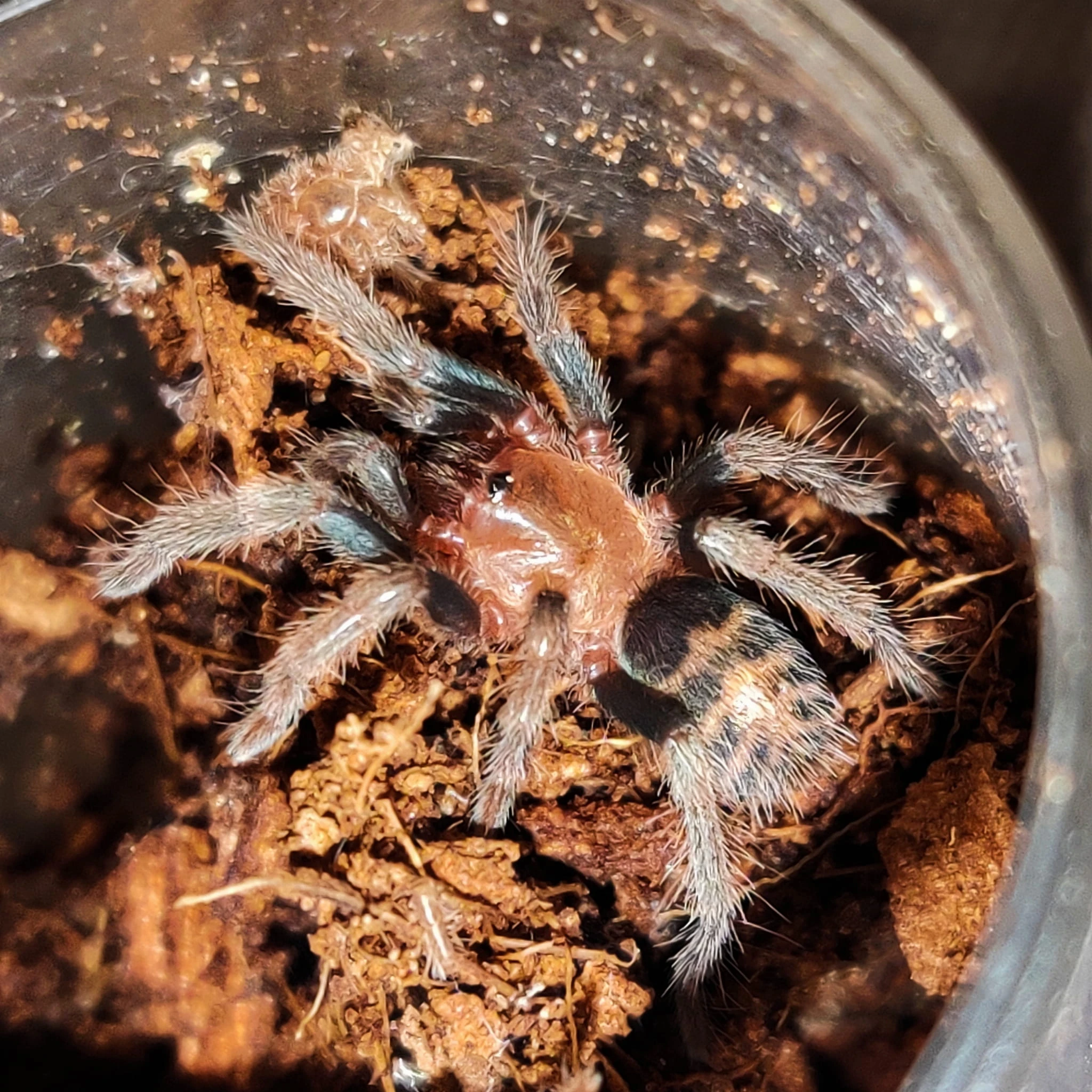


Davus pentaloris
Leave feedback on the product

Select product variant:
Individual variants may differ in price
Ask about the product

Administratorem danych osobowych jest PHU Krystian Solga. Przetwarzamy je w celu przesłania odpowiedzi na zapytanie. Więcej informacji dotyczących przetwarzania danych osobowych znajduje się w polityce prywatności.
Share the product card



Shipping cost for the selected product
The shipping cost applies to this product (in the selected variant - if applicable). It may change after adding other products to the cart.
Description
Davus pentaloris - Guatemalan Tiger Rump with bold coloration and dynamic temperament
Davus pentaloris is one of the most sought-after Central American tarantulas, captivating keepers with its metallic copper carapace and high-contrast tiger stripes set against a velvety black abdomen. Unlike many other colorful tarantulas, this species does not spend years in a dull gray juvenile stage - vivid, saturated patterns emerge in slings as early as the fifth instar. Its compact adult size makes it an ideal display species for hobbyists with limited shelf space.
This spider combines a docile, non-confrontational demeanor with explosive speed and a voracious appetite. As a prolific heavy webber and landscape architect, it quickly blankets the enclosure in a dense carpet of pristine white silk, excavating multi-entrance tunnel systems so you never have to deal with an invisible pet hidden underground.
- Tiger pattern from an early age: striking cinnabar-black stripes and a copper carapace plate visible even in juveniles with a 20 mm diagonal leg span.
- Heavy webber and tireless architect: intensive construction of expansive white silk tunnels creates a stunning visual display in the terrarium.
- Compact adult size: adult females reach up to 12 cm in leg span, thriving in enclosures with a footprint as compact as 20x20 cm.
- Explosive feeding response: lightning-fast ambush bursts from burrow entrances turn every feeding session into a thrilling display.
| Scientific name | Davus pentaloris |
| Common name | Guatemalan Tiger Rump Tarantula |
| Other common names | Tiger Rump, Guatemalan Tiger Rump |
| Origin and habitat | Mexico, Guatemala - humid tropical forest understory |
| Lifestyle | Terrestrial, opportunistic fossorial / burrower |
| Female dimensions | Body length 4.5-5.5 cm (1.8-2.2 in), diagonal leg span 10-12 cm (4.0-4.7 in) |
| Male dimensions | Body length 2.5-3.5 cm (1.0-1.4 in), diagonal leg span 8-9.5 cm (3.1-3.7 in) |
| Daytime temperature | 24-28°C (75-82°F) |
| Nighttime temperature | 20-22°C (68-72°F) (natural nightly drop) |
| Relative humidity | 65-80% (consistent moisture gradient) |
| Substrate depth | 5-8 cm (2-3 in) for adults, up to 50% of container depth for slings |
| Defense mechanism | Rapid retreat, type III urticating setae |
| Venom potency | Mild, medically insignificant (comparable to a wasp sting) |
| Lifespan | Females 10-15 years, males 2-4 years |
| Enclosure dimensions | 20x20x20 cm (8x8x8 in) or 30x30x20 cm (12x12x8 in) (horizontal layout) |
| Legal status | Not CITES listed, no registration permits required |
Variant selection and initial setup guidelines
Depending on the developmental stage you choose, this tarantula requires appropriately scaled housing. Early-stage slings are best housed in small, well-ventilated containers with a layer of substrate, such as small vials, dram bottles, or condiment cups, which makes hunting easier and prevents the spiderling from getting lost. Growing juveniles thrive in transitional Braplast boxes or compact acrylic enclosures, while subadults and adult females require their final horizontal terrarium.
Regardless of the chosen stage, introducing the spider to its new home calls for patience and gentle handling:
Step 1: Thermal acclimatization after transit - upon receiving your parcel, keep the sealed shipping container at room temperature 20-22°C (68-72°F) for 24 hours. Avoid supplemental heat mats during this phase, as sudden temperature spikes elevate metabolism and compound shipping stress.
Step 2: Safe transfer into the enclosure - prepare the final container with a substrate layer of at least 5-8 cm (2-3 in). Open the transport vial inside the enclosure and gently guide the spider toward its prepared hide using a soft paintbrush. Always supervise the transfer with long terrarium tongs measuring 25-30 cm.
Step 3: First meal after travel - offer the first prey item only after 24-48 hours have elapsed in the new habitat. The spider needs time to explore the space, establish anchor points, and lay down its first sensory silk tripwires.
What enclosure and environmental conditions should you provide for Davus pentaloris?
For an adult Davus pentaloris, the ideal setup is a horizontal glass or acrylic terrarium with a footprint of 20x20 cm (8x8 in) or 30x30 cm (12x12 in) and a maximum height of 20-25 cm (8-10 in). The spider requires effective cross-ventilation to prevent stagnant air, a substrate depth of 5-8 cm (2-3 in), and a moisture gradient of 65-80% alongside daytime temperatures of 24-28°C (75-82°F).
Due to its terrestrial lifestyle, excessive enclosure height poses a severe hazard. If a spider climbing the glass walls loses its footing, falling onto hard decor can cause fatal abdominal ruptures. A blend of moist peat moss, coco fiber, and sand or clay makes an outstanding substrate that holds burrow structures firmly. The central enclosure feature is a partially buried flat piece of natural cork bark, which serves as a starter burrow and structural anchor for extensive silk sheets.
Always manage humidity through a well-defined moisture gradient. Instead of misting the entire enclosure, thoroughly moisten one selected corner, where absorbent sphagnum moss helps retain dampness. The opposite end should remain dry to slightly dry. For subadults and adults, a shallow, stable water dish filled with clean drinking water is essential. To protect this warm, humid microclimate against mold outbreaks and mites, seed the substrate with a bioactive cleanup crew of beneficial springtails.
What to feed your Guatemalan Tiger Rump and how to schedule meals?
The diet of Davus pentaloris consists exclusively of live feeder insects sized appropriately to the current developmental instar. The golden rule of feeding dictates that the prey item should measure 50% to at most 100% of the tarantula abdomen length. This species is renowned for its ravenous appetite, tackling prey with remarkable ferocity.
For the youngest slings, flightless fruit flies (Drosophila hydei) and micro red runner roach nymphs measuring 2-3 mm offered every 3-5 days serve as ideal starter meals. Growing juveniles readily hunt small crickets and medium feeder nymphs every 5-7 days. Mature females accept adult red runner roaches, crickets, or juvenile Dubia roaches every 7-10 days.
Monitor your tarantula condition by observing the ratio of abdomen width to carapace width, which should ideally sit between 1:1 and at most 1.3:1. After every molt, observe a strict fasting period so the chelicerae can sclerotize and harden: wait 24-48 hours for slings, 3-7 days for juveniles, and 7-10 days for mature females before offering prey. Remove any uneaten feeder insects within 24 hours to prevent stress to the resting spider.
Common husbandry mistakes and how to avoid them
- Attempting to handle the spider: Davus pentaloris is an exceptionally skittish and lightning-fast tarantula. A sudden burst of speed leading to a drop of even a few dozen centimeters onto a hard surface almost invariably results in fatal abdominal trauma. Always perform maintenance using long terrarium forceps.
- Dehydrating slings and lacking a moisture gradient: early instars possess thin cuticles and dehydrate rapidly. Keep substrate consistently slightly damp around the burrow area, but avoid swampy, waterlogged conditions without sufficient ventilation, which triggers respiratory issues.
- Feeding prematurely after a molt: offering hard-shelled feeder insects before the fangs have fully hardened risks breaking the delicate chelicerae or having the defenseless spider injured by live crickets.
- Powerfeeding and abdominal obesity: an overinflated abdomen hampers the tarantula mobility, drastically increases the risk of fatal ruptures from short falls, and causes dangerous molting complications.
Taxonomy, nomenclatural history, and the 13 cryptic species complex
Davus pentaloris was originally described in 1888 by Eugène Simon as Crypsidromus pentaloris, after which taxonomists transferred it across several genera over the decades, including Hapalopus, Pseudoschizopelma, and Cyclosternum. In hobby literature and the pet trade, this taxon circulated for years under the misapplied name Cyclosternum fasciatum or Davus fasciatus. A comprehensive taxonomic revision by Ray Gabriel in 2016 demonstrated that the true Davus fasciatus is a distinct taxon endemic to Costa Rica and Panama, differing in genital morphology and darker overall coloration. Specimens originating from Mexico and Guatemala, which dominate European breeding stocks, represent the true Davus pentaloris.
Another scientific breakthrough arrived with integrative research published in 2021 by Daniela Candia-Ramírez and Oscar F. Francke in the Zoological Journal of the Linnean Society. Detailed mitochondrial DNA barcoding (COI) correlated with morphometrics revealed that Davus pentaloris in its traditional concept is in fact a complex of cryptic species. Thirteen distinct evolutionary lineages were identified, twelve of which represent species new to science. Biogeographic data indicate that most captive lineages in Europe originate from the Mexican locality of Paso de Milpa in Veracruz or Guatemalan lowlands. As a result, professional breeders increasingly document locality variants, such as Davus sp. Oaxaca.
Is Davus pentaloris venom dangerous to humans?
The venom of Davus pentaloris is mild and medically insignificant for a healthy adult human. In the rare event of a bite, which seldom occurs in captivity, symptoms remain confined to localized redness, mild swelling, and a temporary burning sensation comparable to a wasp sting. The primary defense mechanism of this spider is rapid retreat, and if cornered, kicking microscopic type III urticating setae from its abdomen with its hind legs, which can cause skin irritation and itching. Using metal terrarium tongs measuring 25-30 cm during feeding and tank maintenance ensures complete safety for the keeper.
Are CITES permits or legal registration required for Davus pentaloris?
No. Davus pentaloris is not listed under the Washington Convention (CITES) or European Union wildlife trade annexes. This means purchasing, keeping, and legally breeding this tarantula requires no captive-breeding certificates, veterinary permits, or local government registrations. When purchasing this animal from Ants Invasion, you receive a fully legal, captive-bred tarantula from a proven source.
Why is the Guatemalan Tiger Rump considered an ideal second tarantula?
This species is widely regarded as the ultimate second tarantula for any keeper, serving as a perfect stepping stone between slow-moving terrestrial species and agile arboreals or fast Old World tarantulas. Davus pentaloris teaches keepers alertness, respect for rapid movements, and precise maintenance of a substrate moisture gradient, all while posing no threat of potent venom.
Looking for a striking tarantula with vibrant colors and captivating behaviors? Select your preferred stage from the dropdown menu, add Davus pentaloris to your cart, and enjoy observing this master architect weave impressive silk tunnels in your terrarium.
Shipping and Live Arrival Guarantee
During cold weather, we secure parcels with a professional HeatPack warmer to maintain a safe temperature throughout transit.
Live animals are shipped exclusively from Monday to Thursday to eliminate the risk of packages sitting in courier sorting hubs over the weekend.
We take full responsibility for safe transit. We guarantee your animal arrives active and healthy.
Reviews
If you've added a review and it doesn't appear on the list, it may be pending moderation.
Leave feedback on the product
