

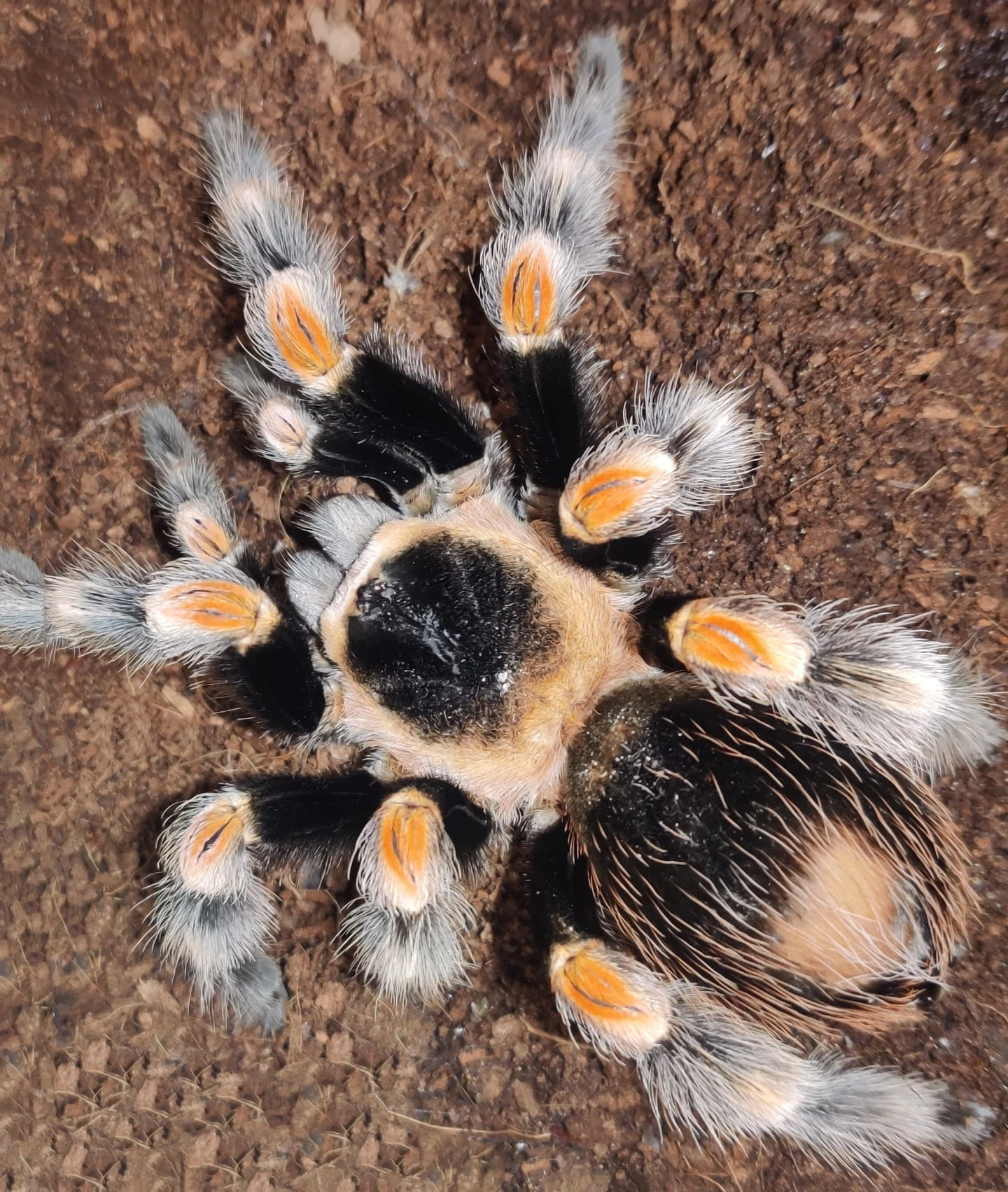


Brachypelma hamorii
Leave feedback on the product

Select product variant:
Individual variants may differ in price
Ask about the product

Administratorem danych osobowych jest PHU Krystian Solga. Przetwarzamy je w celu przesłania odpowiedzi na zapytanie. Więcej informacji dotyczących przetwarzania danych osobowych znajduje się w polityce prywatności.
Share the product card



Shipping cost for the selected product
The shipping cost applies to this product (in the selected variant - if applicable). It may change after adding other products to the cart.
Description
Brachypelma hamorii - Mexican Redknee Tarantula with a Docile Temperament
Brachypelma hamorii (Mexican redknee tarantula, also known as the Mexican orangeknee) is the undisputed icon of the terrarium hobby and the most popular first spider for keepers starting out with invertebrates. It captivates hobbyists with a spectacular contrast of deep velvet black and vivid, orange-red rings on its legs, paired with an exceptionally calm, docile temperament. Remarkable hardiness against beginner mistakes, no requirement for complex heating equipment, and an impressive lifespan exceeding two decades make it a dependable, deeply rewarding choice for years to come.
- Spectacular color contrast: Deep, velvety black coloration paired with fiery orange-red leg rings creates one of the most recognizable patterns in the natural world.
- Legendary calm and predictability: A docile disposition and total lack of defensive aggression make it an ideal tarantula for safe home observation.
- Outstanding resilience to beginner mistakes: Adapts readily to room conditions, forgiving minor humidity fluctuations without demanding complicated equipment.
- Full legality without administrative registration: Sourced 100% legally from closed captive breeding. Under Polish nature conservation law, invertebrates are statutorily exempt from registration at county offices.
| Scientific name | Brachypelma hamorii |
| Common name | Mexican redknee tarantula (Mexican orangeknee) |
| Origin | Mexico (states of Colima, Jalisco, Michoacan) |
| Natural habitat | Subtropical dry forests, thorn scrub |
| Lifestyle | Terrestrial, opportunistic burrower |
| Temperature | 24-28°C (75-82°F) daytime, 20-22°C (68-72°F) nighttime (tolerates room temperature) |
| Humidity | 55-65% (dry substrate, lightly moistened corner around the water dish) |
| Adult size | Leg span 14-16 cm (body length 6.5-7.5 cm) |
| Lifespan | Females 20-30+ years, males 4-6 years (1-2 years after ultimate molt) |
| Urticating setae | Type I and Type III (on the dorsum of the abdomen) |
| Venom potency | Mild, medically insignificant (comparable to a bee sting) |
| Care level | Beginner (perfect choice for a first tarantula) |
| Terrarium dimensions | 30x30x20 cm or 40x30x25 cm (horizontal setup) |
Choosing a Variant and First Steps with Your Tarantula
In the dropdown list above, we offer specimens across multiple developmental stages tailored to your keeping goals. Young spiderlings (instars L1-L2) arrive in secure, ventilated vials and represent an excellent, budget-friendly option for keepers who want to watch complete ontogeny from a tiny spiderling (initially uniformly pinkish-tan, developing vibrant colors from L5-L6). Subadult and adult specimens (marked as DC - body length excluding legs) already exhibit fully formed, striking display colors and substantial size (for example, 3.5 cm body length equals around 8-10 cm leg span). Meanwhile, choosing an adult female guarantees an impressive showpiece from day one, confirmed sex, and record longevity reaching up to 25-30 years. To ensure a stress-free start for your animal, follow this straightforward protocol:
Step 1: Quiet adaptation after transit - After unboxing, place the transport container in its intended location and allow the spider at least 24 hours of rest at a room temperature of 20-22°C (68-72°F) without supplemental heating. Increasing temperatures right after transit prematurely boosts metabolism and compounds travel stress.
Step 2: Preparing a secure habitat - In the permanent terrarium, vertical drop space above the substrate must not exceed 15 cm to eliminate any danger of injury from climbing falls. Provide a substrate depth of at least 8-10 cm, a stable shallow dish of fresh water, and a natural hide, for which curved cork bark is ideal.
Step 3: First feeding - Offer the first meal only after 24-48 hours have elapsed since housing the tarantula in its new enclosure. The size of the feeder insect should range from 50% to a maximum of 100% of the tarantula's abdomen length. For young spiderlings, tiny roach nymphs measuring 2-3 mm are optimal, while adults should be offered a single larger insect using safe feeding tongs.
What Enclosure and Conditions Should You Prepare for Brachypelma hamorii?
For an adult Brachypelma hamorii, a horizontal terrarium measuring 30x30x20 cm with a deep substrate layer of at least 8-10 cm is optimal. The species requires temperatures of 24-28°C (75-82°F) during the day and humidity levels around 55-65%. Keep the substrate roughly 80% dry, moistening only the area immediately surrounding a shallow dish of fresh water.
In nature, this tarantula inhabits dry Mexican scrub forests, digging deep burrows that provide thermal shelter from heat. In terrarium conditions, avoid misting the entire enclosure or maintaining soggy, muddy substrate. Good cross-ventilation effectively prevents stagnant air and fungal outbreaks, creating a stable, hygienic microclimate.
What to Feed Brachypelma hamorii and How to Structure Its Diet?
The staple diet of Brachypelma hamorii consists of live feeder insects measuring between 50% and 100% of the tarantula's abdomen length. Young spiderlings are fed every 3-5 days with tiny roach nymphs, whereas subadult and adult specimens receive prey once every 7-14 days.
For spiderlings, lively small red runner nymphs (turkistan roaches) or pinhead crickets work best. Older individuals readily take subadult and adult red runners as well as Dubia roaches. Remember to remove any uneaten prey from the enclosure after 24 hours. Following ecdysis, the spider's chelicerae must harden in air, so withhold food for 5-7 days for young spiderlings and 10-14 days for adult specimens. You can find our complete selection of live prey in the feeder insects section.
Most Common Keeping Mistakes and How to Avoid Them
- Excessively tall enclosure and fall hazard: The heavy, fluid-filled abdomen of a terrestrial tarantula is prone to fatal rupture even from a fall of just a few inches. Free space between the substrate surface and the enclosure ceiling must never exceed 15 cm.
- Overly wet substrate and poor ventilation: Brachypelma hamorii is an arid-adapted species. Trapped moisture and soggy substrate cause chronic stress, glass climbing, and fungal infection risks. Keep the substrate predominantly dry, supplying moisture locally through the water dish.
- Leaving live feeder insects during molting: A live cricket or roach left inside the enclosure of a molting tarantula can chew on and fatally injure the defenseless, soft arthropod. If the spider shows no interest in prey, remove the insect within 24 hours.
- Handling on open hands: Handling tarantulas induces acute physiological stress and creates a lethal fall risk. Carry out all enclosure maintenance and feeding using long 25-30 cm terrarium tongs.
Taxonomic revision and species identity of Brachypelma hamorii
For several decades, the spider widely captive-bred and traded across European terraria was kept under the scientific name Brachypelma smithi. A landmark systematic revision published in 2017 by Mexican arachnologists Jorge Mendoza and Oscar Francke resolved this historical confusion. Molecular analyses based on cytochrome c oxidase subunit I (COI) gene sequencing revealed approximately 8% genetic divergence between populations separated by the natural barrier of the Balsas River basin. Spiders occurring north of the river in the states of Colima, Jalisco, and Michoacan are formally Brachypelma hamorii, characterized by two pale bands on the chelicerae and a gentler curvature of the male palpal bulb. True Brachypelma smithi is restricted to the state of Guerrero south of the Balsas basin and is far less common in collections.
The molting process (ecdysis) and pre-molt symptoms
Tarantula growth occurs exclusively through periodic shedding of the rigid chitinous exoskeleton (ecdysis). Prior to an impending molt, the animal enters a preparatory phase (pre-molt): it refuses food for several weeks, becomes noticeably less active, and the bald patch on the dorsum of the abdomen (the mirror patch where urticating setae were kicked off) darkens, taking on a glossy, inky-black sheen as new pigment forms under the old cuticle. The spider spins a dense silk molting mat on the ground, rolls onto its back, and uses hemolymph pressure to emerge from its old exuvia. Lying upside down on its back is entirely natural, and the tarantula must never be touched, prodded, or flipped over during this vulnerable stage. The new carapace and chelicerae harden over the following 7 to 14 days. Proper hydration protects the spider from molting complications (dysecdysis) - if the tarantula encounters difficulty shedding old cuticle, never pull it off mechanically, as continuous access to a clean water dish remains the true key to a safe molt.
Frequently Asked Questions (FAQ)
Is Brachypelma hamorii venom dangerous to humans?
Venom from this species is very mild and medically insignificant for a healthy, non-allergic human. Its effect is comparable to a mild bee or wasp sting, limited to brief localized discomfort and slight redness. Brachypelma hamorii is a gentle, docile tarantula that invariably chooses retreat or kicking urticating setae from its abdomen when threatened. Routine use of 25-30 cm feeding tongs ensures complete keeper safety.
Does purchasing Brachypelma hamorii require official registration?
No, purchasing this tarantula does not require visits to government offices or official registration. Although the entire genus Brachypelma is listed under CITES Appendix II and EU Annex B (Council Regulation 338/97), Polish nature conservation law (Article 64(1)) mandates registration with local county offices solely for amphibians, reptiles, birds, and mammals. All invertebrates are legally exempt from this requirement. Every order includes documentation confirming legal captive-bred origin.
What should I do if my spider is lying on its back and unresponsive?
Lying on its back with legs extended slightly upward is the textbook sign that ecdysis has begun. Novice keepers frequently mistake this posture for death. Under no circumstances should you touch, nudge, or flip the spider over, as its soft tissues are exceptionally vulnerable to fatal injury. Provide complete quiet, dim the ambient lighting, and ensure the enclosure has a full dish of fresh water.
Looking for the perfect first tarantula with breathtaking colors and a docile temperament? Select your preferred stage from the dropdown menu above - from a young spiderling for fascinating growth observations to a colorful subadult or a long-lived adult female. Add Brachypelma hamorii to your cart and enjoy safely keeping this living icon of the terrarium hobby in your own home!
Shipping and Live Arrival Guarantee
During colder weather, packages are secured with professional HeatPack warmers to maintain optimal temperatures throughout transit.
Live animals are dispatched exclusively Monday through Thursday to eliminate any risk of parcels being held over the weekend.
We take full responsibility for safe transit and guarantee that your tarantula arrives healthy and safe.
Reviews
If you've added a review and it doesn't appear on the list, it may be pending moderation.
Leave feedback on the product
