

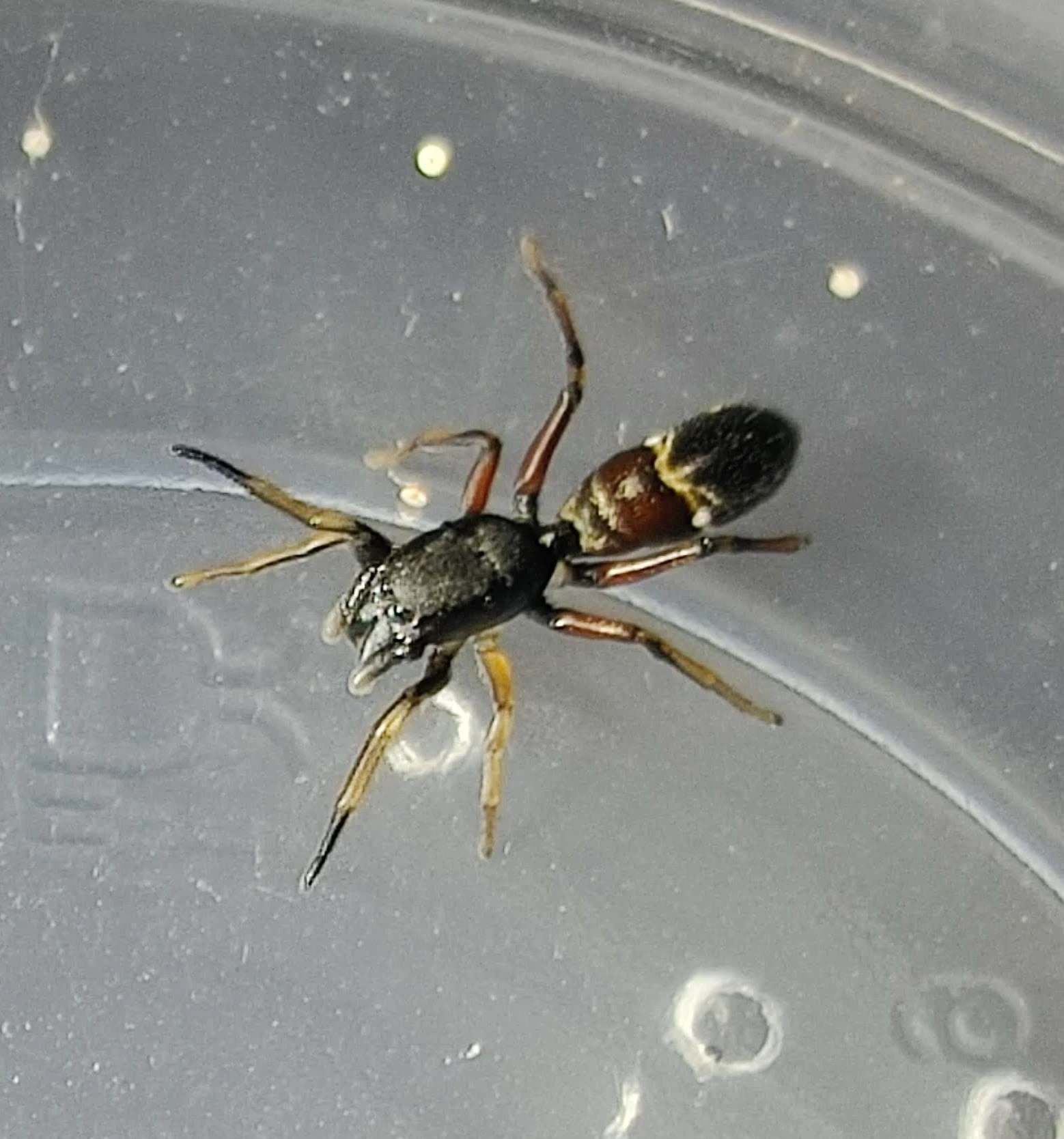


Leptorchestes berolinensis
Leave feedback on the product

Ask about the product

Administratorem danych osobowych jest PHU Krystian Solga. Przetwarzamy je w celu przesłania odpowiedzi na zapytanie. Więcej informacji dotyczących przetwarzania danych osobowych znajduje się w polityce prywatności.
Share the product card



Shipping cost for the selected product
The shipping cost applies to this product (in the selected variant - if applicable). It may change after adding other products to the cart.
Description
Leptorchestes berolinensis (Ant-mimic Jumping Spider) – An Unusual Ant-Mimicking Jumper
Discover the fascinating world of Leptorchestes berolinensis, also known as the Ant-mimic Jumping Spider – an exceptional representative of the Salticidae family (jumping spiders), which delights with its incredible ability of mimicry. This European spider is a true gem for jumping spider enthusiasts and lovers of evolutionary adaptations in the natural world. Its observation, both in nature and potentially in captivity, provides unforgettable experiences.
Note! We currently ship random sex, size L4 and up. If you are interested in a specific sex, size, or want to buy a pair, please contact us via Messenger or email.
Get to Know the Ant-mimic Jumping Spider Better:
- Species: Leptorchestes berolinensis (C. L. Koch, 1846)
- Common Name (suggested): Ant-mimic Jumping Spider / Berolinensis Ant Jumper
- Family: Salticidae (Jumping Spiders) – intelligent and active spiders, valued in captivity.
- Masterful Mimicry (Batesian Mimicry): This is one of the most astonishing features of this jumping spider. L. berolinensis perfectly imitates ants, which protects it from predators.
- Different Models: Depending on its developmental stage, it can imitate different ant species, such as Camponotus vagus, Lasius fuliginosus (males), or Colobopsis truncata (juveniles).
- Behavior and Appearance: A slender, elongated body with a characteristic constriction on the abdomen, and the way it moves its front legs (imitating ant antennae), make it almost indistinguishable from its models.
- Morphology:
- Males: Body length 4.8-6.5 mm. Cephalothorax dark brown, eye area black. Abdomen dark brown with a white stripe at the constriction, anterior part sometimes yellowish-orange. Characteristic light, trapezoidal spot on the underside of the abdomen (may be absent).
- Females: Body length 5.75-7.1 mm. Coloration similar to males, however, the spot on the underside of the abdomen is larger, and behind it are two white, longitudinal lines.
- Distribution: Widely distributed in Europe, from Spain to Turkmenistan. Also occurs in Poland, although it is a rare species there.
- Natural Habitat: Prefers warm and sunny places. Found on tree trunks, wooden fences, building walls, in piles of dead wood, as well as in ruderal and urbanized areas. It has also been observed near apiaries, where it likely finds an abundance of food.
Keeping Jumping Spiders – Leptorchestes berolinensis in a Terrarium:
- Difficulty Level: The species is generally little known in captivity. Some sources may suggest it is difficult, however, at the moment we are successfully keeping them in standard jumping spider containers of about 100 ml capacity and all specimens are doing great – they hunt and live normally. Due to the limited amount of available keeping information, precisely determining its difficulty level is currently challenging.
- Terrarium: Typical for jumping spiders, vertically oriented or with plenty of climbing elements (e.g., pieces of bark, twigs). Good ventilation must be ensured. Ideal for observing its unusual behaviors.
- Temperature: As a species preferring warm locations, the terrarium temperature should be maintained in the range of approx. 20-29°C (68-84°F).
- Humidity: Moderate. Lightly misting one of the terrarium walls every few days is recommended, avoiding the formation of standing water.
- Feeding: In nature, it is a predator hunting small insects. Laboratory studies and our practice have shown that it readily accepts Drosophila fruit flies. In captivity, standard jumping spider food such as fruit flies, small crickets, or other small invertebrates can be provided. Although it is a master of ant mimicry, feeding ants is not recommended – its mimicry is defensive (Batesian).
- Behavior: Active during the day, a curious spider. Observing its ant-like movements and hunts is a real treat for any arachnid enthusiast. Unlike many other jumping spiders, this one often hunts by approaching its prey, rather than making a long jump towards it.
Conservation Status of Leptorchestes berolinensis:
- Polish Red List of Threatened Animals: This species is listed on the Polish Red List as Vulnerable (VU). This means its population in Poland is generally considered small and susceptible to threats.
- Our Specimens: It should be emphasized that our specimens come from a location where this species is very common, which may indicate local variation in abundance.
- Legal Protection: Despite its VU status on the Red List, Leptorchestes berolinensis is not currently under strict or partial species protection in Poland (it is not listed in the Regulation of the Minister of Environment on species protection of animals). Nevertheless, its general rarity and threat status at the national level should encourage a responsible approach and respect for its natural habitats.
Why Take an Interest in Leptorchestes berolinensis?
- An unparalleled example of mimicry in the world of European jumping spiders.
- A fascinating subject of research and observation for anyone interested in ethology, evolution, and the diversity of arachnids.
- Can be an interesting addition to the collection for jumping spider enthusiasts wishing to expand their knowledge of a rare and unusual species.
We encourage you to further explore information about Leptorchestes berolinensis and other fascinating spiders from the Salticidae family. The world of jumping spiders is full of surprises!
Reviews
If you've added a review and it doesn't appear on the list, it may be pending moderation.
Leave feedback on the product
