

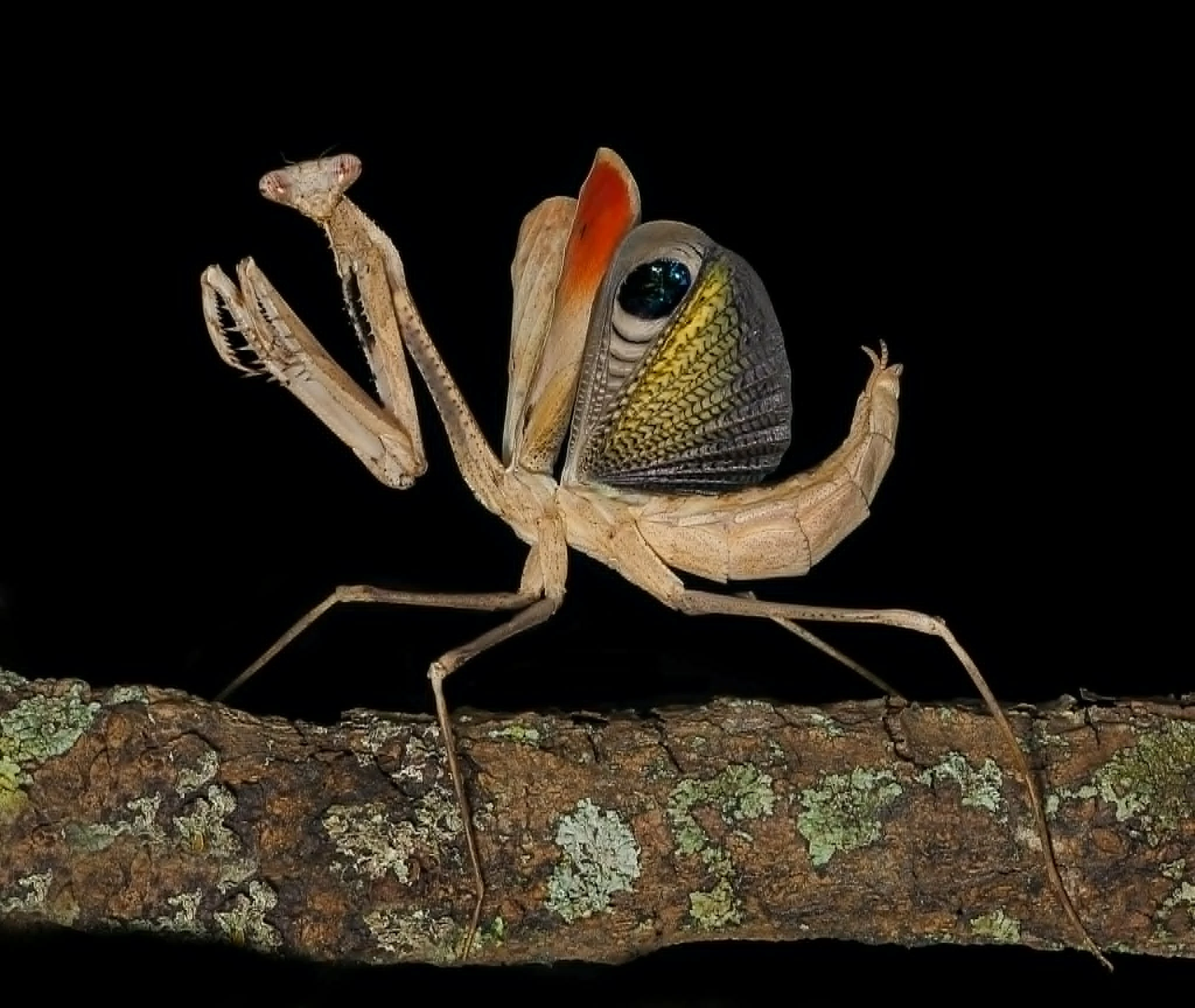


Pseudempusa pinnapavonis
Leave feedback on the product

Wybierz wariant produktu:
Individual variants may differ in price
Ask about the product

Administratorem danych osobowych jest PHU Krystian Solga. Przetwarzamy je w celu przesłania odpowiedzi na zapytanie. Więcej informacji dotyczących przetwarzania danych osobowych znajduje się w polityce prywatności.
Share the product card



Shipping cost for the selected product
The shipping cost applies to this product (in the selected variant - if applicable). It may change after adding other products to the cart.
Description
Pseudempusa pinnapavonis - An impressive predator and a spectacle of peacock eyes
Imagine a predator that transforms from a perfectly camouflaged dried twig into a terrifying, multicolored beast in a fraction of a second. Pseudempusa pinnapavonis, commonly known as the peacock mantis, is one of the most fascinating and largest representatives of Asian fauna you can invite to your insectarium. Starting as an inconspicuous, stick-like nymph, this insect gains mass with each successive molt, eventually shocking its surroundings as an adult ten-centimeter female with spread wings featuring huge, iridescent "peacock eyes" and a unique ability to emit a warning hiss.
Breeding these powerful insects is an extraordinary adventure, combining communion with majestic nature and daily admiration of ruthless hunting efficiency. Although its size and spectacular appearance command respect, the peacock mantis is forgiving of initial mistakes, making it highly rewarding to keep individually. These are excellent and safe terrarium animals that will successfully become a living decoration of any exotic room. Watching their evolution from a delicate insect to an armored giant is a process that immensely rewards every moment spent caring for the terrarium.
| Feature | Description |
|---|---|
| Latin name | Pseudempusa pinnapavonis |
| Common name | Peacock mantis |
| Origin | Myanmar, Thailand |
| Adult insect size | Female up to 10 cm, male up to 8.5 cm |
| Target terrarium | Minimum 20x20x30 cm |
| Temperature (Day) | 25-28°C / 77-82°F |
| Temperature (Night) | 20-24°C / 68-75°F |
| Humidity (Day / Night) | 50-70% / 60-80% |
| Lifespan | Female 14-24 months, male 10-18 months |
| Breeding difficulty | Easy for a single individual |
Anatomy and dimorphism
Pseudempusa pinnapavonis presents one of the most spectacular examples of sexual dimorphism. Massive females grow to an impressive 10 centimeters, have stout abdomens with 6 clearly identified sternites and shortened wings, which ultimately deprives them of active flight ability. Their powerful raptorial legs, decorated on the inside with a blood-red spot, guarantee a crushing striking force. Males are much slimmer, lighter and measure a maximum of about 8 centimeters. They have long, fully developed wings enabling flight in search of partners, 8 visible segments on a narrow abdomen and magnificent antennae studded with sensitive chemoreceptors. When choosing exotic insects for home, it is worth paying attention to this species - they are true, living evolutionary works of art.
Crypsis and deimatism with stridulation
The initial developmental stages rely fully on perfect camouflage, known as crypsis. Young mantises sway slightly in the wind, deceptively resembling dried twigs and protecting themselves from threats. However, with the onset of adulthood, defensive tactics change dramatically. When threatened, the massive female stands on her hind legs, spreads her armed forelegs sideways and rapidly opens her wings, revealing giant, shimmering "peacock eyes" in shades of purple, crimson and black. This shocking visual spectacle is intensified by the ability to stridulate, unique in this order. The mantis rhythmically rubs the hard edges of her wings against the pleura of her abdomen, generating a loud, warning hiss. Their exceptional defensive arsenal commands great admiration and allows you to observe interesting predator behaviors, which can successfully be admired in the comfort of your home.
Southeast Asian Biotope (Myanmar, Thailand)
Understanding the needs and parameters of this species requires a close look at its natural environment. Asian tropical forests and dense thickets of Thailand and Myanmar have shaped an eminently arboreal species. In the thicket of leaves and on the trunks of old trees, these mantises spend their entire lives and hunt, instinctively avoiding moist litter, which is the domain of predatory ants and dangerous fungi. When constructing a home habitat, we must remember to replicate these warm, light-saturated territories with a cyclically changing moisture level.
Terrarium construction and the vertical rule
To achieve full breeding success, we must rigorously observe the sacred rule of vertical space. Mantises molt hanging upside down, so the distance from the ceiling to the hard ground must be an absolute minimum of three times the insect's current body length. In the case of fast-growing adult females, ideal for a terrarium will be large vertical enclosures measuring at least 20x20x30 cm with a solid mesh. Ignoring this requirement leads to a tragic dysecdysis, consisting of catching on the bottom and the soft insect getting stuck in its old exoskeleton, which ends in irreversible disability or imminent death. The walls and ceiling should be lined with a material that facilitates gripping, such as the aforementioned mesh or rough natural cork.
Microclimate and drinking drops
Careful maintenance of the appropriate temperature is essential for healthy development. During the day we aim for a stable range of 25-28°C / 77-82°F. It is extremely important, however, to imitate the natural cooling of the Thai forest at night, allowing for a clear temperature drop to the level of 20-24°C / 68-75°F. Humidity is another extremely important pillar of care in the molting cycle. During the day we keep it within 50-70%, facilitating its natural increase to 60-80% after turning off the lights. Such nocturnal parameters guarantee proper hydration and flexibility of the cuticle during molts. Remember that these mantises do not drink water from bowls standing on the bottom. We hydrate them exclusively by regularly spraying the glass and leaves in the terrarium, from where they will actively lick the shiny drops.
Feeding and digestive fasting
The diet of this species evolves very clearly as the insect grows in size. Newly hatched nymphs hunt flightless fruit flies with great enthusiasm, and older individuals smoothly transition to fishing maggots and smaller Turkestan cockroaches fed with tweezers. The imago, on the other hand, is a true eating machine, able to efficiently hunt prey half its own body size. We eagerly offer adult females locusts and fat cockroaches. However, one must be extremely careful not to overfeed the insect. We always observe the flexible membranes between the female's abdominal segments. When it becomes oval, stretched and strongly rounded, we order a mandatory digestive fast of several days for the sake of her health. Most crucially, a heavily fed female with a tense abdomen becomes extremely delicate. An accidental fall even from a height of thirty centimeters causes her abdominal membranes to rupture and an immediate, fatal loss of hemolymph.
Brutal reproduction and oothecae
Although isolated single specimens are eminently easy to breed insects, the process of their reproduction requires immense focus and nerves of steel. Aggression and innate cannibalism in Pseudempusa pinnapavonis during courtship can surprise even veterans. To save the male from decapitation, the female must be previously brought to maximum fattening with cockroaches. The male then risks his life, cautiously entering the hunting area and jumping on her back, after which the marathon copulation often extends to over a dozen hours. The result of this sacrifice and a fully successful pairing are phenomenal oothecae. The fluffy mass laid on a vertical branch very quickly hardens to the parameters of strong construction foam, protecting the valuable interior. The cocoon has a characteristic, central opening seam, from which, after two months of careful incubation, a wave of a new generation counting from 100 to even 160 predatory nymphs will pour into the world.
Most common breeding mistakes and how to avoid them
The main threat to mantises in captivity are the stumbles and mistakes of the breeders themselves. Keeping a mantis that is too large in a low box without a rough ceiling mesh is a straight path to disability. Another huge mistake is ignoring the natural thermals and maintaining a continuous, even temperature without night drops, which drastically shortens the lives of animals and exhausts their bodies with a lack of rest. It should be remembered that the lack of systematic cleaning of organic residues at high humidity quickly leads to an attack of murderous mold on uneaten food. The last, but extremely dangerous shortcoming is the continuous, unreflective fattening of adult females without using a digestive rest phase. Eliminating these few mistakes makes care a pure passion.
Summary for the breeder
The peacock mantis perfectly combines what is objectively best in invertebrates: monumental sizes, undemanding appetite and a stunning multimodal array of defense mechanisms that can take your breath away with every deimatic presentation. This species is perfectly suited as a birthday gift for avid breeders of exotic insects, and at the same time will be an excellent choice for beginner enthusiasts wishing to observe the fascinating world of nature in their own home. Provide it with adequate vertical space and a reasonably balanced diet, and in return this predator will reward you with an amazing spectacle of anatomy, reigning for many months in your private rainforest.
Reviews
If you've added a review and it doesn't appear on the list, it may be pending moderation.
Leave feedback on the product
 Log in with Google
