

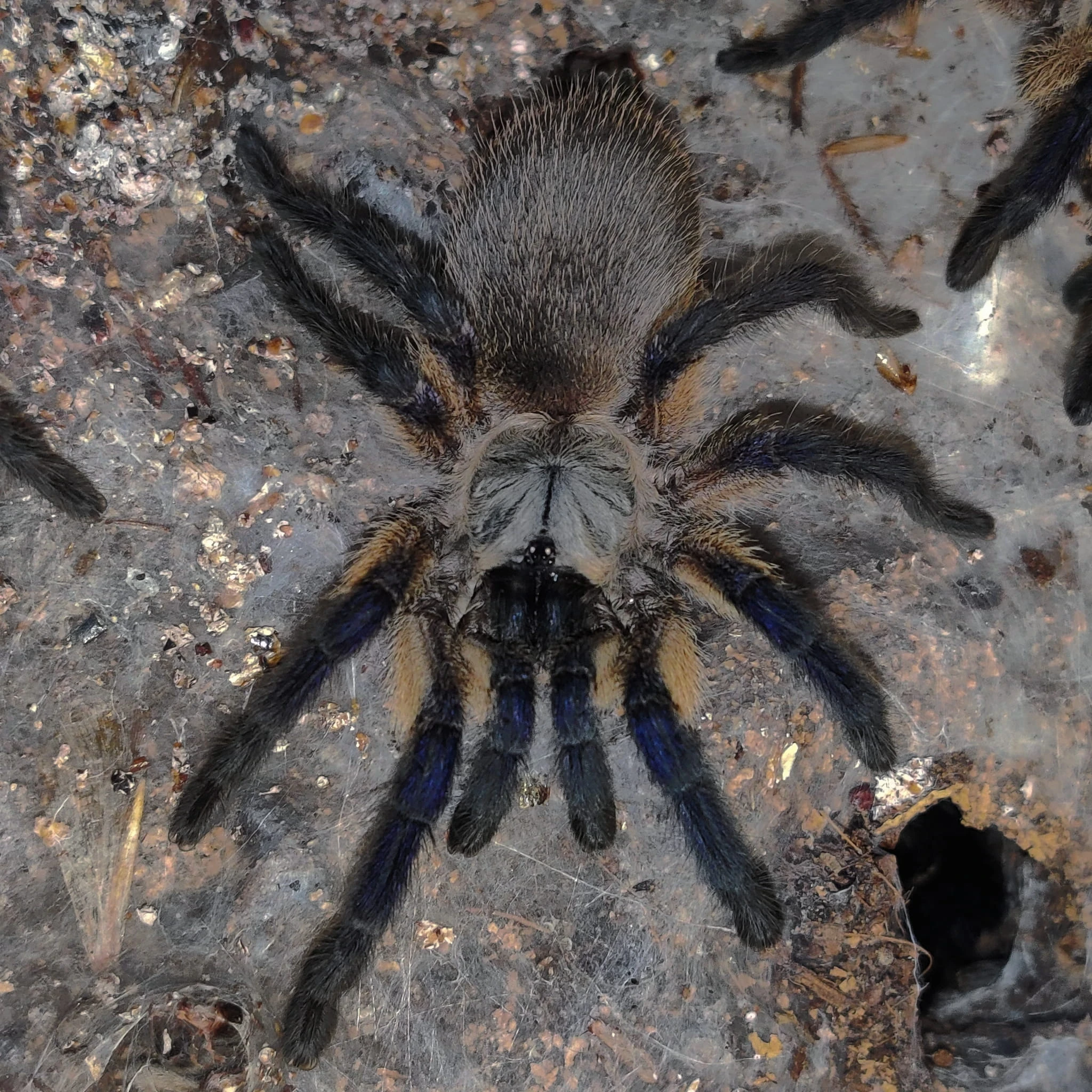


Monocentropus balfouri
Leave feedback on the product

Select product variant:
Individual variants may differ in price
Ask about the product

Administratorem danych osobowych jest PHU Krystian Solga. Przetwarzamy je w celu przesłania odpowiedzi na zapytanie. Więcej informacji dotyczących przetwarzania danych osobowych znajduje się w polityce prywatności.
Share the product card



Shipping cost for the selected product
The shipping cost applies to this product (in the selected variant - if applicable). It may change after adding other products to the cart.
Description
Monocentropus balfouri – The Communal Jewel of Socotra
In the world of terrarium keeping, few species evoke as much emotion and desire as Monocentropus balfouri. This extraordinary tarantula from the isolated island of Socotra mesmerizes with the electrifying blue of its legs, contrasting against a creamy-golden carapace. However, its beauty is just the prelude. The true phenomenon is its unique, extremely rare ability among tarantulas to live in organized, multi-generational colonies. Observing their complex social behaviors, communal hunting, and parental care makes it an absolutely exceptional jewel in any advanced collection.
WARNING: Species exclusively for advanced keepers. M. balfouri is an Old World tarantula – it is fast, defensive, and possesses potent, medically significant venom. It demands the highest level of experience, respect, and responsibility.
Why is Monocentropus balfouri an Exceptional Choice for the Expert?
- Hypnotic Coloration: The spectacular contrast of metallic blue legs and a creamy-golden carapace makes it one of the most beautiful tarantulas in the world.
- Unique Communal Ability: As one of the very few tarantulas, it can form organized groups, displaying complex social behaviors, including advanced maternal care.
- Endemic from a Mysterious Island: Its origin from the isolated Socotra Island, the "Galapagos of the Indian Ocean," adds an aura of mysticism and rarity.
- Master Weaver: It is known for producing vast amounts of dense webbing, creating spectacular nests and tunnels.
- Old World Temperament: Its speed and defensive posture provide a satisfying challenge for the most experienced keeper.
Temperament and Safety – Essential Knowledge
The key to safe keeping is understanding its defensive nature. This is a species intended exclusively for advanced experts.
- Venom: Potent and medically significant. A documented human bite case showed severe systemic symptoms, including severe muscle cramps and rhabdomyolysis. Requires absolute respect and caution.
- Speed and Defensiveness: This is a very fast and skittish spider. Its first reaction to a threat is to flee into its burrow. Only when cornered, especially when defending offspring, will it unhesitatingly assume a threat posture and attack. It can produce hissing sounds (stridulation).
- No Urticating Hairs: As an Old World tarantula, it does not possess urticating hairs. Its only weapon is a powerful bite.
- Handling: Handling this species is categorically discouraged. All activities within the terrarium must be performed using long, at least 30-centimeter tweezers, in a secure environment, with utmost caution.
Keeping in a Terrarium – A Complete Guide
Terrarium – A Dry Burrow in Humid Air
The key is to replicate the conditions of a natural burrow on Socotra: a dry shelter surrounded by humid air.
- Type and Size: For a single adult, a terrestrial terrarium of approx. 30x30x20 cm is sufficient. For a colony (min. 3-5 individuals), a much larger tank is required (min. 75 liters).
- Substrate: A thick layer of substrate (minimum 10-15 cm) that allows digging is essential (a mix of coconut fiber, peat, sand).
- Decor: Numerous anchor points for webbing and hides must be provided (cork bark, roots). In a communal setup, the number of hides must exceed the number of spiders.
Temperature and Humidity – Simulating Socotra's Climate
- Temperature: The optimal range is 24-29°C (75-84°F).
- Humidity: Should be 50-70%. The best method is to keep the substrate dry and provide constant access to a water dish. The evaporating water will ensure adequate air humidity. Avoid soaking the substrate. Good ventilation is crucial.
Monocentropus balfouri at a Glance
| Scientific Name | Monocentropus balfouri |
| Common Name | (Socotra Island Blue Baboon) |
| Origin | Socotra Island (Yemen) |
| Lifestyle | Terrestrial / Fossorial (Burrowing) |
| Venom Strength | Potent, medically significant |
| Temperament | Defensive, skittish, fast |
| Urticating Hairs | Absent |
| Lifespan | Females 10-15 years, males 3-4 years |
| Target Size | up to 18 cm leg span |
| Difficulty Level | Exclusively for advanced experts |
Acquiring Monocentropus balfouri is not just a simple purchase. It is embarking on a fascinating journey into the world of advanced arachnoculture. For those who are willing to meet its demands, it will be a true pearl in their collection and a source of endless fascination.
Reviews
If you've added a review and it doesn't appear on the list, it may be pending moderation.
Leave feedback on the product
