

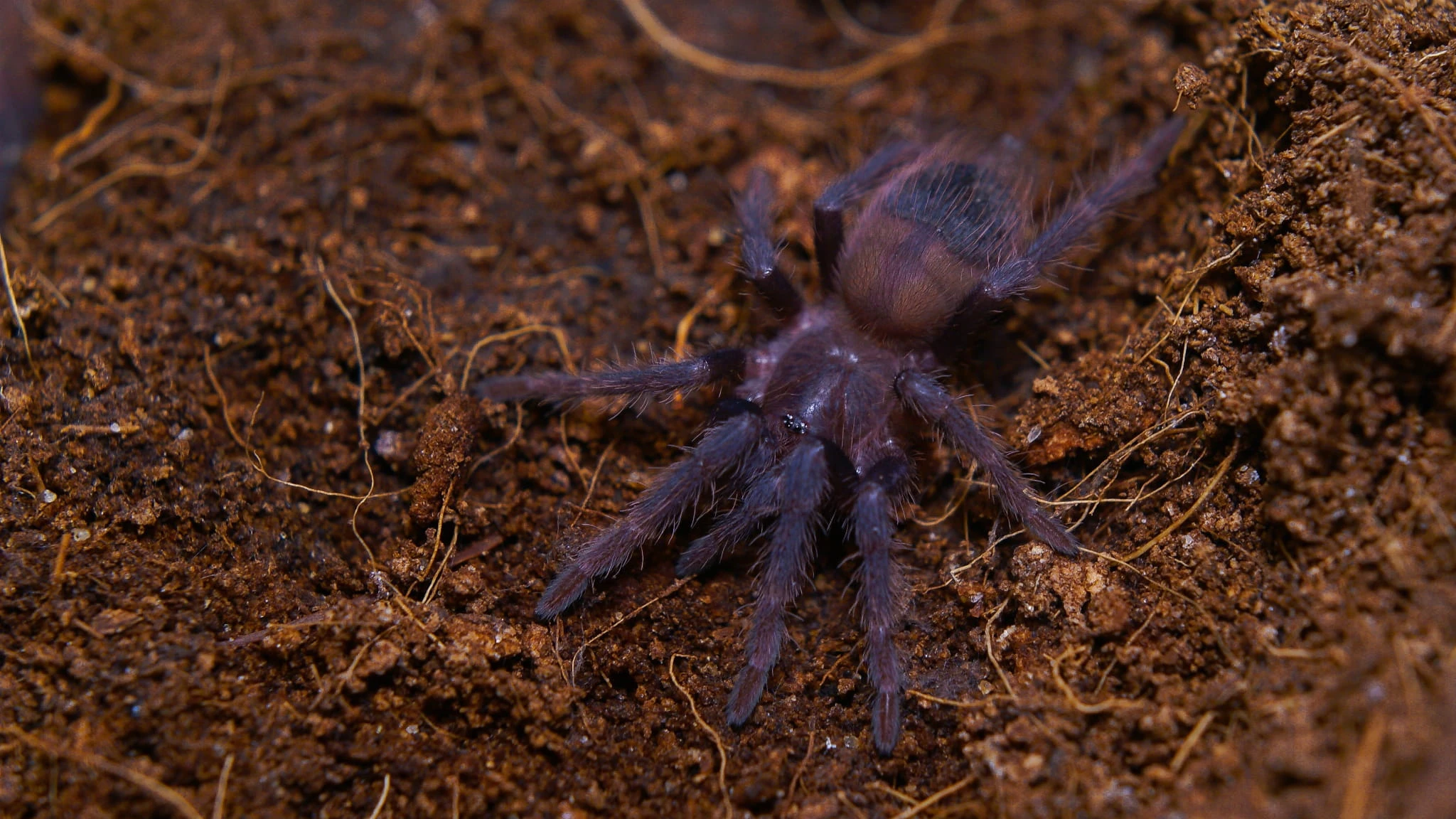


Lasiocyano sazimai
Leave feedback on the product

Select product variant:
Individual variants may differ in price
Ask about the product

Administratorem danych osobowych jest PHU Krystian Solga. Przetwarzamy je w celu przesłania odpowiedzi na zapytanie. Więcej informacji dotyczących przetwarzania danych osobowych znajduje się w polityce prywatności.
Share the product card



Shipping cost for the selected product
The shipping cost applies to this product (in the selected variant - if applicable). It may change after adding other products to the cart.
Description
Lasiocyano sazimai (formerly Pterinopelma sazimai) - Spectacular Brazilian Blue Tarantula with Metallic Sheen
For decades, keepers dreaming of an intensely blue spider had to settle for difficult, defensive Old World arboreal or fossorial species. Lasiocyano sazimai definitively solves this problem by combining breathtaking, metallic cobalt coloration with the calm temperament and mild venom of a New World terrestrial tarantula. Unlike obligate burrowers, this Brazilian gem readily stays out in the open, serving as a stunning, living centerpiece in any terrarium.
- Spectacular coloration: A deep, electrifying structural blue covering the carapace and legs contrasts magnificently with a dark abdomen adorned with coppery setae.
- Outstanding display tarantula: Unlike typical fossorial species, adults eagerly showcase themselves out in the open on the substrate surface.
- Hardy and voracious: Robust metabolism and lightning-fast feeding response make this tarantula forgiving of minor parameter fluctuations.
- Fully legal and paperwork-free: Not subject to CITES restrictions, meaning no registration or legal permits are required.
| Scientific name | Lasiocyano sazimai (synonym: Pterinopelma sazimai) |
| Origin | Brazil (Serra do Espinhaço mountain range, Chapada Diamantina, campos rupestres biome) |
| Adult size | Females: 6-7 cm body length (BL), 14-16 cm diagonal leg span (DLS). Males: 4-5 cm BL |
| Lifespan | Females: 15-20 years. Males: 3-5 years (1-2 years after ultimate molt) |
| Daytime temperature | 24-26°C (75-79°F) (room temperature is completely sufficient) |
| Nighttime temperature | 20-22°C (68-72°F) (a natural drop stimulates proper metabolism) |
| Humidity | 60-70% (maintained with a clear moisture gradient) |
| Enclosure type | Terrestrial enclosure (minimum 30x30x25 cm for an adult female) |
| Venom potency | Mild (comparable to a bee or wasp sting, medically insignificant) |
| Legal status / CITES | None (non-CITES species, no registration required) |
Choosing a Variant and First Steps with Your Tarantula
Depending on the developmental stage selected from the variant list, Lasiocyano sazimai varies in appearance, growth rate, and enclosure requirements. Young spiderlings (L1-L3) feature cryptic ash-brown coloration, while the first metallic sheen on the legs emerges around the L5 instar. The tarantula displays its full, rich cobalt blue during the juvenile stage and in adulthood. Regardless of the chosen stage, follow the procedure below upon unboxing:
Step 1: Acclimation and rest after transit - Leave the shipping vial in a quiet, shaded place for 24 hours at room temperature 20-22°C (68-72°F) without supplemental heating from a heat mat. Elevated temperature right after transport unnecessarily accelerates metabolism and increases stress.
Step 2: Transfer to the target enclosure - Keep tiny spiderlings (L1-L3) in ventilated vials or mini deli cups (50-100 ml) with slightly moist peat. Move juveniles (L4-L7) into small rearing containers with a substrate layer and a hide, and house adult specimens in a final terrestrial enclosure measuring 30x30x25 cm with a shallow water dish.
Step 3: First feeding - Offer the first meal only after 24 hours in the new enclosure. Strictly select the feeder insect size according to the golden abdomen rule: the feeder length must measure between 50% and at most 100% of the tarantula's abdomen length.
What Enclosure and Substrate to Prepare for Lasiocyano sazimai?
For an adult Lasiocyano sazimai, an optimal setup is a terrestrial terrarium measuring 30x30 cm at the base and 20-25 cm in height with effective cross-ventilation. A 6-8 cm layer of compacted peat or coconut fiber works excellently as substrate, while the key decor element is an artificial rock crevice created from an arched piece of cork oak bark.
In nature, this endemic Brazilian tarantula inhabits high-altitude campos rupestres rocky grasslands at elevations above 1,000 meters above sea level. Due to the hard quartzite terrain, it does not dig deep vertical burrows, functioning as an opportunistic burrower that adapts natural crevices beneath boulders. In captivity, a contoured, securely anchored piece of cork oak bark is ideal, which the spider quickly lines with dense webbing. A critical requirement is providing a moisture gradient: keep one corner around the water dish slightly damp while the remaining two-thirds of the enclosure stays completely dry. Stagnant, humid air is very hazardous for this species, so the terrarium must feature reliable cross-ventilation.
What to Feed the Brazilian Blue Tarantula and How to Plan Its Diet?
The diet of Lasiocyano sazimai consists of live feeder insects matched to the size of the spider's abdomen. Feed young spiderlings every 3-5 days with red runner cockroach nymphs (Turkestan roach hatchlings) or cut mealworms, juveniles every 7 days with medium crickets, and adult tarantulas every 10-14 days with adult Dubia roaches.
This tarantula boasts a hearty appetite and a dramatic feeding response to substrate vibrations caused by prey. Always ensure that the feeder size never exceeds the length of the carapace or the girth of the spider's abdomen. An approaching molt is easily recognized when the spider refuses food and the mirror patch on the opisthosoma turns distinctly dark. During this time, stop feeding immediately and remove any live insects from the enclosure, as they could severely injure the vulnerable spider while it molts.
Common Keeping Mistakes and How to Avoid Them
- Overly wet substrate and poor ventilation: Excessive moisture combined with stagnant air is the primary cause of fungal infections. Keep the substrate dry with just one damp corner, and ensure the enclosure has active cross-ventilation.
- Excessive enclosure height: Lasiocyano sazimai is a heavy-bodied terrestrial tarantula that cannot climb glass safely. A fall from higher than 15-20 cm risks a fatal abdomen rupture.
- Feeding before and after molting: Leaving a live cricket in the enclosure during a molt can be fatal to the tarantula. After a successful molt, wait at least 10-14 days for adults and 3-5 days for slings before offering food, until the chelicerae harden and turn completely black.
- Handling attempts: When stressed, this species readily kicks urticating setae type III, causing intense burning and itchy skin. Perform all maintenance inside the enclosure using 25-30 cm terrarium tweezers.
Why did this tarantula's name change from Pterinopelma sazimai to Lasiocyano sazimai?
The species was scientifically described in 2011 by Rogério Bertani as Pterinopelma sazimai and immediately entered the prestigious Top 10 New Species list. In June 2023, a team of Brazilian arachnologists led by Arthur Galleti-Lima published groundbreaking phylogenomic research utilizing ultraconserved elements (UCE) sequencing. This revealed that the species does not belong to the typical Pterinopelma clade, but represents a distinct, monotypic lineage sister to the genus Nhandu and closely related to Lasiodora. The new generic name Lasiocyano was established, derived from the Greek words lasios (hairy) and kyanos (dark blue). The specific epithet sazimai honors the distinguished zoologist Prof. Ivan Sazima. Note that the spider's striking blue color is structural: nanostructures on the setae refract light, which is why it shines most brilliantly under cool white lighting (above 6000 K) right after a fresh molt.
Frequently Asked Questions (FAQ)
Is Lasiocyano sazimai venom dangerous to humans?
No. The venom of this tarantula is very mild and comparable to a bee or wasp sting. As a New World species, its primary defensive response to disturbance is retreating quickly into its hide or kicking urticating hairs from its abdomen. Bites are exceptionally rare and pose no medical threat to a non-allergic individual. Performing routine maintenance with standard 25-30 cm terrarium tweezers guarantees full safety.
When does a young tarantula develop its intense blue coloration?
Young slings from L1 to L4 are uniformly greyish-brown, which provides natural camouflage in their environment. The first distinctive metallic reflections appear on the legs around the L5-L6 molt. The vibrant, spectacular cobalt blue fully emerges during the subadult stage and after the ultimate molt. Color intensity is always highest on freshly molted individuals, gradually turning darker over the months leading up to the next molt.
Does keeping or purchasing Lasiocyano sazimai require CITES registration?
No. Lasiocyano sazimai is not listed under the Washington Convention (CITES) or EU wildlife protection annexes. This means that purchasing and keeping this species is 100% legal and requires no captive-breeding certificates, environmental office notifications, or official registration permits.
Ready to add one of the world's most spectacular species to your collection? Select the desired stage from the variant list above, add the tarantula to your cart, and enjoy the mesmerizing metallic blue in your home.
Shipping and Live Arrival Guarantee
During cold weather, we secure every parcel with a professional HeatPack chemical warmer to maintain optimal transit temperature.
Live animals are dispatched exclusively Monday through Thursday to eliminate the risk of packages getting stuck in transit over the weekend.
We take full responsibility for safe transit. We guarantee that your animal arrives healthy and alive.
Reviews
If you've added a review and it doesn't appear on the list, it may be pending moderation.
Leave feedback on the product
