

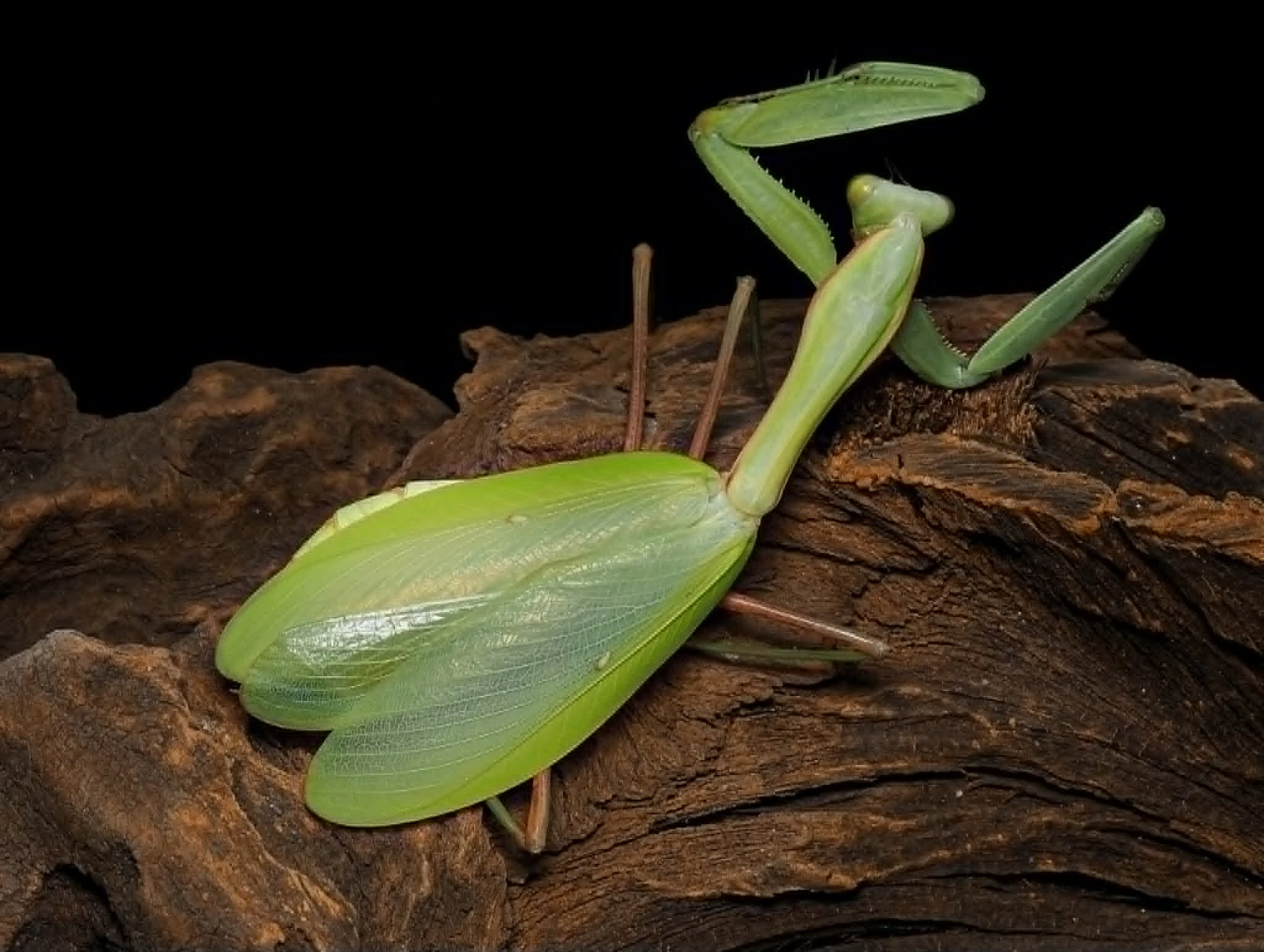
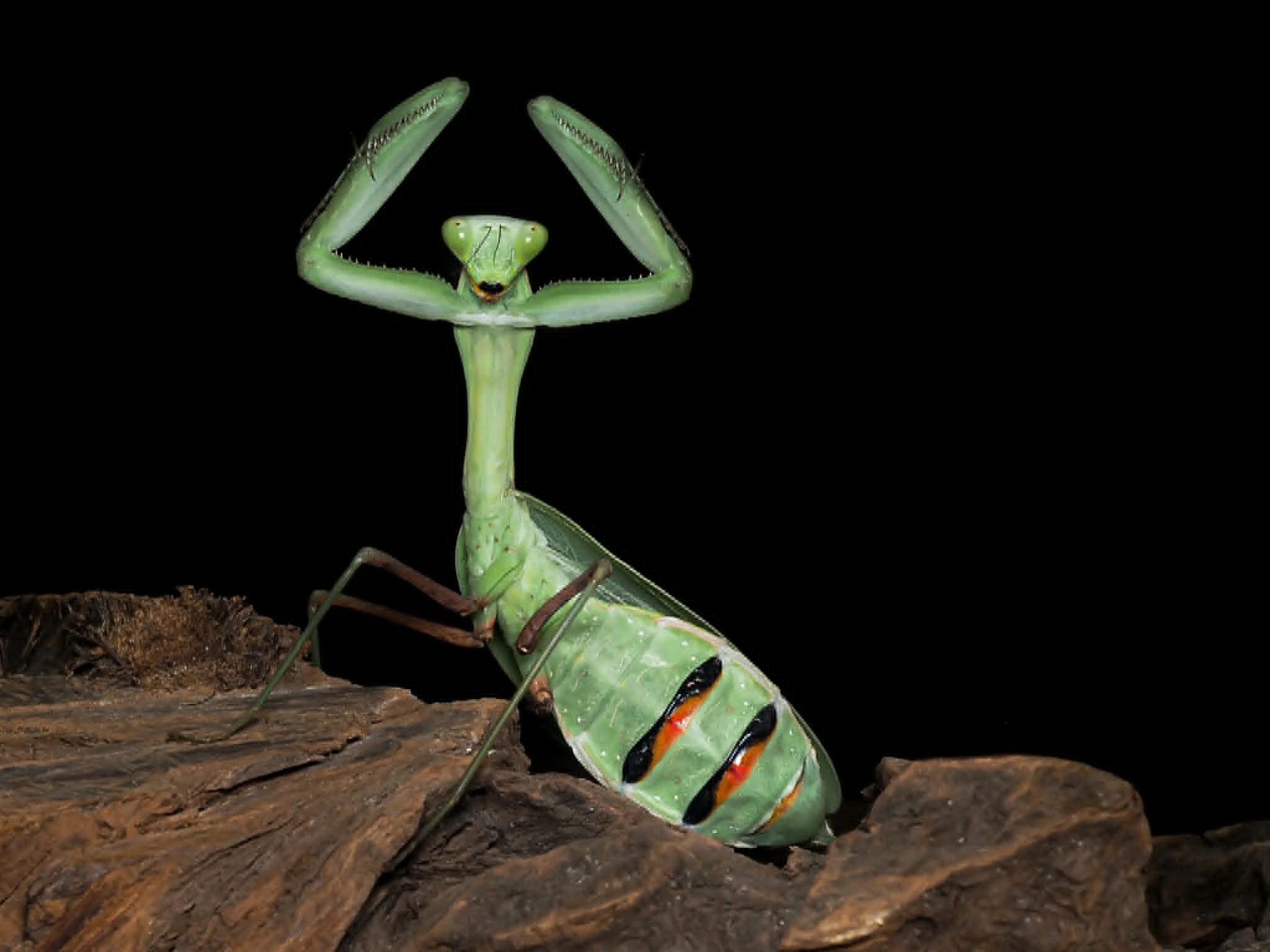


Hierodula membranacea
Leave feedback on the product

Wybierz wariant produktu:
Individual variants may differ in price
Ask about the product

Administratorem danych osobowych jest PHU Krystian Solga. Przetwarzamy je w celu przesłania odpowiedzi na zapytanie. Więcej informacji dotyczących przetwarzania danych osobowych znajduje się w polityce prywatności.
Share the product card



Shipping cost for the selected product
The shipping cost applies to this product (in the selected variant - if applicable). It may change after adding other products to the cart.
Description
Hierodula membranacea - The Queen of Asian Predators and a Titan of Terrarium Keeping
In the dark heart of Indian rainforests and on the evergreen slopes of the Western Ghats hides an absolutely perfect predator. Hierodula membranacea, commonly known as the Giant Asian Mantis, is a fascinating evolutionary phenomenon and an impressive display of nature's ruthless power. This massive predator has been winning the hearts of enthusiasts around the world for decades, proving that exotic insects at home can be much more than just a decoration. Its powerfully built raptorial legs, ability to strike lightning-fast, and extraordinary adaptation to diverse environmental conditions make it a living masterpiece of biomechanics. This is the very species that has completely revolutionized how modern exotic insect keeping is perceived, offering every keeper a spectacular insight into the primal and unyielding laws of the jungle.
Whether you are completing your first starter kit, terrarium keeping with this species will delight you from day one, providing unforgettable experiences. These powerful invertebrates are completely safe terrarium animals that mesmerize with their stoic calmness and predatory instinct. Watching them precisely calculate the distance to their prey, turning their triangular head almost 180 degrees, is a breathtaking experience that reveals extremely interesting predator behaviors every day. If you dream of powerful, yet easy-to-keep insects that can grow lightning-fast to impressive sizes and are simply perfect for a terrarium, you have just found a species that will exceed all your expectations.
| Feature | Description |
|---|---|
| Latin name | Hierodula membranacea |
| Common name | Giant Asian Mantis |
| Origin | India, Sri Lanka, Thailand, Southeast Asia (incl. Western Ghats) |
| Adult dimensions | Females 9-10 cm, males 7-8 cm |
| Day temperature | 24-28°C (75-82°F) (optimal activity and digestion) |
| Night temperature | 20-22°C (68-71°F) (natural nighttime drop stimulating the circadian rhythm) |
| Air humidity | 60-70% (essential for exoskeleton flexibility during molts) |
| Minimum enclosure (Imago) | 20x20x30 cm (vertical layout with mesh on the ceiling) |
| Lifespan | Females up to 10-12 months, males 6-8 months |
Evolution, biomechanics, and a master radar system
In the natural and ruthless forest environment, Hierodula membranacea has developed highly complex survival mechanisms. One of the most fascinating aspects of its physiology is a unique auditory organ located on the ventral side of the thorax. This highly specialized evolutionary receptor allows the insect to precisely detect the deadly echolocation of bats in the frequency range of 25 to 45 kHz, linked to the MR-501-T3 neuron. When the mantis is in flight and hears an approaching predator, it instantly folds its wings, performs a dramatic dodge, and dives rapidly toward the ground. In an environment where a mistake means instant death, this biomechanical shield gives it a huge advantage. In home conditions, you will rarely observe such aerial acrobatics, but the awareness of the presence of such an evolutionarily advanced organism inspires great admiration.
Compound eyes provide the mantis with stereoscopic vision and a field of view reaching almost 300 degrees. When the prey comes within the right distance, the strike of the raptorial forelegs happens in a fraction of a second. Sharp spikes on the tibiae and femora prevent escape even for strong invertebrates with hard chitinous armor.
Sexual dimorphism and life cycle in the Western Ghats
In the world of Hierodula membranacea, sexual dimorphism is pronounced and has a deep ecological justification. Massive females reaching up to 9-10 cm in length are ruthless, arboreal hunting machines with a wide abdomen. Slimmer and lighter males grow to 7-8 cm and have longer wings protruding beyond the abdomen, making them capable flyers in search of partners.
You can easily determine the sex of your mantises from the L4 instar using standard magnification. Just count the sternites, which are the ventral segments on the underside of the abdomen:
- Female: 6 visible segments (the final sternites fuse to form an enlarged subgenital plate shielding the ovipositor).
- Male: 8 visible segments with regular structure.
In nature, females lay large, oval oothecae on higher, sunlit branches of shrubs such as Lantana camara. The frothy mass hardens quickly in contact with the air, forming a rigid, dark brown cocoon protecting hundreds of eggs from drying out and predators.
Practical enclosure engineering and disaster prevention
Creating a safe home for your mantis requires following basic spatial rules. The golden rule of mantis keeping is based on proportions relative to body length:
- Enclosure height: minimum 3 times the body length of the mantis (3xL).
- Width and depth: minimum 2 times the body length (2xL).
Why is vertical space so critical? Hierodula membranacea molts exclusively in a vertical position, hanging upside down by its feet and sliding gravitationally out of the old skin. Lack of sufficient clearance below the insect will lead to hitting the ground, permanent deformation of the exoskeleton, or suffocation in the old skin. To ensure a firm grip for the insect, the terrarium ceiling must be lined with fine fabric or nylon mesh (avoid hard steel mesh that can damage the foot pads).
Equally important is two-way ventilation (e.g., at the bottom and top of the enclosure), which eliminates stagnant air. Misting with lukewarm water is done every 1-2 days, allowing the mantis to drink droplets from the walls and leaves, maintaining humidity at a safe level of 60-70%.
The complex art of feeding and gut-loading strategy
The mantis menu changes with its successive molts:
- Instar L1: flightless fruit flies Drosophila melanogaster.
- Instars L2-L3: larger flies Drosophila hydei and freshly hatched Turkestan roaches.
- Instars L4-L5: houseflies (Musca domestica), small roaches, and wax moths.
- Instars L6+ and Imago: blowflies (Calliphora), adult Turkestan roaches, dubia roaches, and locusts.
A key principle is the gut-loading technique, which means nutritiously feeding the feeder insects themselves (fresh vegetables, bran, fruits) before offering them to the mantis.
The best indicator of satiety is the abdomen profile. A slightly rounded abdomen means fullness; avoid overfeeding to the state of a highly tensioned, spherical shell, which risks rupturing the abdomen upon a fall. Important warning: never leave adult crickets in the terrarium unattended. A hungry cricket can attack and kill a defenseless mantis during the molting process.
Cannibalism prevention and breeding safety
Hierodula membranacea is an extreme dietary opportunist with a strong territorial instinct. While L1-L2 nymphs can be kept together with a constant abundance of flies, from instar L3, and absolutely from L4, complete separation into individual containers is required.
When planning to breed, a strict protocol must be followed:
- The female must be intensively fed for 3-5 days before meeting the male.
- Before introducing the partner, we offer the female a large prey (e.g., a locust) that will occupy her attention during the approach.
- The male is introduced from behind, outside the female's field of vision.
- After copulation lasting 6-12 hours, the male abruptly flies away - he must be immediately caught and moved to a separate terrarium.
From a single ootheca after 5-8 weeks of incubation (at a temperature of 26-28°C (79-82°F) and 65-75% humidity), from 100 up to 250 agile L1 nymphs hatch simultaneously.
Most common keeping mistakes and how to avoid them
- Lack of appropriate mesh on the ceiling: smooth glass or plastic prevents a firm grip during the molt, leading to the insect's fall and death.
- Too small or too low container: lack of free space under the hanging mantis causes deformation of wings and legs.
- Waterlogging without ventilation: constantly wet substrate and lack of air circulation cause bacterial and fungal infections of the digestive tract.
- Leaving feeder insects during molting: active feeder insects stress the mantis and can fatally injure it.
- Overfeeding adult males: excess calories in mature males drastically shortens their lifespan.
Comprehensive equipment for your keeping
In our store's offer, you will find everything necessary to create the perfect environment for Hierodula membranacea: vertical terrariums with mesh ventilation, safe climbing elements, misters, and diverse live feeder insects at every stage of development. We ship all insects in safe, ventilated containers, and on colder days, we include a professional Heatpack with every package, guaranteeing the safe arrival of animals at your door.
Reviews
If you've added a review and it doesn't appear on the list, it may be pending moderation.
Leave feedback on the product
 Log in with Google

